
A kind of inorganic infrared nonlinear optical crystal material and preparation method thereof
A nonlinear optics and crystal material technology, applied in the fields of polycrystalline material growth, chemical instruments and methods, crystal growth, etc. Harsh synthesis conditions and other problems, to achieve the effect of air stability, mild conditions, and good thermal stability
- Summary
- Abstract
- Description
- Claims
- Application Information
AI Technical Summary
Problems solved by technology
Method used
Image

Examples
Embodiment 1
[0025] Example 1: Hg 2 BrI 3 Preparation, characterization, transmittance range and thermal stability of
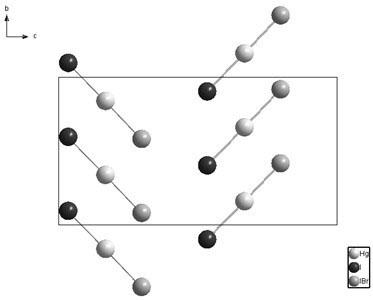
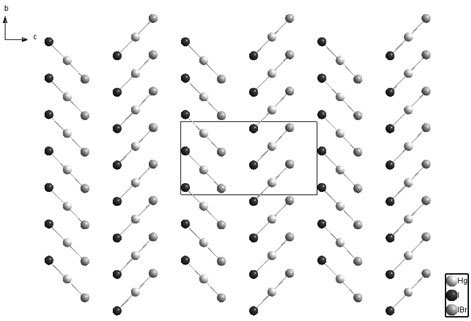
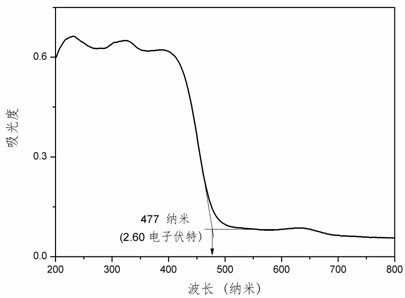
[0026] 0.7208 g (2 mmol) HgBr 2 and 0.4544 g (1 mmol) HgI 2 Add it to 15-20 ml of acetone solution, stir at 30-50 degrees Celsius until it becomes a clear and transparent solution, and continue to react for 8 hours. After the reaction is completed, cool it naturally, and obtain a yellow and transparent solution by natural volatilization at room temperature. The crystal is the desired crystal material. The crystal structure of the obtained compound was characterized by single crystal X-ray diffraction. The crystal is orthorhombic, space group Cmc 21 (No.36), the unit cell parameter is a = 4.698(1) ?, b = 7.2246(6)?, c = 13.520(1) ?, α = β = gamma = 90 o . The unit cell diagram of the compound is figure 1 As shown, the unit cell packing diagram of the compound on the bc plane is as follows figure 2 shown. Hg 2 BrI 3 The structure is simple, which is...
Embodiment 2
[0027] Example 2: Hg 2 BrI 3 powder frequency doubling effect
[0028] The frequency doubling performance of the prepared material is obtained by the Kurtz-Perry powder frequency doubling test method. The specific operation steps are as follows:
[0029]Grind the obtained second-order nonlinear optical crystal material into a powder with a particle size of about 80-100 microns, and then install it in a sample cell with glass windows on both sides, then place the sample cell on the laser optical path, and use Nd:YAG pulse A laser is used as a light source to generate fundamental frequency light with a wavelength of 1064 nanometers, which is injected into the sample cell. KTP single crystal powder with a particle size of about 80-100 microns is used as a standard sample, and the signal is displayed on the oscilloscope through a photomultiplier tube. Test results show that its powder frequency doubling effect is 1.2 times that of KTP (potassium titanyl phosphate).
Embodiment 3
[0030] Example 3: Hg 2 BrI 3 Frequency doubling effect phase matching test
[0031] The obtained second-order nonlinear optical crystal materials were ground and sieved into powders with different particle size ranges (20-40, 40-60, 60-80, 80-100, 100-125, 125-150 and 150-200 Micron), and then installed in the sample cell with glass windows on both sides, then put the sample cell on the laser optical path, use Nd:YAG pulsed laser as the light source to generate fundamental frequency light with a wavelength of 1064 nanometers into the sample cell, and the signal is photoelectrically multiplied The tube is displayed on the oscilloscope, and the intensity of frequency-multiplied signals of different particle sizes is tested. After drawing, analyze and judge whether the compound can be phase-matched. For the test results of powder frequency doubling phase matching, see Figure 7 , it can be seen that the materials can be phase matched.
PUM
 Login to View More
 Abstract
Description
Claims
Application Information
 Login to View More