Tunable laser for outputting non-polarized light

A technology for tuning lasers and non-polarized light, which is applied to lasers, laser components, semiconductor lasers, etc., can solve the problems of large size of tunable lasers, difficulty in achieving narrow-band output, and susceptibility to mechanical vibrations, etc., to achieve a large free spectral range , to meet the effect of small size, easy installation and production

CN102820611BInactive Publication Date: 2014-06-04GP PHOTONICS INC
3 Cites 0 Cited by

Patent Information

Authority / Receiving Office
CN · China
Patent Type
Patents(China)
Current Assignee / Owner
Publication Date
2014-06-04
Estimated Expiration
Not applicable · inactive patent

Smart Images

  • Figure 1
    Figure 1
  • Figure 2
    Figure 2
  • Figure 3
    Figure 3
Patent Text Reader

Abstract

A tunable laser for outputting non-polarized light comprises a first reflection mirror (72), a broadband laser gain medium (76), a tunable Fabry-Perot filter (400), a tunable acoustooptic filter (500), a second reflection mirror (84), a third reflection mirror (86), and a laser control circuit (88). A broadband light beam sent by the broadband laser gain medium (76) is filtered by the tunable Fabry-Perot filter (400) and then is filtered by the tunable acoustooptic filter (500). A first-grade diffraction light beam of the tunable acoustooptic filter (500) is divided into two beams of polarized light with polarization states perpendicular to each other, and a zero-grade diffraction light beam of the tunable acoustooptic filter (500) serves as an output light beam of the laser. The tunable laser for outputting non-polarized light implements continuous, rapid and precise tuning on the output light of the laser in a wide spectral range, has characteristics of absence of mechanical movement parts, high electronic tuning speed, stable and reliable performance, small sizes, easiness in mounting and production and the like, and can be widely applied in the fields of lasers, optical testing, optical fiber communications, biological and medical instruments, optical fiber sensor networks and the like.
Need to check novelty before this filing date? Find Prior Art

Description

technical field

[0001] The invention belongs to the field of optoelectronic technology, in particular to a tunable laser with non-polarized light output. Background technique

[0002] Because the grating has high spectral resolution in a large spectral range, it is widely used in various tunable lasers. The existing problems are: since a precision stepping motor is required to drive the grating for scanning, the tunable laser using this technology is relatively large in size, easily affected by mechanical vibration, and expensive.

[0003] The traditional optical Fabry-Perot etalon is a filter device made by the principle of multi-beam interference. There are two main types: one is air-spaced, and the other is optical glass-spaced. Through the multi-beam interference effect of the Fabry-Perot cavity formed by the high reflectivity of the multi-layer dielectric film on the two light-passing surfaces, the multi-wavelength narrow-band filter output in a wide spectrum range can...

Examples

Embodiment Construction

[0038] Embodiments of the present invention will be described in further detail below in conjunction with the accompanying drawings.

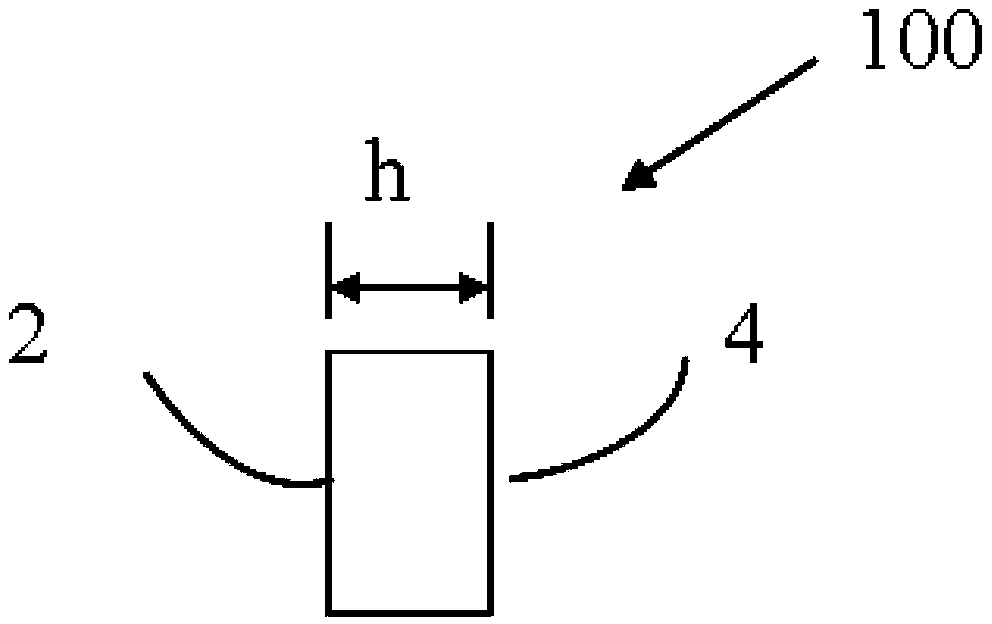
[0039] figure 1 A schematic diagram of a common Fabry-Perot optical etalon 100 is given. The material of the Fabry-Perot optical etalon 100 generally adopts optical glass such as fused silica or BK7 in the near-infrared and visible light bands. Assuming that the refractive index of the material is n, the two light-transmitting surfaces 2 and 4 are all coated with high The reflective film, whose reflectivity is R, has a thickness of h, and light is incident at an incident angle close to zero, can only pass through the etalon if it satisfies 2nh=mλ, where m is the order of the transmitted light. Free Spectral Range FSR of Optical Etalon 100 1 Can be expressed as: Δλ=λ 2 / (2nh), or expressed in frequency: Δν=c / (2nh), where c is the speed of light. The peak frequency of transmitted light can be expressed as: ν=mc / (2nh), where m is the interfere...