This helps you quickly interpret patents by identifying the three key elements:
Problems solved by technology
Method used
Benefits of technology
Problems solved by technology
Unfortunately, chondrocyte implantation still has a large number of problems to be solved, such as not easy to obtain a sufficient number of autologous cells, and the technical and cost issues of applying it to a large number of patients, such as the attachment of implanted cells, regenerative efficiency and safety sex
Method used
the structure of the environmentally friendly knitted fabric provided by the present invention; figure 2 Flow chart of the yarn wrapping machine for environmentally friendly knitted fabrics and storage devices; image 3 Is the parameter map of the yarn covering machine
View more
Image
Smart Image Click on the blue labels to locate them in the text.
Viewing Examples
Smart Image
Click on the blue label to locate the original text in one second.
Reading with bidirectional positioning of images and text.
Smart Image
Examples
Experimental program
Comparison scheme
Effect test
Embodiment 1
[0071] [Example 1] Preparation of peptide
[0072] At the request of the present inventors, a peptide having the amino acid sequence shown in SEQ ID NO. 1 (Glu-Leu-His-Leu-Asp) was prepared by Peptron Corporation (South Korea). Specifically, using an automated peptide synthesizer (ASP48S, Peptron Inc.), the amino acid units were linked one by one from the C-terminus by Fmoc SPPS (9-fluorenylmethoxycarbonyl solid-phase peptide synthesis method).
[0073] Use NH 2-His(Trt)-2-chloro-trityl resin, the first amino acid at the C-terminus of the peptide was attached to the resin. All amino acids used to synthesize peptides are protected by trityl (Trt), tert-butoxycarbonyl (Boc), tert-butyl (t-Bu), etc., where the N-terminus is protected by Fmoc, and all amino acids are removed in acid Residues. Using 2-(1H-benzotriazol-1-yl)-1,1,3,3-tetramethyluronium hexafluorophosphate (HBTU) / hydroxybenzotriazole (HOBT) / N-methylmorphine phenoline (NMM) as the coupling reagent. (1) Dissolve th...
Embodiment 2-12
[0074] [Example 2-12] Preparation of Peptides
[0075] The peptides of Examples 2-12 were prepared in the same manner as in Example 1, except that the amino acid sequences listed in Table 1 below were used instead of the amino acid sequences in Example 1.
[0076] Table 1
[0077] Example serial number
Embodiment 13
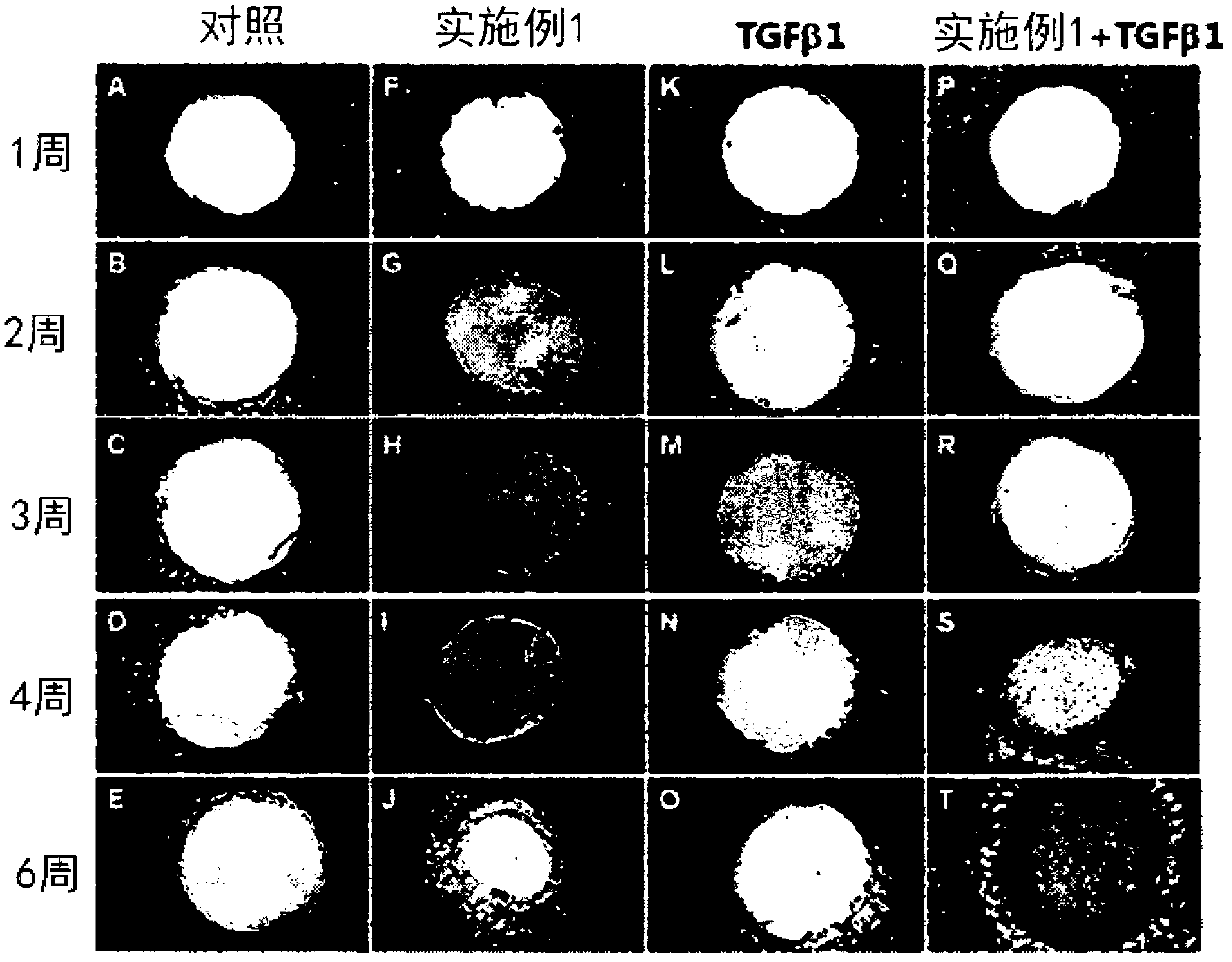
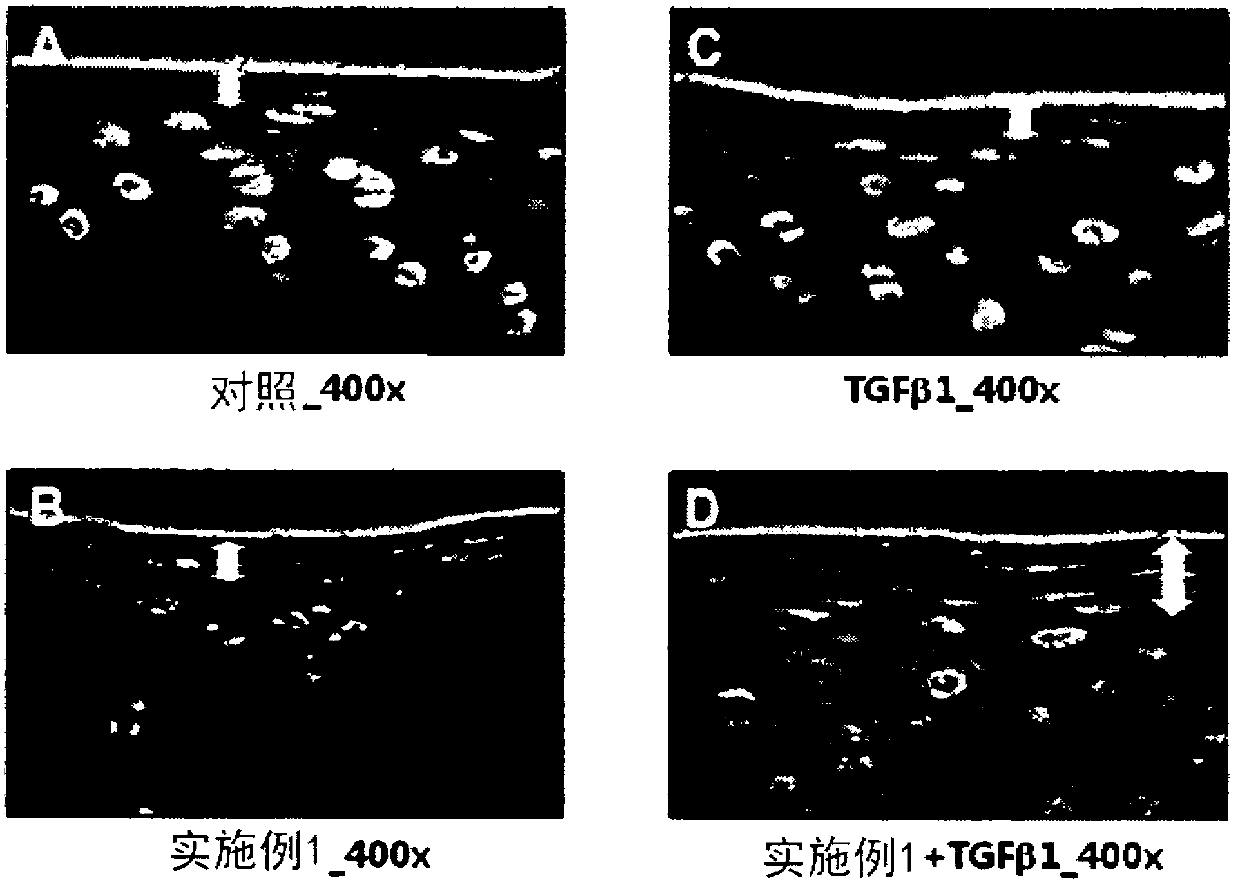
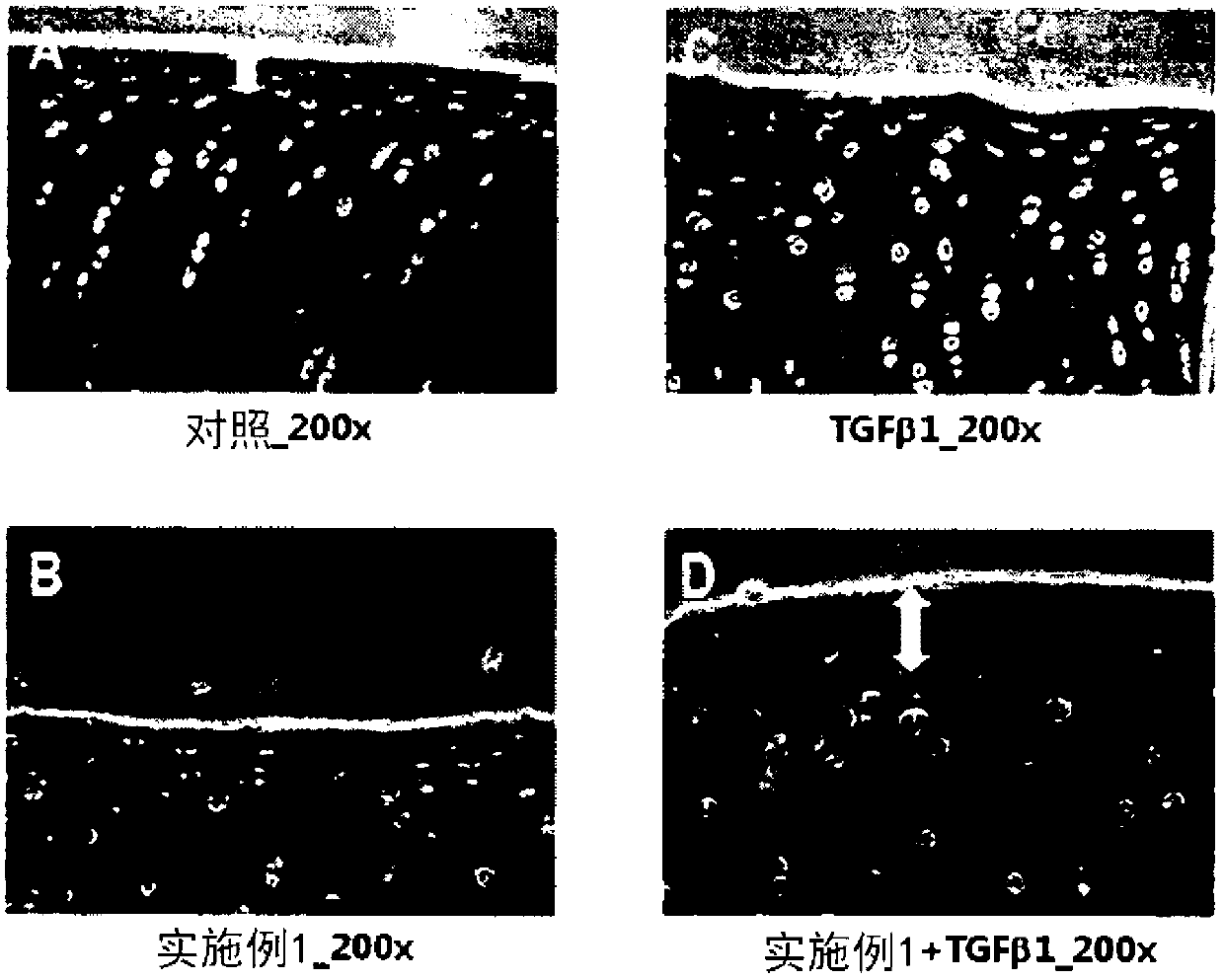
[0078] [Example 13] Confirmation of cartilage regeneration effect with damaged cartilage tissue explants
[0079] Articular cartilage explants were prepared from hoof joints of cows younger than 3 years old within one hour of slaughter at a regional slaughterhouse (located in Ojeong-dong, Daejeon, South Korea). For this purpose, the cartilage part other than the bone was evenly excised from the joint using a scalpel, and cut into a size of about 3 mm x 3 mm to prepare cartilage tissue explants. Using a syringe (21G) with a truncated and ground tip, the lesion area was prepared by uniformly making vertical holes in the surface of the center of the explant.
[0080] The perforated tissue explants were divided into 4 groups including the control group. Each group was placed in Dulbecco's modified Eagle's medium / F12 (DMEM / F12, 1:1, Welgene) supplemented with ascorbate (50 μg / ml, Sigma) and 10% fetal bovine serum (FBS, Invitrogen). ); then treated with 25 μM of the peptide of Exa...
the structure of the environmentally friendly knitted fabric provided by the present invention; figure 2 Flow chart of the yarn wrapping machine for environmentally friendly knitted fabrics and storage devices; image 3 Is the parameter map of the yarn covering machine
Login to View More
PUM
Login to View More
Abstract
The present invention provides a peptide represented by formula (I) of X1-Leu-X2-Leu-X3 wherein X1 represents Glu or Asp, X2 represents His, Lys or Arg, X3 represents Asp or Glu, with Glu, Asp, Leu, His, Lys and Arg being respectively glutamic acid, aspartic acid, leucine, histidine, lysine and arginine; or a pharmaceutically acceptable salt thereof; a composition for the treatment or prevention of at least one selected from cartilage damage and arthritis, containing the same peptide or a pharmaceutically acceptable salt thereof as an active ingredient; and a composition containing the same peptide or a pharmaceutically acceptable salt thereof and TGFss1.; The above-mentioned peptide or a pharmaceutically acceptable salt thereof is effective for the treatment and / or prevention of cartilage damage and / or arthritis and is capable of exhibiting effects of the regeneration of cartilage tissue, the inhibition of the expression of cartilage tissue matrix degrading enzyme and / or the inhibition of cartilage tissue ossification.
Description
technical field [0001] The present invention relates to a novel peptide. In particular, the present invention relates to a novel peptide effective for the treatment and / or prevention of cartilage damage or arthritis. Background technique [0002] Cartilage tissue is composed of matrix and chondrocytes. Among them, the collagen fibers (collagen, proteoglycan) of the matrix as well as non-collagen proteins play an important role in maintaining the unique physical properties of cartilage by drawing water into or out of the cartilage. Cartilage tissue damage is often accompanied by joint diseases, and the cartilage tissue of the joint can be roughly divided into four regions, namely, the outermost superficial tangential zone (STZ), the middle zone, the deep zone, and the calcified zone (Clouet J et al., Drug Discovery Today (2009) 14:19 / 20, 913-925). The superficial tangential zone is an area with a relatively low proportion of matrix, where collagen fibers are densely arrang...
Claims
the structure of the environmentally friendly knitted fabric provided by the present invention; figure 2 Flow chart of the yarn wrapping machine for environmentally friendly knitted fabrics and storage devices; image 3 Is the parameter map of the yarn covering machine
Login to View More
Application Information
Patent Timeline
Application Date:The date an application was filed.
Publication Date:The date a patent or application was officially published.
First Publication Date:The earliest publication date of a patent with the same application number.
Issue Date:Publication date of the patent grant document.
PCT Entry Date:The Entry date of PCT National Phase.
Estimated Expiry Date:The statutory expiry date of a patent right according to the Patent Law, and it is the longest term of protection that the patent right can achieve without the termination of the patent right due to other reasons(Term extension factor has been taken into account ).
Invalid Date:Actual expiry date is based on effective date or publication date of legal transaction data of invalid patent.



 Login to View More
  Login to View More