
Diffusion bonding method of ti(c,n) based cermets and steel without external pressure
A cermet and diffusion joining technology, applied in the field of welding, can solve the problems of short diffusion time between castings and surface ceramic layers, unfavorable surface densification and sufficient diffusion, large thermal residual stress, etc. The effect of sufficient diffusion time
- Summary
- Abstract
- Description
- Claims
- Application Information
AI Technical Summary
Problems solved by technology
Method used
Image

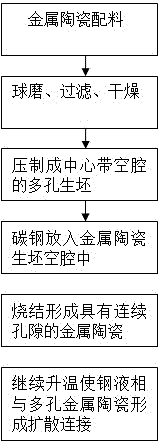
Examples
example 1
[0016] Example 1: The particle size of Ni in the raw materials used to prepare Ti(C,N)-based cermets is 1.5 μm, that of Co is 1.3 μm, that of Fe is 2.0 μm, and that of Mo 2 The particle size of C is 1.5μm, TiC 0.7 N 0.3 The particle size is 1.8 μm. The weight percent of Ti(C,N)-based cermet composition is 5wt% for Ni, 5wt% for Co, 5wt% for Fe, Mo 2 C accounted for 9wt%, TiC 0.7 N 0.3 for the margin. The ball milling medium of the cermet mixed powder is No. 120 solvent oil, its dosage is 400ml, the ball milling speed is 60r / min, the milling time is 48h, the milling ball is Φ6mm WC-8wt%Ni cemented carbide ball, the weight ratio of ball to material 5:1, add 10wt% paraffin, 0.5wt% oleic acid, and 0.5wt% Tween 80 as a composite molding agent; after ball milling, the cermet slurry is filtered with 400 mesh, and the vacuum drying temperature is 85°C. The vacuum degree is 3 Pa; the pressure of the cermet porous green body is 200MPa when pressing, the cavity volume is fixed, an...
example 2
[0017] Example 2: The particle size of Ni in the raw materials used to prepare Ti(C,N)-based cermets is 1.2 μm, that of Co is 1.5 μm, and that of Mo 2 The particle size of C is 1.8μm, TiC 0.7 N 0.3 The particle size is 1.4μm; the composition weight percentage of Ti(C,N)-based cermet is 20wt% for Ni, 8wt% for Co, and 8wt% for Mo. 2 C accounted for 12wt%, TiC 0.7 N 0.3is the balance; the ball milling medium of the cermet mixed powder is No. 120 solvent oil, its dosage is 200ml, the ball milling speed is 90r / min, the milling time is 36h, and the milling ball is Φ8mm WC-8wt%Ni cemented carbide ball, The weight ratio of ball to material is 10:1, add 5wt% paraffin, 1wt% oleic acid, and 2% Tween 80 as composite molding agent; after ball milling, the cermet slurry is filtered with 400 mesh, and the vacuum drying temperature is 95 ℃, the vacuum degree is 3 Pa; the pressure of the cermet porous green body is 100MPa, the cavity volume is fixed, and the porosity of the green body is...
PUM
| Property | Measurement | Unit |
|---|---|---|
| particle size | aaaaa | aaaaa |
| particle size | aaaaa | aaaaa |
| particle size | aaaaa | aaaaa |
Abstract
Description
Claims
Application Information
 Login to View More