Self-adaptation compression reconstruction method based on energy effectiveness observation in cognitive sensor network

An energy-efficient, sensor network technology, applied in the field of adaptive compression and reconstruction based on energy-efficient observation in cognitive sensor networks, can solve problems such as difficulty in constructing observation matrices, and achieve the effect of effective compromise

CN103347268AInactive Publication Date: 2013-10-09HANGZHOU DIANZI UNIV
2 Cites 39 Cited by

Patent Information

Authority / Receiving Office
CN · China
Current Assignee / Owner
Publication Date
2013-10-09
Estimated Expiration
Not applicable · inactive patent

Smart Images

  • Figure 1
    Figure 1
  • Figure 2
    Figure 2
  • Figure 3
    Figure 3
Patent Text Reader

Abstract

The invention discloses a self-adaptation compression reconstruction method based on energy effectiveness observation in a cognitive sensor network. The self-adaptation compression reconstruction method based on the energy effectiveness observation in the cognitive sensor network comprises the steps that (1) a node carries out local detection and compression measurement on data which are actually sensed through an analog transcriber according to the characteristic that power consumption of the node of a cognitive sensor is limited, (2) a space-time relevance structure of sensing signals is used, sensing data are mapped to a wavelet orthogonal basis cascading dictionary to carry out sparse conversion and to carry out self-adaptation observation through a weighting energy subset function, appropriate observation values are obtained in an energy effectiveness mode, orthogonalization is carried out on selected observation vectors to construct a measurement matrix, (3) the sensing data after compression measurement are fed back to an aggregation node through a report channel, the aggregation node carries out self-adaptation reconstruction on the sensing data by using a gradient projection sparse reconstruction Barzilai-Borwein method based on a convex relaxation method, and effective compromise between reconstruction performance and energy consumption of the node is achieved. The self-adaptation compression reconstruction method based on the energy effectiveness observation in the cognitive sensor network can carry out accurate reconstruction on the sensing signals, ensures energy effectiveness of the sensing node, and has actual application significance.
Need to check novelty before this filing date? Find Prior Art

Description

technical field

[0001] The invention belongs to the technical field of information and communication engineering, and relates to a wireless sensor network technology in a wireless communication system, a cognitive radio technology, and a convex-relaxation quadratic programming adaptive compression reconstruction method in the theory of compressed sensing, so as to realize the performance of perceptual signal reconstruction and An effective trade-off between energy consumption of network nodes, specifically an adaptive compression reconstruction method based on energy-efficient observations in cognitive sensor networks. Background technique

[0002] Cognitive Radio (CR), also known as cognitive radio, can intelligently use a large amount of idle spectrum to satisfy secondary users (Secondary Users, SUs) without affecting the communication of Primary Users (PUs). Reliable communication of Cognitive Users (CUs), so as to improve the utilization of wireless spectrum and realize ...

Examples

Embodiment Construction

[0082] Embodiments of the present invention will be described in detail below in conjunction with the accompanying drawings.

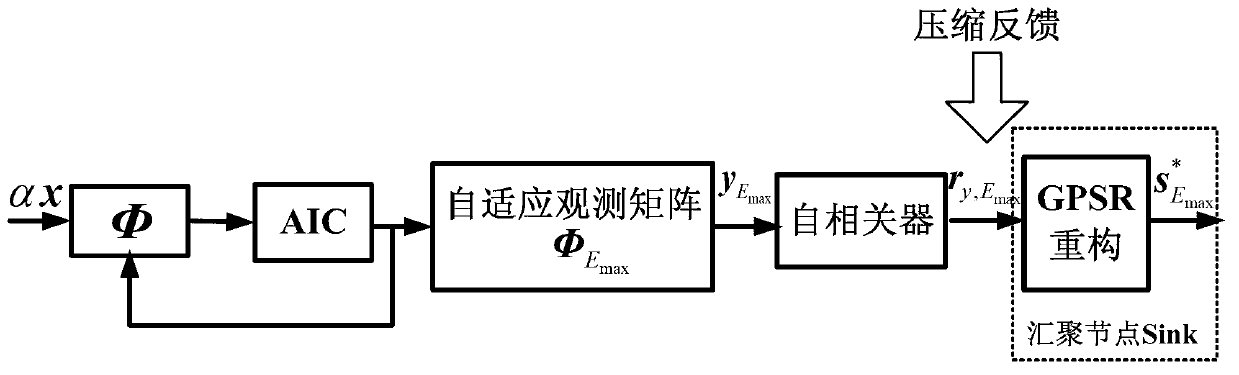
[0083] figure 1 Flowchart of GPSR compression reconstruction based on energy-efficient observations in cognitive WSN. This figure shows the specific implementation process of the GPSR compression reconstruction method based on energy weighted adaptive observation of the present invention. According to the characteristics of limited power consumption of cognitive sensor nodes, the method uses the analog information converter (AIC) to perform local detection and compression measurement of the actual perceived data. Utilizing the space-time correlation structure of the perceptual signal, the perceptual data is mapped to the wavelet orthogonal base cascade dictionary for sparse transformation, and the weighted energy subset function is used for adaptive observation to obtain appropriate observation values ​​in an energy-efficient manner. Orthogonalize th...