Furnace lining detection device of induction furnace body

A detection device, induction furnace technology, applied in electromagnetic measurement device, overall lining, electromagnetic/magnetic thickness measurement, etc., can solve the problems of operator's personal safety hazards, inability to manually judge furnace lining, delay production, etc., to improve safety , Avoid personal safety and equipment failure problems, and prolong the service life.

CN103528378AInactive Publication Date: 2014-01-22昆山良昕环保节能有限公司
5 Cites 1 Cited by

Patent Information

Authority / Receiving Office
CN · China
Patent Type
Applications(China)
Current Assignee / Owner
Publication Date
2014-01-22
Estimated Expiration
Not applicable · inactive patent

Smart Images

  • Figure 1
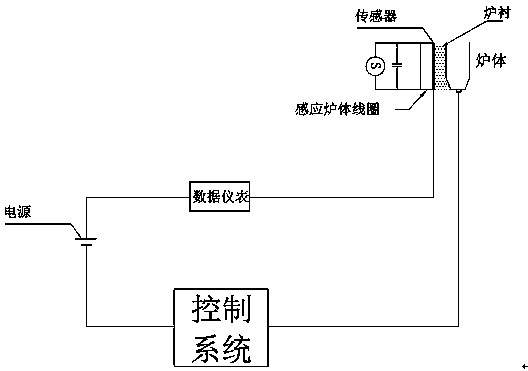
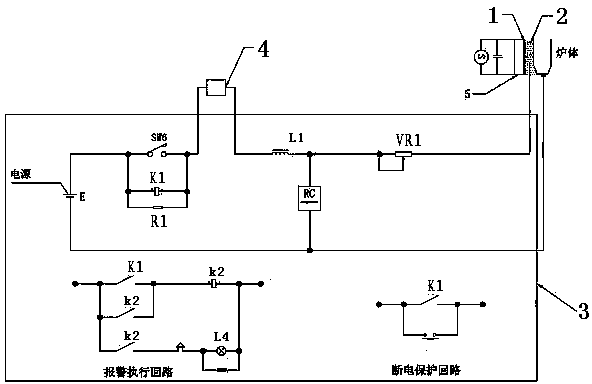
    Figure 1
  • Figure 2
    Figure 2
Patent Text Reader

Abstract

The invention discloses a furnace lining detection device of an induction furnace body. The device comprises furnace body side sensors and further comprises a control system and a data instrument, wherein the furnace body side sensors are divided into at least two blocks installed in a furnace lining of the induction furnace body side, the sensors in at least one block are connected in series, the sensors in two blocks are are connected with the control system and the data instrument through wires, the control system and the data instrument are arranged outside the induction furnace body, and signals for feeding back impedance changes are transmitted to the control system and the data instrument. The control system comprises a data adjusting resistor VR1, a filtering circuit RC-L, a data comparison circuit K1-R1, an alarming executing circuit and a power-off protection circuit, and the data adjusting resistor VR1, the filtering circuit RC-L, the data comparison circuit K1-R1, the alarming executing circuit and the power-off protection circuit are sequentially connected. The detection device is capable of real-time detection and intelligent control, safe, reliable, low in cost, simple in structure, easy to operate and capable of preventing various potential hazards caused by the phenomenon that high-temperature molten steel penetrates through a furnace.
Need to check novelty before this filing date? Find Prior Art

Description

technical field

[0001] The invention relates to an induction furnace lining detection device, which belongs to the field of electromechanical technology. Background technique

[0002] Induction furnace is a commonly used electromechanical equipment. The structure of the furnace itself roughly includes the furnace shell, coil, upper and lower refractory plates, furnace lining, etc.

[0003] During the working process of the induction furnace, the furnace lining is in direct contact with molten steel, slag and furnace gas during the steelmaking process, and is constantly subjected to physical, mechanical and chemical erosion, so the quality of the furnace lining is extremely important. Furnace lining is generally made of refractory materials directly rammed in the furnace body. The quality of the ramming mainly depends on the uniformity and compactness of the ramming. These two factors mainly depend on the person. Of course, different people will have different effects. On t...

Examples

Embodiment Construction

[0015] The present invention will be further described below in conjunction with the accompanying drawings.

[0016] Such as figure 1 and figure 2 As shown, an induction furnace lining detection device includes a sensor 1, a control system 3, a data instrument 4, and a plurality of wires 5; the sensor 1 is divided into at least two blocks and installed in the lining on the side of the induction furnace, wherein at least A block sensor is connected in series, and two of the block sensors are connected to the control system 3 outside the induction furnace through a wire 5, and a data instrument 4 is connected in series in the control system.

[0017] The sensor 1 is divided into at least two blocks and installed in the furnace lining 2 on the side of the induction furnace body, one of the blocks is connected to a port of the control system 3, and the remaining blocks are connected to the other port of the control system 3 after being connected in series. form a detection loop...