
Sand grain diameter detection device and method based on fluid/solid interface wave
A sediment particle and detection device technology, which is applied in the direction of measuring device, particle and sedimentation analysis, particle size analysis, etc., can solve the problems of low precision, narrow measurement range, and long measurement time at one time
- Summary
- Abstract
- Description
- Claims
- Application Information
AI Technical Summary
Problems solved by technology
Method used
Image



Examples
Embodiment Construction
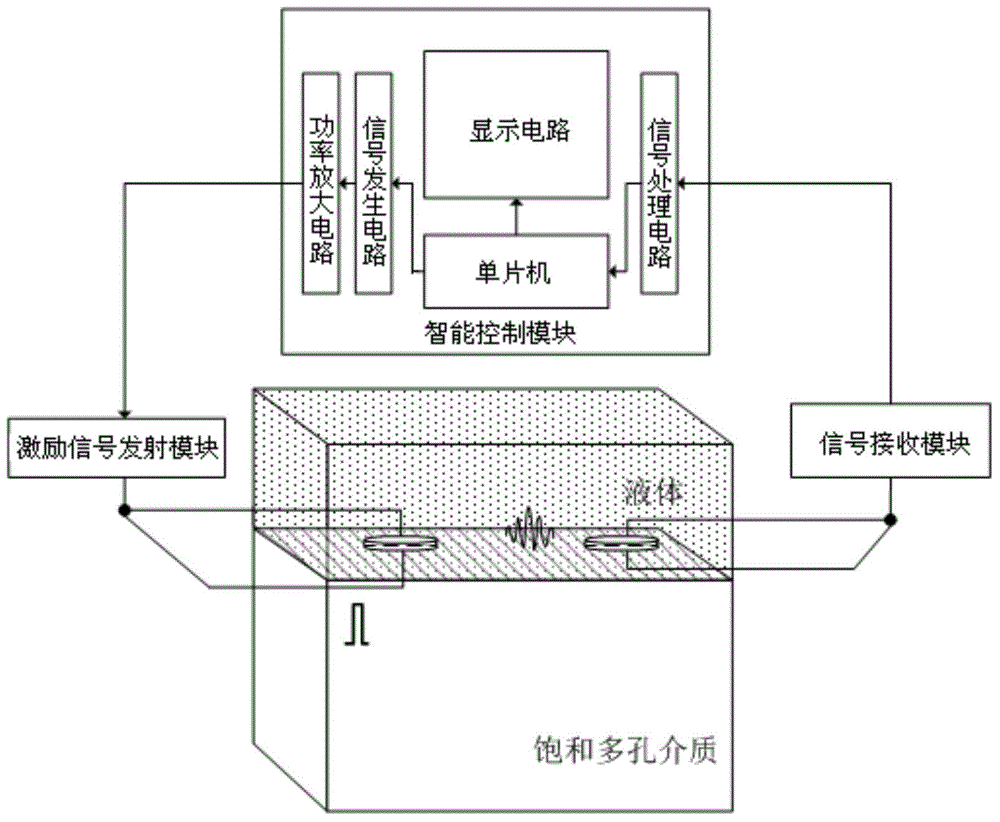
[0063] The present invention will be further described below in conjunction with the accompanying drawings.
[0064] Such as figure 1 As shown, the sediment particle size detection device based on the fluid-solid interface wave is small in size, easy to carry, and easy to use. It is suitable for field river sediment particle size detection. It has a wide range of particle size detection and high reliability. The Scholte wave has a relatively large amplitude and is sensitive to the medium on both sides (when both sides are ideal fluid and elastic solid, Scholte is non-dispersive and non-attenuating, and when the medium on either side changes, the interface wave will produce dispersion and attenuation effects) characteristics, greatly improving the detection accuracy and range of breadth, specifically including
[0065] The intelligent control module is used to generate the pulse signal, and process the received Scholte wave and display after propagating along the fluid-solid i...
PUM
 Login to View More
 Abstract
Description
Claims
Application Information
 Login to View More