
Method for quantitatively detecting 2, 4-dichlorophenol in water
A quantitative detection method and technology of dichlorophenol, applied in measurement devices, instruments, scientific instruments, etc., can solve the problems of low measurement sensitivity, large sample loss, complex pretreatment, etc., and achieve fewer interfering substances, simple steps, and reduced interference. Effect
- Summary
- Abstract
- Description
- Claims
- Application Information
AI Technical Summary
Problems solved by technology
Method used
Image

Examples
Embodiment 1
[0027] Embodiment 1: the selection of working curve
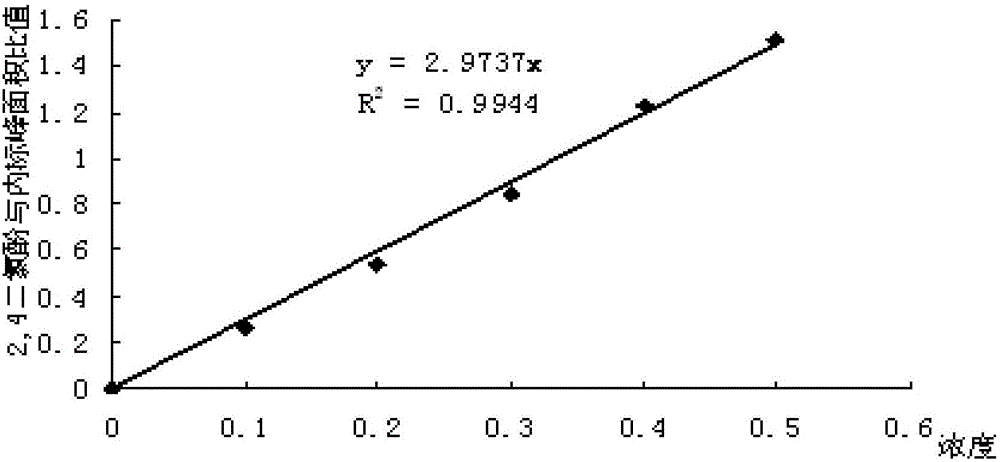
[0028] Prepare a series of standard solutions with concentrations of 0mg / L, 0.1mg / L, 0.2mg / L, 0.3mg / L, 0.4mg / L, and 0.5mg / L, and measure them according to the steps in the summary of the invention. Taking the concentration of 2,4-dichlorophenol as the x-axis, and the ratio of the peak area of 2,4-dichlorophenol and 1,4-dichlorobenzene as the y-axis, a curve representing the relationship between the two is established, and its equation is: y =2.9737x, R of the curve 2 =0.9944, good linearity.
Embodiment 2
[0029] Embodiment 2: the mensuration of actual water sample
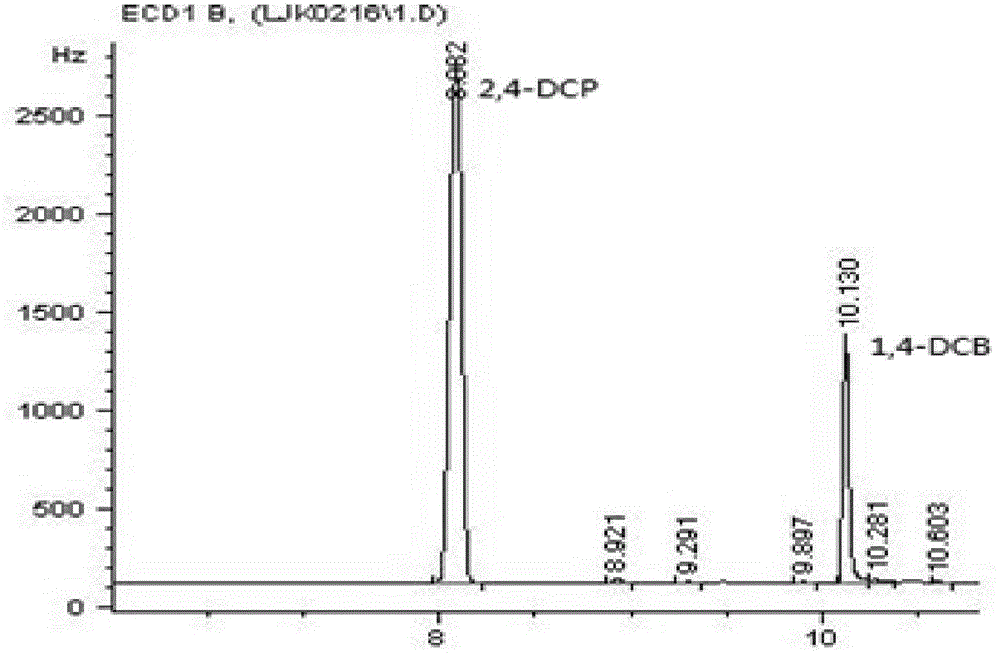
[0030] Before detection, the fiber head is aged first. The aging chromatographic conditions are: HP-5 capillary column; gasification chamber temperature: 260°C; detector temperature: 280°C; / min to 260°C and keep for 30min; the carrier gas is nitrogen, the flow rate: 2ml / min; make-up gas: 60ml / min. After aging, set the chromatographic conditions as follows: HP-5 capillary column; gasification chamber temperature: 260°C; detector temperature: 280°C; column temperature: 60°C, keep for 5 minutes, and rise to 130°C at 15°C / min , rise to 280°C at 30°C / min, and keep for 2min; the carrier gas is nitrogen, the flow rate: 2ml / min; make-up gas: 60ml / min.
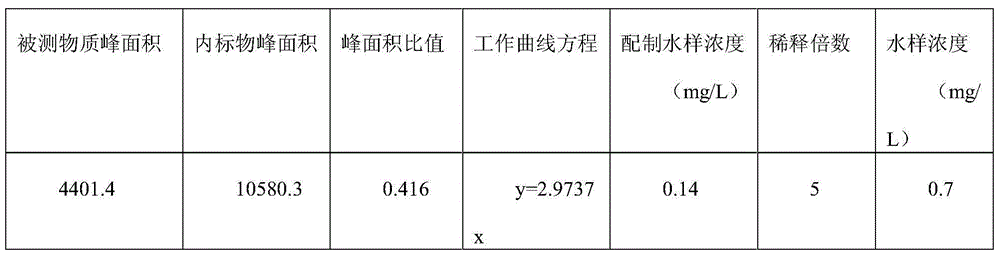
[0031] The water sample is the effluent of the laboratory reactor, and the concentration of 2,4-dichlorophenol contained in the effluent is higher than the maximum concentration value of 0.5 mg / L that can be detected by this method. Therefore, when preparing the sample, it...
PUM
| Property | Measurement | Unit |
|---|---|---|
| Sensitivity | aaaaa | aaaaa |
Abstract
Description
Claims
Application Information
 Login to View More