
Speech Enhancement Method Based on Nonlocal Mean Filtering
A non-local mean, speech enhancement technology, applied in speech analysis, instruments, etc., can solve the problems of affecting hearing quality, difficult to achieve accurate estimation, easy residual noise in the background, etc., to avoid excessive dependence, reduce music noise, and improve clarity. Effect
- Summary
- Abstract
- Description
- Claims
- Application Information
AI Technical Summary
Problems solved by technology
Method used
Image

Examples
Embodiment Construction
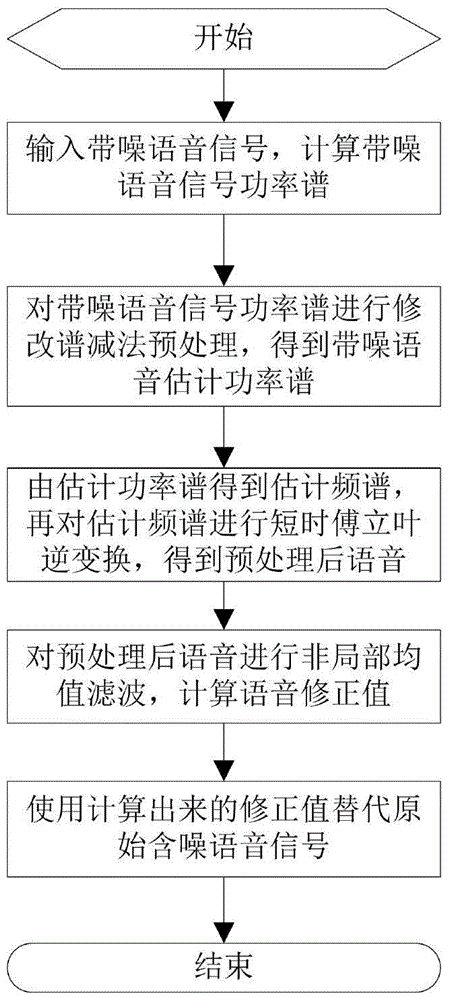
[0031] refer to figure 1 , the present invention is based on the speech enhancement method of non-local mean filter, and its realization steps are as follows:
[0032] Step 1, input the noisy speech, and calculate the power spectrum of the noisy speech signal.
[0033] 1.1) For the input noisy speech y(i), divide the noisy speech into N frames with 256 speech points per frame, and overlap 128 points between frames to obtain the frame-divided signal y λ (i 1 ), and for y λ (i 1 ) plus Hamming window to get the windowed signal y λ (i 1 )':
[0034] the y λ (i 1 )'=y λ (i 1 )*ham(256);
[0035] Among them, i represents the time-domain signal discrete point sequence, i=1,2,...,m, m represents the total number of voice sequence numbers, λ represents the number of frame sequences, λ=1,2,...,N, i 1 Indicates the sequence number in the frame, i 1 =1,2,...,256, ham(256) means a Hamming window with a size of 256 points;
[0036] 1.2) For the windowed signal y λ (i 1 )' t...
PUM
 Login to View More
 Abstract
Description
Claims
Application Information
 Login to View More