Hyper-spectral image classification method based on non-local similarity and sparse coding
What is AI technical title?
AI technical title is built by PatSnap AI team. It summarizes the technical point description of the patent document.
A non-local similarity, hyperspectral image technology, applied in the field of image processing, can solve problems such as the inability to obtain neighborhood information and the poor classification effect of homogeneous regions.
Active Publication Date: 2014-12-24
XIDIAN UNIV
View PDF6 Cites 21 Cited by
Summary
Abstract
Description
Claims
Application Information
AI Technical Summary
This helps you quickly interpret patents by identifying the three key elements:
Problems solved by technology
Method used
Benefits of technology
Problems solved by technology
Although this method can quickly classify hyperspectral images, it still has the disadvantage that the neighborhood information of samples cannot be obtained well by comparing the Euclidean distance to obtain the neighborhood sample matrix, resulting in poor classification effect in homogeneous regions. it is good
Method used
the structure of the environmentally friendly knitted fabric provided by the present invention; figure 2 Flow chart of the yarn wrapping machine for environmentally friendly knitted fabrics and storage devices; image 3 Is the parameter map of the yarn covering machine
View more
Image
Smart Image Click on the blue labels to locate them in the text.
Viewing Examples
Smart Image
Click on the blue label to locate the original text in one second.
Reading with bidirectional positioning of images and text.
Smart Image
Examples
Experimental program
Comparison scheme
Effect test
Embodiment 1
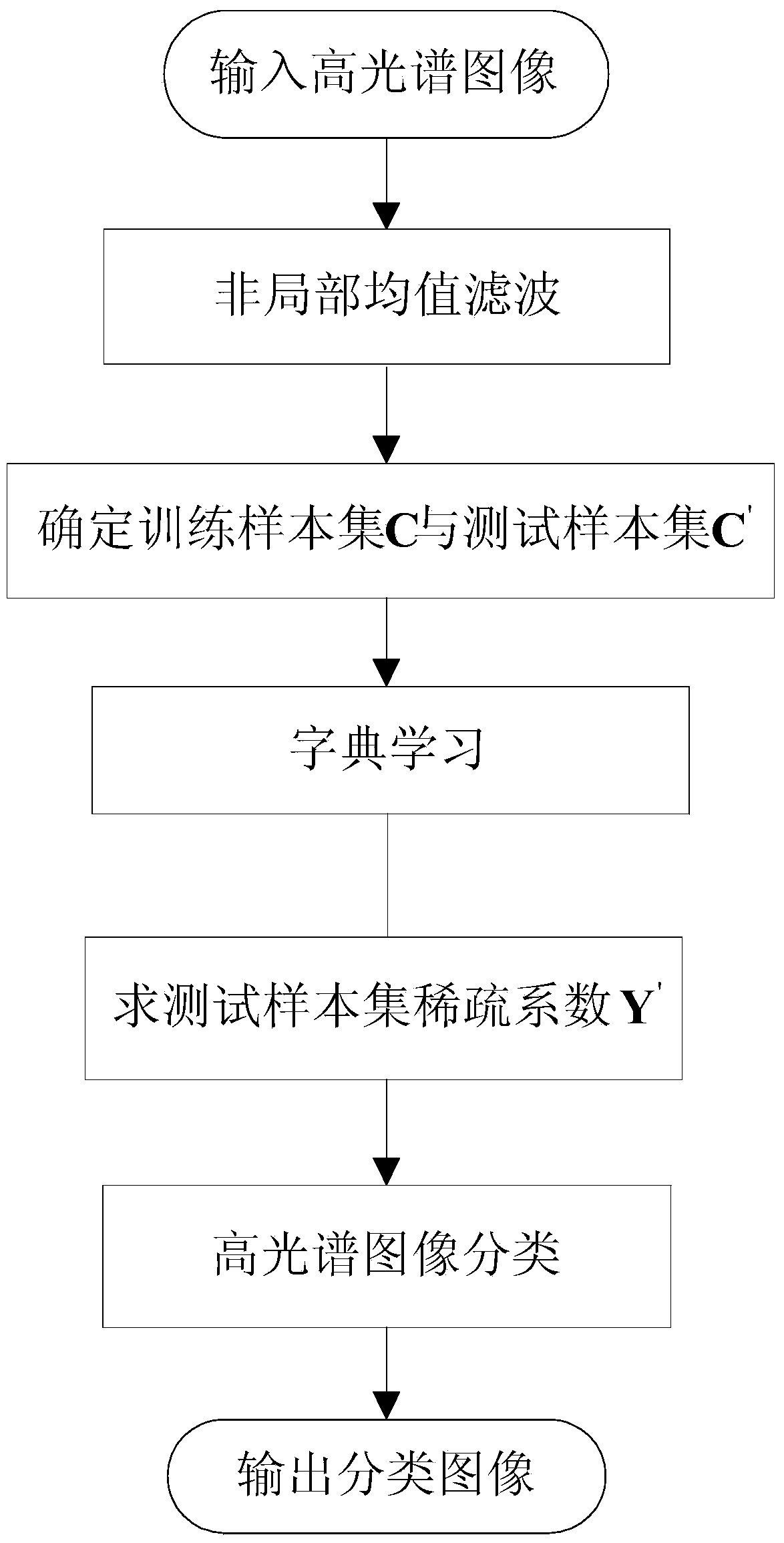
[0065] like figure 1 As shown, the hyperspectral image classification method based on non-local similarity and sparse coding includes the following steps:
[0066] (1) Input hyperspectral image:
[0067] Input the hyperspectral image to be classified, which contains n pixels in total, set each pixel in the input hyperspectral image as a sample, and obtain the sample X of the hyperspectral image=[x 1 ,x 2 ,...,x p ,...,x n ]∈R d ,1≤p≤n, where d is the band number of the hyperspectral image, x p represents the p-th sample of a hyperspectral image, R d Represents a d-dimensional real number vector space;
[0068] (2) Non-local mean filtering:
[0069] The first step is to select a test sample x i , with x i As the center, set a 7×7 neighborhood window;
[0070] The second step is to set a filter window with a size of 3×3, and perform mean filtering on the samples in the neighborhood window;
[0071] The third step is to calculate the test sample x according to the fol...
Embodiment 2
[0110] In this embodiment, on the basis of Embodiment 1, the effects of the present invention are further described in combination with simulation diagrams.
[0112] The hardware test platform of this experiment is: the processor is Intel Core2 CPU, the main frequency is 2.33GHz, the memory is 2GB, and the software platform is: Windows XP operating system and Matlab R2012a. The input image of the present invention is a hyperspectral image Indian Pines, the image size is 145×145×220, the image contains 220 bands and 16 types of ground objects, and the image format is TIF.
[0116] The hyperspectral image classification method propo...
the structure of the environmentally friendly knitted fabric provided by the present invention; figure 2 Flow chart of the yarn wrapping machine for environmentally friendly knitted fabrics and storage devices; image 3 Is the parameter map of the yarn covering machine
Login to View More
PUM
Login to View More
Abstract
The invention belongs to the technical field image processing and particular relates to a hyper-spectral image classification method based on non-local similarity and sparse coding. The hyper-spectral image classification method based on the non-local similarity and the sparse coding comprises the achieving steps of 1 inputting a hyper-spectral image; 2 filtering a non-local average; 3 determining a training sample set C and a test sample set C'; 4 performing dictionary learning; 5 calculating the sparse coefficient of the test sample set; 6 performing hyper-spectral image classification; 7 outputting classified images. By means of the non-local average filtering method, the defect that in the prior art, only spectral information of the hyper-spectral image is utilized to perform hyper-spectral image classification and accordingly edge portion misclassification is caused is overcome, and the hyper-spectral image classification method can have the advantage that the edge portion misclassification is accurate. In addition, the shortcoming that neighborhood information of the hyper-spectral image cannot be effectively utilized in the prior art is overcome, and the hyper-spectral image classification method can have the advantage that the homogeneous area classification effect is good.
Description
technical field [0001] The invention belongs to the technical field of image processing, in particular to a hyperspectral image classification method based on non-local similarity and sparse coding in the technical field of hyperspectral image classification. The invention can be used to classify the hyperspectral images. Background technique [0002] The improvement of spatial domain and spectral domain resolution of hyperspectral images provides more abundant information for classification, but also brings great challenges. Traditional classification methods, including maximum likelihood classification, decision tree classification, artificial neural network classification, and support vector machine classification, all only classify features from the spectral domain level. However, hyperspectral remote sensing data not only contains rich spectral information of surface objects, but also has specific description and expression of surface object characteristics in two diff...
Claims
the structure of the environmentally friendly knitted fabric provided by the present invention; figure 2 Flow chart of the yarn wrapping machine for environmentally friendly knitted fabrics and storage devices; image 3 Is the parameter map of the yarn covering machine
Login to View More
Application Information
Patent Timeline
Application Date:The date an application was filed.
Publication Date:The date a patent or application was officially published.
First Publication Date:The earliest publication date of a patent with the same application number.
Issue Date:Publication date of the patent grant document.
PCT Entry Date:The Entry date of PCT National Phase.
Estimated Expiry Date:The statutory expiry date of a patent right according to the Patent Law, and it is the longest term of protection that the patent right can achieve without the termination of the patent right due to other reasons(Term extension factor has been taken into account ).
Invalid Date:Actual expiry date is based on effective date or publication date of legal transaction data of invalid patent.



 Login to View More
  Login to View More