Use of a semiconducting compound in an organic light emitting device
What is AI technical title?
AI technical title is built by Patsnap AI team. It summarizes the technical point description of the patent document.
A compound and application technology, applied in the application field of semiconductor compounds in organic light-emitting devices, can solve problems such as unclear thermal stability, and achieve the effect of high thermal stability
Active Publication Date: 2015-01-28
NOVALED GMBH
View PDF13 Cites 9 Cited by
Summary
Abstract
Description
Claims
Application Information
AI Technical Summary
This helps you quickly interpret patents by identifying the three key elements:
Problems solved by technology
Method used
Benefits of technology
Problems solved by technology
Furthermore, given the missing data, it is unclear whether all the compounds proposed confer high thermal stability on devices using them
Method used
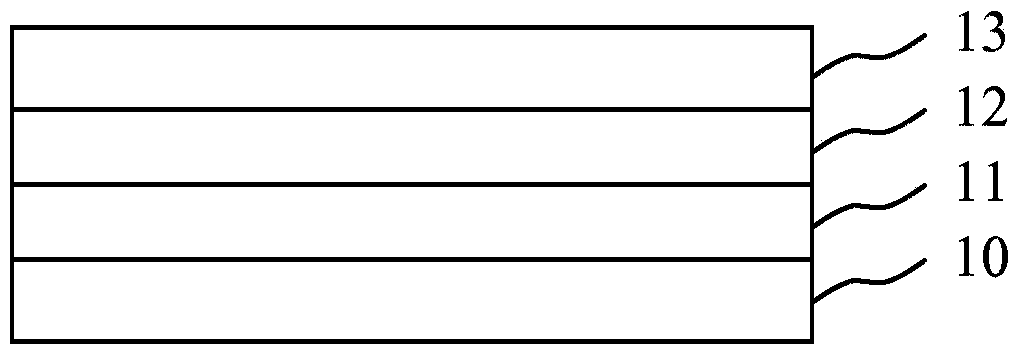
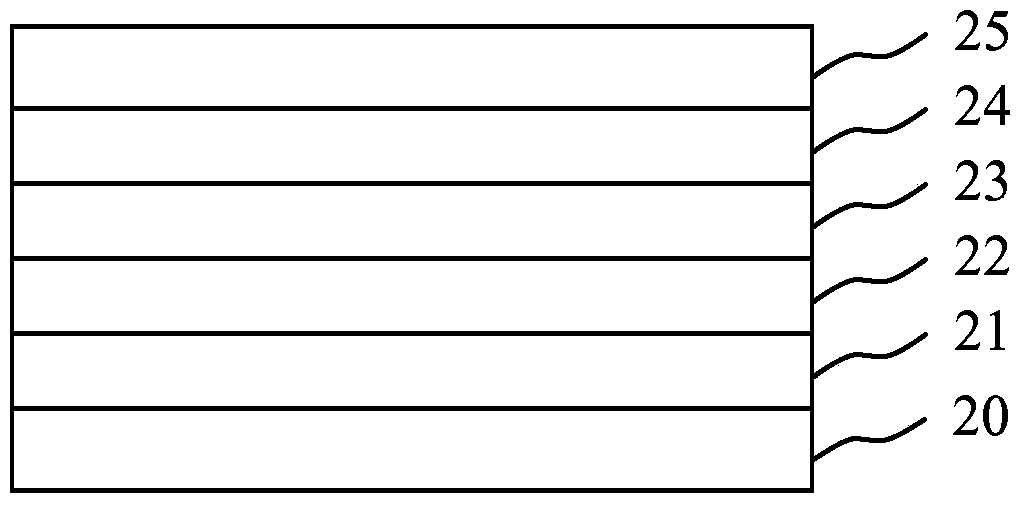
the structure of the environmentally friendly knitted fabric provided by the present invention; figure 2 Flow chart of the yarn wrapping machine for environmentally friendly knitted fabrics and storage devices; image 3 Is the parameter map of the yarn covering machine
View more
Image
Smart Image Click on the blue labels to locate them in the text.
Viewing Examples
Smart Image
Click on the blue label to locate the original text in one second.
Reading with bidirectional positioning of images and text.
Smart Image
Examples
Experimental program
Comparison scheme
Effect test
Embodiment 1
[0206] Bottom blue emitting OLEDs were fabricated on glass substrates coated with patterned ITO (90 nm thickness) with the following layer sequence:
[0207] 1. p-doped N,N'-bis(naphthalene-1-yl)-N,N'-bis(phenyl)-benzidine (a-NPD) (5 mol% of 2,2',2 ″-(cyclopropane-1,2,3-triylidene) tris(2-(p-cyanotetrafluorophenyl)acetonitrile) (PD2) is used as a hole injection and transport layer with a thickness of 130nm;
[0208] 2. Undoped 4,4',4"-tris(carbazol-9-yl)-triphenylamine (TCTA), with a thickness of 10nm;
[0209] 3. Emitter layer with TPBI:Firpic (molar ratio 4:1) with a thickness of 15 nm. TPBI is 1,3,5-tris(1-phenyl-1H-benzimidazol-2-yl)benzene and Firpic is bis(3,5-difluoro-2-(2-pyridyl-(2-carboxy pyridyl) iridium (III);
[0213] Encapsulate the device with a cover glass layer...
Embodiment 2
[0215] A second OLED was fabricated as described in Example 1, except that compound C2 was used instead of compound C1. at 10mA / cm 2 The voltage at 4.3V and the device reaches 1000cd / m at 4.8V 2 .
Embodiment 3
[0217] A third OLED was fabricated as described in Example 1, except that Compound C3 was used instead of Compound Cl. at 10mA / cm 2 The voltage at 4.0V and the device reaches 1000cd / m at 4.2V 2 .
the structure of the environmentally friendly knitted fabric provided by the present invention; figure 2 Flow chart of the yarn wrapping machine for environmentally friendly knitted fabrics and storage devices; image 3 Is the parameter map of the yarn covering machine
Login to View More
PUM
Property
Measurement
Unit
thickness
aaaaa
aaaaa
glass transition temperature
aaaaa
aaaaa
glass transition temperature
aaaaa
aaaaa
Login to View More
Abstract
The invention relates to a use of a compound according to formula (1), wherein each of R1, R2, R1, R2 is independently selected from H, C1-C6 alkyl, C1-C6 haloalkyl and C6-C10 aryl or both substituents on the same aromatic ring of the xanthene skeleton are hydrocarbyi groups linked with each other to form together an anelated divalent C2-C10 hydrocarbyi group; X and X' are independently selected from C and N, R5 is H if X is C, R5 is H if X' is C, R5 is lone electron pair if X is N, R5 is lone electron pair if X' is N, and each of R3, R4, R3, R4 is independently selected from H and C6-C10 aryl, with the proviso that neither both R3, R4 nor both R3, R4 are aryl at the same time and if X is C, R3and R4 are not H at the same time, and if X' is C, R3 and R4 are not H at the same time, or both substituents on the same phenyl or pyridyl ring are hydrocarbyi groups linked with each other to form together a divalent C4-C10 hydrocarbyi group representing an anelated, substituted or unsubstituted, six-membered aromatic ring; in an electron transporting layer or in an electron injecting layer comprised in an electronic device.
Description
Background technique [0001] Since Tang et al. disclosed efficient organic light-emitting diodes (OLEDs) in 1987 (C.W.Tang et al., Appl. Technology progresses to high-end commercial displays and lamps. OLEDs contain a series of thin layers essentially made of organic materials between two electrodes. This layer typically has a thickness in the range of 1 nm to 5 μm. This layer is usually formed in vacuum by means of vapor deposition or from solution, for example by means of spin coating or printing. [0002] OLEDs emit light after injecting charge carriers into the light-emitting layer from the cathode side in the form of electrons and from the anode side in the form of holes. Charge carrier injection is achieved based on an applied external voltage, then excitons are formed in the light-emitting region, and these excitons radiatively recombine. At least one electrode is transparent or translucent, in most cases in the form of a transparent oxide, such as indium tin oxide (...
Claims
the structure of the environmentally friendly knitted fabric provided by the present invention; figure 2 Flow chart of the yarn wrapping machine for environmentally friendly knitted fabrics and storage devices; image 3 Is the parameter map of the yarn covering machine
Login to View More
Application Information
Patent Timeline
Application Date:The date an application was filed.
Publication Date:The date a patent or application was officially published.
First Publication Date:The earliest publication date of a patent with the same application number.
Issue Date:Publication date of the patent grant document.
PCT Entry Date:The Entry date of PCT National Phase.
Estimated Expiry Date:The statutory expiry date of a patent right according to the Patent Law, and it is the longest term of protection that the patent right can achieve without the termination of the patent right due to other reasons(Term extension factor has been taken into account ).
Invalid Date:Actual expiry date is based on effective date or publication date of legal transaction data of invalid patent.


 Login to View More