Supercharge Your Innovation With Domain-Expert AI Agents!

A method and system for separating waste plastics based on image recognition

A technology of image recognition and separation system, which is applied in the field of waste plastic separation and system based on image recognition, which can solve the problems of failure to achieve the purpose of separation, low efficiency, large investment, etc.

Inactive Publication Date: 2016-08-31
TONGJI UNIV
View PDF8 Cites 2 Cited by
  • Summary
  • Abstract
  • Description
  • Claims
  • Application Information

AI Technical Summary

Problems solved by technology

However, it is too difficult for the photoelectric separator to be used to separate waste plastics from the garbage sieve. First of all, waste plastics are entangled with debris such as paper and cloth. Even if the machine can distinguish from the material, the actuator is difficult to separate. The second is that the colors are different, and it is difficult to distinguish them by color; the third is that the surface of waste plastics is dirty, so that neither reflected light nor penetrating light can reflect the material nature of waste plastics
Based on this, the use of existing photoelectric separators to separate waste plastics from garbage screens not only requires a large investment, but also requires multiple units to be used in conjunction to achieve it. It is also inefficient and cannot achieve the expected separation purpose.

Method used

the structure of the environmentally friendly knitted fabric provided by the present invention; figure 2 Flow chart of the yarn wrapping machine for environmentally friendly knitted fabrics and storage devices; image 3 Is the parameter map of the yarn covering machine
View more

Image

Smart Image Click on the blue labels to locate them in the text.
Viewing Examples
Smart Image
  • A method and system for separating waste plastics based on image recognition
  • A method and system for separating waste plastics based on image recognition
  • A method and system for separating waste plastics based on image recognition

Examples

Experimental program
Comparison scheme
Effect test

Embodiment 1

[0070] Embodiment 1: Different types of waste plastics separated from oversize, such as PE, PP, PS, PVC, etc.;

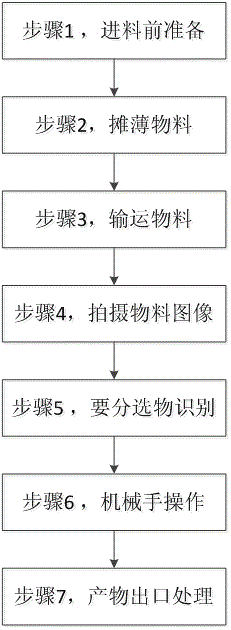
[0071] exist image 3 In the shown embodiment 1, the sorting system needs to follow the implementation requirements of the sorting system, keep all kinds of input and output signals smooth and effective, and the software and hardware run normally. The goal of sorting is to separate the mixed waste plastics in the garbage sieve and classify them into different waste plastics at the same time. according to figure 2 Steps 1-6 are shown for sorting, and each step is described as follows:

[0072] Step 1: Preparation before feeding. Sieve the garbage at a certain speed, such as 1m 3 The processing capacity per minute enters the hopper, shakes the hopper to loosen and evenly screen the garbage;

[0073]Step 2: Through a narrow and long outlet, the waste on the screen is evenly diluted on the crawler. The aspect ratio of the outlet should be kept at a certain value ...

Embodiment 2

[0098] Example 2: Separation of mixed waste plastics from garbage oversize.

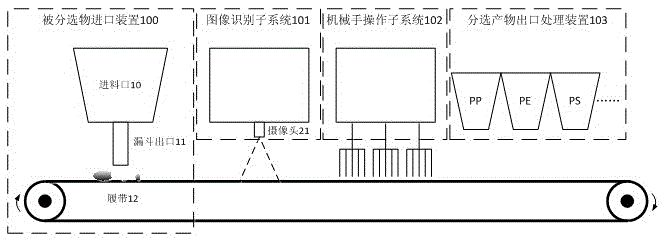
[0099] exist Figure 4 In the shown embodiment 2, the sorting system needs to follow the implementation requirements of the sorting system, keep all kinds of input and output signals smooth and effective, and the software and hardware run normally. The goal of sorting is to separate the mixed waste plastics in the garbage sieve. according to image 3 Steps 1-6 are shown for sorting, and each step is described as follows:

[0100] Step 1: Preparation before feeding. Sieve the garbage at a certain speed, such as 1.5 m 3 The processing capacity per minute enters the hopper, shakes the hopper to loosen and evenly screen the garbage;

[0101] Step 2: Through a narrow and long outlet, the waste on the screen is evenly diluted on the crawler. The aspect ratio of the outlet should be kept at a certain value to facilitate manipulator operation, for example, 10:1—15:1, and the track width should be selec...

Embodiment 3

[0123] Example 3: Separation of sundries from mixed waste plastics.

[0124] exist Figure 5 In the shown embodiment 3, the sorting system needs to follow the implementation requirements of the sorting system, keep all kinds of input and output signals smooth and effective, and the software and hardware run normally. The goal of sorting is to separate the impurities in mixed waste plastics and improve the purity of mixed waste plastics. according to image 3 Steps 1-6 are shown for sorting, and each step is described as follows:

[0125] Step 1: Preparation before feeding. Mix the waste plastic at a certain speed, such as 1.0 m 3 The processing capacity per minute enters the hopper, shakes the hopper to loosen and evenly mix the waste plastics;

[0126] Step 2: Through a narrow and long outlet, the mixed waste plastic flow is evenly spread on the track. The aspect ratio of the exit should be kept at a certain value to facilitate manipulator operation, such as 8:1—13:1, a...

the structure of the environmentally friendly knitted fabric provided by the present invention; figure 2 Flow chart of the yarn wrapping machine for environmentally friendly knitted fabrics and storage devices; image 3 Is the parameter map of the yarn covering machine
Login to View More

PUM

No PUM Login to View More

Abstract

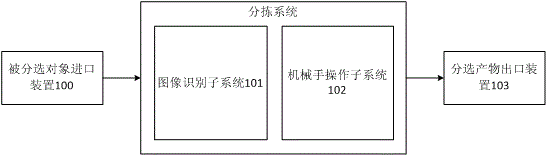
The invention relates to a waste plastic separating method and system based on image recognition. A current object needing to be separated is judged based on the surface texture and the reflected light spectrum distribution, and the method and the system are applied to the production process of sorting plastics from garbage oversize products and used for removing impurity components from the waste plastics and sorting different kinds of waste plastics out of the mixed waste plastics. The system comprises an inlet device of a sorted object, a sorting system and a sorted product outlet device, wherein the sorting system is composed of an image recognition subsystem and a mechanical arm operation subsystem. According to the system, the purposes of sorting the waste plastics from the garbage oversize products in which various waste is mixed and separating sundries from the waste plastics are achieved; or the purpose of separating single waste plastics from the mixed waste plastics is achieved, and the sorting efficiency of the waste plastics reaches 90 percent.

Description

technical field [0001] The invention relates to a method and system for separating waste plastics based on image recognition. Background technique [0002] With the rapid development of modern synthetic resin industry, the application of plastic products is becoming more and more extensive. While plastic products bring convenience to people, a large amount of waste plastics also cause serious pollution to the environment. The use cycle of plastics is very short, and a large number of plastic products are discarded after about 6 to 12 months. 40% of plastics It can no longer be used after 1-2 years. In the past few decades, waste plastics have been regarded as part of municipal solid waste (MSW), and waste plastics account for 4%-10% (wt) or 10%-20% (vol) in MSW in developed countries. [0003] Waste plastics are essentially re-polymerized from hydrocarbons such as ethylene, propylene, and styrene extracted through a series of processing processes after petroleum is extract...

Claims

the structure of the environmentally friendly knitted fabric provided by the present invention; figure 2 Flow chart of the yarn wrapping machine for environmentally friendly knitted fabrics and storage devices; image 3 Is the parameter map of the yarn covering machine
Login to View More

Application Information

Patent Timeline
no application Login to View More
Patent Type & Authority Patents(China)
IPC IPC(8): B07B13/00
Inventor 王海陈德珍尹丽洁
Owner TONGJI UNIV
Features
  • R&D
  • Intellectual Property
  • Life Sciences
  • Materials
  • Tech Scout
Why Patsnap Eureka
  • Unparalleled Data Quality
  • Higher Quality Content
  • 60% Fewer Hallucinations
Social media
Patsnap Eureka Blog
Learn More