Floating point calculation method based on FPGA

A floating-point operation and fixed-point technology, applied in the field of programmable processors, can solve the problems of difficult development of floating-point operations, long research and development cycle, and high research and development costs, and achieve the effects of improving the efficiency of floating-point operations, reducing costs, and resolving conflicts.

CN104679719AActive Publication Date: 2015-06-03南京晶达微电子科技有限公司
3 Cites 11 Cited by

Patent Information

Authority / Receiving Office
CN · China
Current Assignee / Owner
Publication Date
2015-06-03

Smart Images

  • Figure 1
    Figure 1
  • Figure 2
    Figure 2
  • Figure 3
    Figure 3
Patent Text Reader

Abstract

The invention provides a floating point calculation method based on a FPGA. The method comprises the steps of processing a group of data which is identical in index and different in mantissa and used as a data block, expressing the data in calculation by adopting a fixed point format, adjusting the data precision by virtue of left shifting, right shifting the data to avoid the overflow error in the fixed point calculation, and dividing result data by a preset gain to obtain correct data after the calculation is ended. By adopting the floating point calculation method, the contradiction between a fixed point algorithm and a floating point algorithm is solved, the floating point calculation efficiency is improved, and the cost is reduced.
Need to check novelty before this filing date? Find Prior Art

Description

technical field

[0001] The invention relates to a programmable processor, in particular to an FPGA-based floating-point calculation method. Background technique

[0002] In communication and radar signal processing, FFT is a commonly used tool, and it is mostly completed by FPGA when the speed requirement is relatively high or the integration degree is high. The vast majority of processors use fixed-point data format to process data, which makes the processing structure relatively simple, but the overflow phenomenon is more serious, and the use of simple fixed-point truncation will submerge small signals in large signals, making the result data Lose the necessary precision. As the requirements for data precision are getting higher and higher, the general fixed-point algorithm can no longer meet the high-precision requirements, and it is necessary to resort to floating-point processors for calculations to avoid overflow problems in applications. Most foreign FFT Cores use f...

Examples

Embodiment Construction

[0015] The following and accompanying appendices illustrating the principles of the invention Figure 1 A detailed description of one or more embodiments of the invention is provided together. The invention is described in connection with such embodiments, but the invention is not limited to any embodiment. The scope of the invention is limited only by the claims and the invention encompasses numerous alternatives, modifications and equivalents. In the following description, numerous specific details are set forth in order to provide a thorough understanding of the present invention. These details are provided for the purpose of example and the invention may be practiced according to the claims without some or all of these specific details.

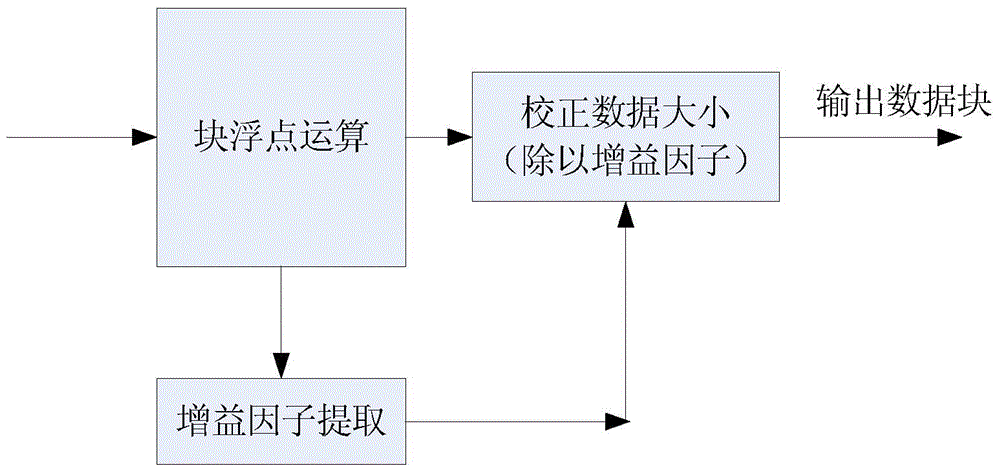
[0016] One aspect of the present invention provides an FPGA-based floating-point calculation method. figure 1 It is a flowchart of an FPGA-based floating-point calculation method according to an embodiment of the present invention.

...