Connection flux statistical information extraction method and VLSI structure

A technology of statistical information and extraction method, applied in the field of connectivity statistical information extraction method and VLSI structure, can solve problems such as the inability to meet high-speed real-time image processing, achieve obvious speed advantages, avoid recording, and save memory space.

CN104680531AActive Publication Date: 2015-06-03XI AN JIAOTONG UNIV
2 Cites 11 Cited by

Patent Information

Authority / Receiving Office
CN · China
Current Assignee / Owner
Publication Date
2015-06-03

Smart Images

  • Figure 1
    Figure 1
  • Figure 2
    Figure 2
  • Figure 3
    Figure 3
Patent Text Reader

Abstract

The invention discloses a connection flux statistical information extraction method and a VLSI (Very Large Scale Integration) structure. The connection flux statistical information extraction method comprises the following steps: simultaneously scanning two adjacent rows of a binary image; judging whether a connected area exists between the current row and the previous row; if yes, merging the area, connected with the current row, in the previous row into the current row according to an equivalent run pair merging rule; meanwhile, marking the area, not connected with the current row, in the previous row as an ended area, and outputting the information of the ended area; then updating the run number of the connected area in the current row; when the current row is the last one, according to the equivalent run pair merging rule, merging the connected area in the current row, then marking the merged and obtained area as the ended area, and outputting the information of the ended area, so as to obtain the connection flux statistical information. The connection flux statistical information extraction method disclosed by the invention can quickly process the binary image and extract the connection flux statistical information of the binary image, and is low in hardware resource consumption.
Need to check novelty before this filing date? Find Prior Art

Description

technical field

[0001] The invention belongs to the field of image processing technology and integrated circuit design, and relates to a method for extracting statistical information of connectivity and a VLSI structure. Background technique

[0002] The connectivity information statistics of the binary image is to connect each other (4 neighbors or 8 Neighborhood) "1" value pixel set is extracted, the purpose is to find all connected regions in the image, and mark all pixels belonging to the same connected region with a unique label value, and count the characteristics of each connected region . This preprocessing operation is widely adopted in many fields of image processing and pattern recognition. Therefore, it is an important step to extract image features, target detection and recognition to distinguish each connected region by a certain method and study the characteristics of each connected region separately.

[0003] The current regional connectivity algorithms ca...

Examples

Embodiment 1

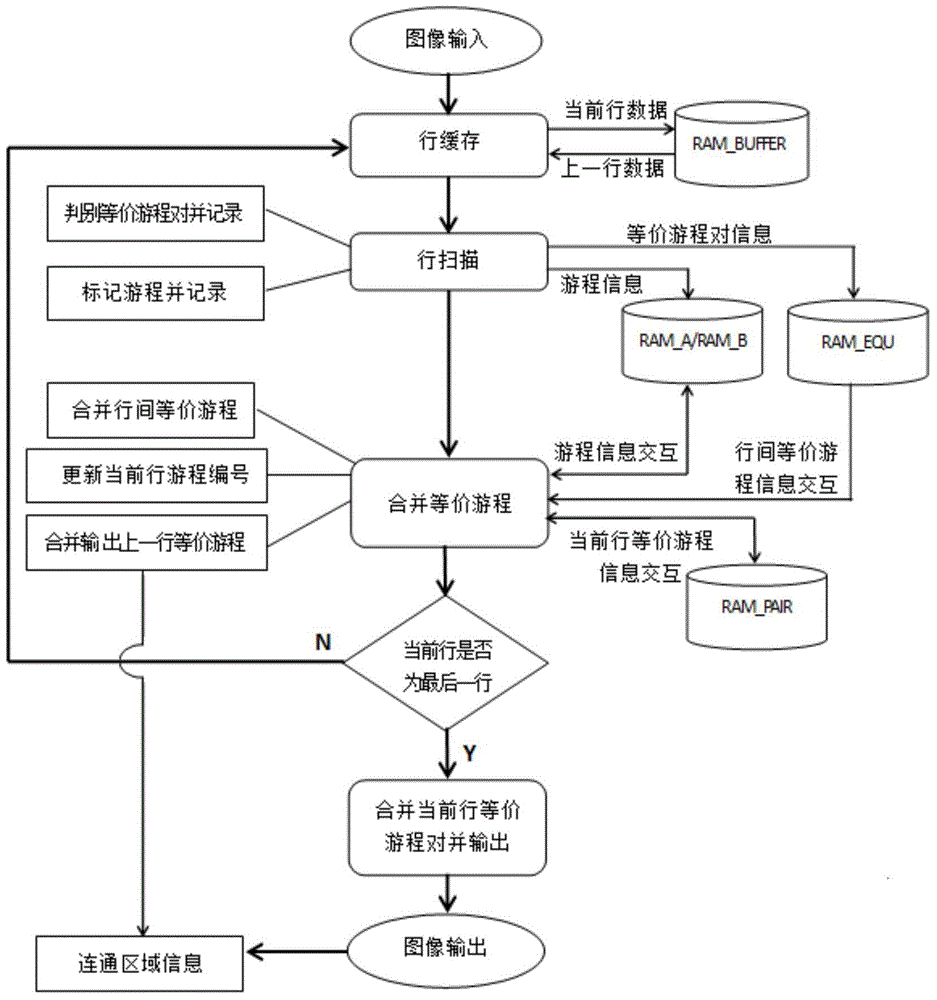
[0052] refer to figure 2 , the concrete process of the present invention is:

[0053] 1) Image input: choose four-connected or eight-connected configuration.

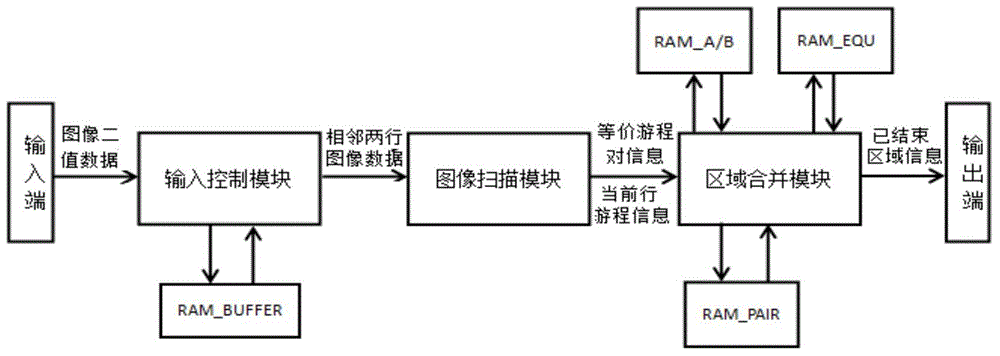
[0054] 2) Line buffer: Receive the image binary data input from the input terminal, and output the binary data of two adjacent lines of the image in parallel through the buffer function of RAM_BUFFER.

[0055] 3) Line scanning: scan the binary data array of the image, and scan two lines of the image at the same time each time, that is, each line will be scanned twice, the first time as the current line, the second time as the previous line, and the line During the scanning process, a 2X2 scanning template is used, such as figure 2 As shown, the template moves to the right column by column during the scanning process.

[0056] Mark the run and record: when the binary data of the previous line of the 2X2 scanning template is 01, a new run is generated in the previous line; when the binary data of the previous line of...