
Process method for enhancing the milling rigidity of aluminum alloy ultra-thin blade overall impeller
A technology of integral impeller and process method, applied in metal processing equipment, milling machine equipment, manufacturing tools, etc., can solve problems affecting the quality and performance stability of the impeller and impeller components, missing blades, undercutting and overcutting of blade surface contours, etc. , to achieve the effect of improving surface quality, reducing vibration and improving cutting efficiency
- Summary
- Abstract
- Description
- Claims
- Application Information
AI Technical Summary
Problems solved by technology
Method used
Image

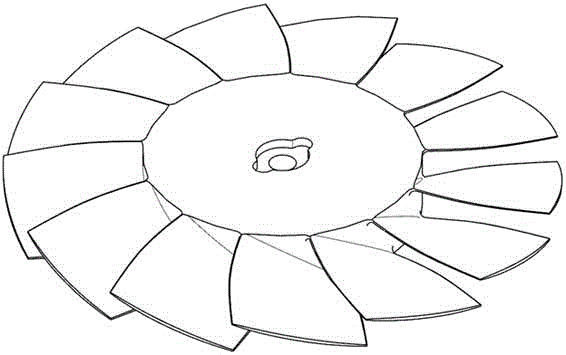
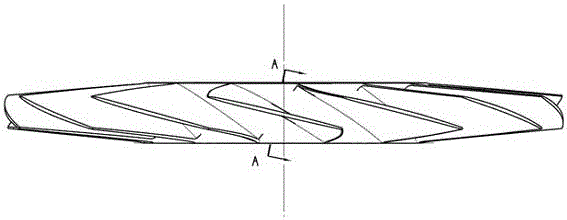
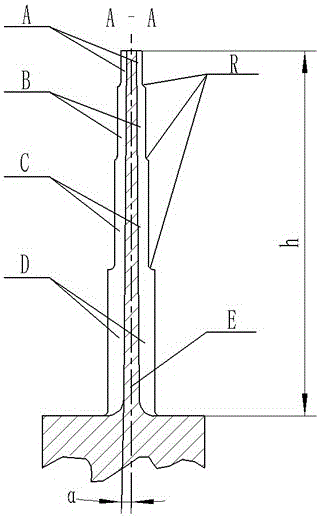
Examples
Embodiment Construction
[0023] The present invention will be further described below according to the accompanying drawings.
[0024] A process method for enhancing the milling rigidity of an integral impeller of an aluminum alloy material ultra-thin blade, comprising the following steps:
[0025] Step 1: Layer the leaves.
[0026] The layering scheme is shown in Table 1.
[0027] Table 1: Leaf layering scheme. Where h is the blade height, a is the average thickness of the blade crown and the thickest part of the blade root, and ε is the ratio of the blade height to the average thickness.
[0028]
[0029] Step 2: Rough machining allowance is reserved.
[0030] Rough machining allowance is reserved for each layer respectively, and the reservation scheme is shown in Table 2.
[0031] Table 2: Reserved plan for the margin of each layer of the rough machining blade
[0032]
[0033] Step 3: Five-axis simultaneous finishing.
[0034] Five-axis simultaneous finishing of an ultra-thin blade mon...
PUM
 Login to View More
 Abstract
Description
Claims
Application Information
 Login to View More