
Preparation method of compound micro-ecological preparation effervescent tablets for preventing and treating fowl plague
A technology of compound microecology and effervescent tablets, which is applied in the direction of medical preparations containing active ingredients, pharmaceutical formulas, antiviral agents, etc., can solve the problems of large residues, unsatisfactory effects, and large toxic and side effects, and achieve easy raw materials. Obtain, improve the body's immunity, and have less side effects
- Summary
- Abstract
- Description
- Claims
- Application Information
AI Technical Summary
Problems solved by technology
Method used
Image

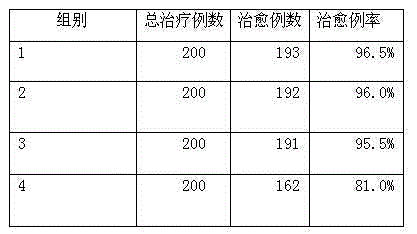
Examples
Embodiment 1
[0023] Embodiment 1: the preparation of lactic acid bacteria freeze-dried powder
[0024] (1) Preheat the MRS liquid medium to 37°C, inoculate the lactic acid bacteria seed liquid at 5% inoculum, and culture it at 37°C for 18-24 hours, harvest the bacterial liquid and store it at -4°C for later use. The lactic acid bacteria for Lactobacillus Brucella ( Lactobacillus buchneri );
[0025] (2) Mix the lactic acid bacteria liquid and the freeze-drying protective agent (commercially available) at a volume ratio of 1:1, and freeze-dry in a vacuum to make the lactic acid bacteria freeze-dried powder.
Embodiment 2
[0026] Embodiment 2: the preparation of Chinese medicine polysaccharide and Chinese medicine flavone
[0027] (1) 20 parts by weight of lotus leaf, 2 parts by weight of comfrey, 10 parts by weight of Daqingye, 10 parts by weight of ginger, 30 parts by weight of woody fragrance, 30 parts by weight of red peony, 6 parts by weight of safflower and 6 parts by weight of almond Mix to obtain the mixed Chinese medicine;
[0028] (2) Take the mixed Chinese medicine, add purified water 20 times the weight of the raw materials, and boil in a water bath to 90°C for 4 hours;
[0029] (3) Discard the traditional Chinese medicine residue in step (2), collect the liquid medicine, centrifuge after cooling at room temperature, discard the precipitate, and collect the supernatant;
[0030] (4) The supernatant in step (3) is subjected to alcohol precipitation, the precipitate is the crude Chinese medicine polysaccharide, and the supernatant is the crude Chinese medicine flavonoid;
[0031] (5)...
Embodiment 3
[0035] Embodiment 3: the preparation of Chinese medicine polysaccharide and Chinese medicine flavone
[0036] (1) 10 parts by weight of lotus leaf, 10 parts by weight of comfrey, 5 parts by weight of Daqingye, 5 parts by weight of ginger, 20 parts by weight of woody fragrance, 20 parts by weight of red peony, 4 parts by weight of safflower and 4 parts by weight of almond Mix to obtain the mixed Chinese medicine;
[0037] (2) Take the mixed Chinese medicine, add purified water 20 times the weight of the raw materials, and boil in a water bath to 90°C for 4 hours;
[0038] (3) Discard the traditional Chinese medicine residue in step (2), collect the liquid medicine, centrifuge after cooling at room temperature, discard the precipitate, and collect the supernatant;
[0039] (4) The supernatant in step (3) is subjected to alcohol precipitation, the precipitate is the crude Chinese medicine polysaccharide, and the supernatant is the crude Chinese medicine flavonoid;
[0040] (5) ...
PUM
 Login to View More
 Abstract
Description
Claims
Application Information
 Login to View More