
Application of polypeptide specific-binding TRB3 in treating or preventing abdominal aortic aneurysm
An abdominal aortic aneurysm, species-specific technology, applied in the direction of medical preparations containing active ingredients, antineoplastic drugs, drug combinations, etc., can solve the problem of lack of TRB3 protein inhibitors and achieve significant curative effect
- Summary
- Abstract
- Description
- Claims
- Application Information
AI Technical Summary
Problems solved by technology
Method used
Image

Examples
Embodiment 1
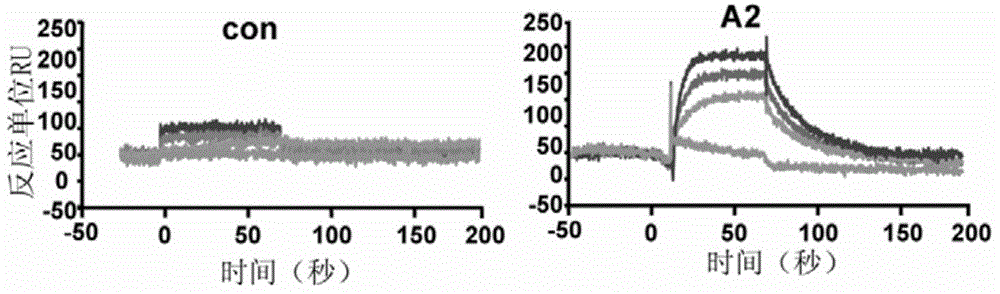
[0058] Example 1: Using surface plasmon resonance to screen peptides that bind to TRB3 protein.
[0059] First, the P62 protein is truncated into different polypeptide fragments, and the peptides are synthesized with a peptide solid-phase synthesizer. This process is carried out by Beijing Saibaisheng Gene Co., Ltd. EXAMPLES The entire screening process was carried out in a surface plasmon resonance instrument BiacoreT200.
[0060] The screening method is as follows:
[0061] 1. The purified protein TRB3 (purchased from R&D Company) was coupled to a CM5 chip (purchased from GE Company) through amino groups, unbound protein was washed away at a flow rate of 10 μL / min, and the surface of the chip was equilibrated for 2 hours.
[0062] 2. Automatically inject 250 μL of different concentrations of polypeptide fragments (200, 50, 12.5, 6.25 nM), and the whole process is carried out at 25°C. The buffer used was HBS-EP buffer (0.01M HEPES, 0.15M NaCl, 3mM EDTA, 0.005% surfactant). ...
Embodiment 2
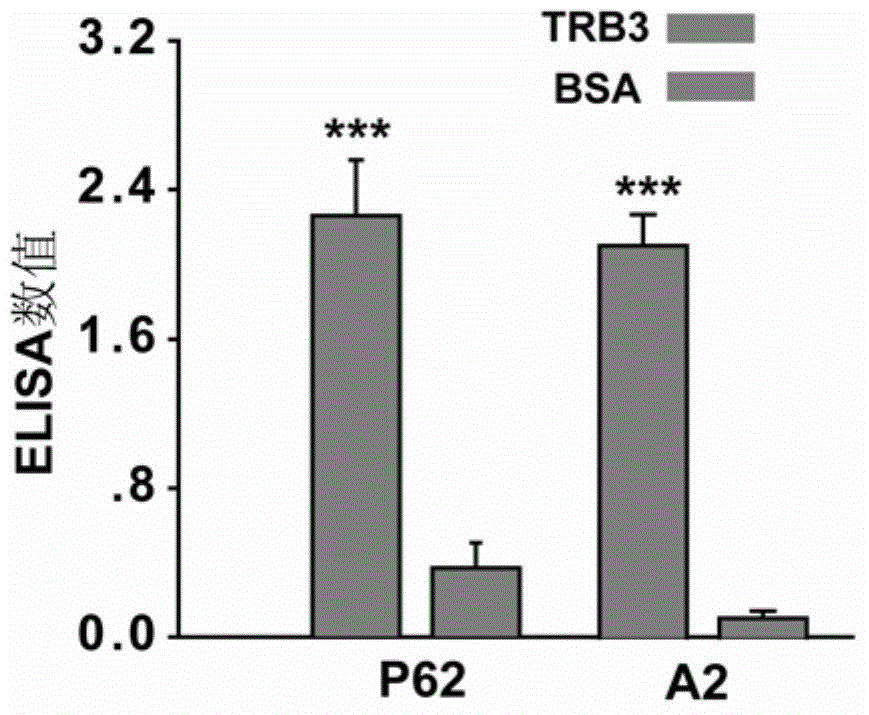
[0067] Example 2: ELISA method to verify the binding of peptide A2 to protein TRB3.
[0068] The specific operation steps are as follows:
[0069] 1. Dilute human TRB3 protein and bovine serum albumin (BSA) to 10 μg / ml with PBS, add 100 μl to each well, and coat 96-well ELISA plate overnight at 4°C.
[0070] 2. Wash three times with PBS containing 0.1% Tween-20. The plates were coated with 200 μl of blocking solution (10% BSA--PBS), and coated at 37° C. for 2 hours.
[0071] 3. Pour off the coating solution, add 200 μl of 1 μg / ml polypeptide B1, A2 and B3 solutions, and set up positive control wells, add 200 μl of 1 μg / ml P62 protein solution, and incubate at 37°C for 1 hour.
[0072] 4. Wash five times with PBS containing 0.1% Tween-20. Add 100 μl anti-M13 monoclonal antibody diluted with blocking solution 1:4000 to each well, and incubate at room temperature for 1 h.
[0073] 5. Wash six times with PBS containing 0.1% Tween-20. Prepare substrate chromogenic solution (10...
Embodiment 3
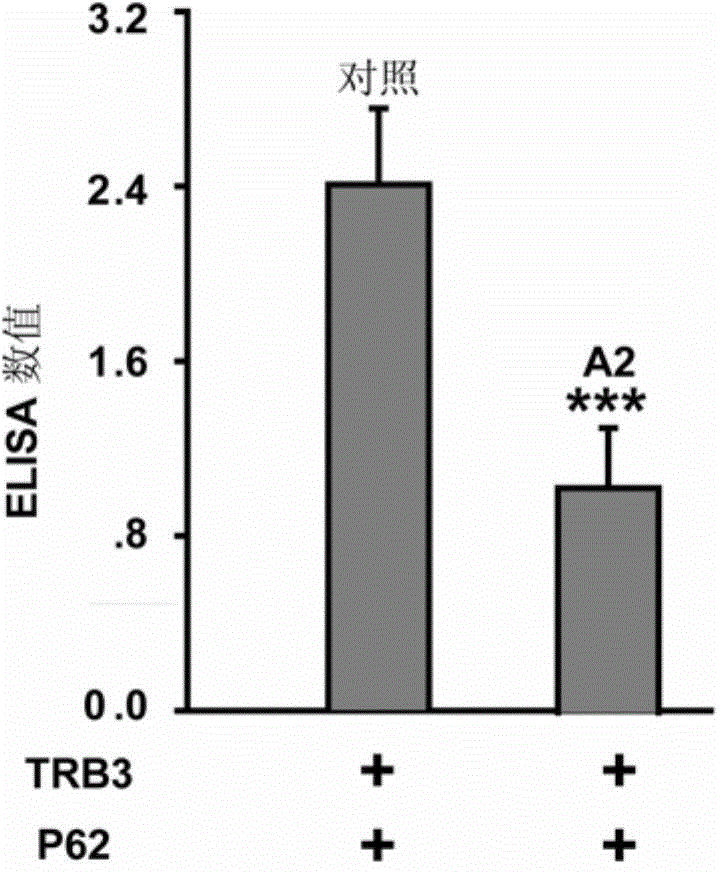
[0076] Example 3: The method of competition ELISA verifies that peptide A2 can compete for the binding of TRB3 and P62 protein.
[0077] The specific operation steps are as follows:
[0078] 1. Dilute human TRB3 protein and BSA to 10 μl / ml with PBS, add 100 μl to each well, and coat 96-well ELISA plate overnight at 4°C.
[0079] 2. Wash three times with PBS containing 0.1% Tween-20. The plates were coated with 200 μl of blocking solution (10% BSA--PBS), and coated at 37° C. for 2 hours.
[0080] 3. Pour off the coating solution, add 200 μl of 1 μg / ml P62 protein solution, and incubate at 37°C
[0081] 1h.
[0082] 4. Wash five times with PBS containing 0.1% Tween-20. Add 100 μl of horseradish catalase-labeled polypeptide A2 diluted with blocking solution to each well, and incubate at room temperature for 1 h.
[0083] 5. Wash six times with PBS containing 0.1% Tween-20. Prepare substrate chromogenic solution (100mmol / L sodium acetate, pH 6.0, add 10μl 30% hydrogen peroxi...
PUM
 Login to View More
 Abstract
Description
Claims
Application Information
 Login to View More