Check patentability & draft patents in minutes with Patsnap Eureka AI!

A kind of microemulsion system and method for extraction and separation of nickel and lithium

A microemulsion and system technology, applied in the direction of improving process efficiency, etc., can solve problems such as long extraction time, long stripping process, and many emulsions, and achieve the effects of reducing raw material types, facilitating experimental preparation, and fast separation speed

Active Publication Date: 2018-06-29
麟州(巨野)孵化器有限公司
View PDF6 Cites 0 Cited by
  • Summary
  • Abstract
  • Description
  • Claims
  • Application Information

AI Technical Summary

Problems solved by technology

One of the key technologies in hydrometallurgy is how to realize the effective separation of ions. The methods used to separate metal ions in the existing hydrometallurgy process mainly include chemical precipitation, ion adsorption and solvent extraction. The addition of excess precipitant will bring new pollution; ion adsorption method often has the disadvantages of poor adsorption selectivity and low yield; solvent extraction solvent extraction method has the advantages of good selectivity, high recovery efficiency, and good separation effect. However, solvent extraction also has the disadvantages of large amount of extractant, long extraction time, and more emulsions used, which is likely to cause waste of resources and increase extraction costs.
Microemulsion extraction and separation of metal ions has the advantages of high separation efficiency, strong selectivity, and wide application range. P204 (i.e., bis(2-ethylhexyl) phosphate) is a commonly used extractant for extraction and separation of metal ions, but in the prior art In the application of P204 as the extraction agent, there are defects such as large amount of extraction agent, long stripping process, and difficult waste liquid treatment, which seriously restrict the development of separating nickel, lithium and other metal ions in waste lithium-ion batteries.

Method used

the structure of the environmentally friendly knitted fabric provided by the present invention; figure 2 Flow chart of the yarn wrapping machine for environmentally friendly knitted fabrics and storage devices; image 3 Is the parameter map of the yarn covering machine
View more

Image

Smart Image Click on the blue labels to locate them in the text.
Viewing Examples
Smart Image
  • A kind of microemulsion system and method for extraction and separation of nickel and lithium
  • A kind of microemulsion system and method for extraction and separation of nickel and lithium
  • A kind of microemulsion system and method for extraction and separation of nickel and lithium

Examples

Experimental program
Comparison scheme
Effect test

Embodiment 1

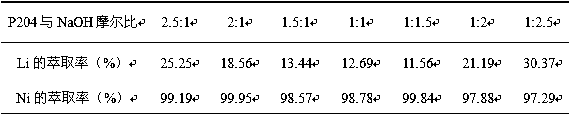
[0012] Saponification: Add 22 mL of NaOH solution with a concentration of 1.0 mol / L to 5.0 mL of P204, mix well, place in a constant temperature shaker in a water bath, shake at a frequency of 150 rpm, shake at room temperature for 30 minutes, take it out and let it stand for 12 hours .

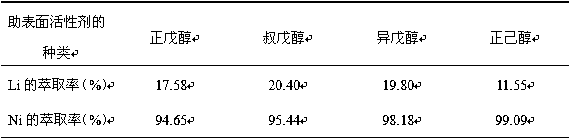
[0013] Preparation of microemulsion: Saponification P204, n-hexanol, and n-heptane are mixed in a volume ratio of 0.8:3:7, and the mixture is ultrasonicated at room temperature for 30 minutes, and then left to stand for 24 hours to obtain a transparent microemulsion system.

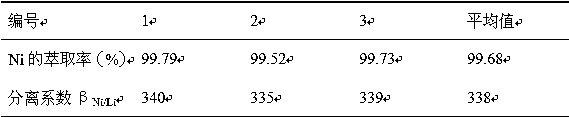
[0014] Extraction and separation: Take 5.0 mL of the above-mentioned microemulsion, mix it according to the milk-water ratio of 1:8 (the concentrations of nickel ions and lithium ions in the outer aqueous phase are 100 mg / L and 80 mg / L, respectively), after mixing evenly, Place in a constant temperature oscillator in a water bath with an oscillation frequency of 150rpm, shake at room temperature for 8 minutes, take it ou...

Embodiment 2

[0019] Saponification: Add NaOH solution with a concentration of 1.0 mol / L to P204, the molar ratio of P204:NaOH solution is: 1:1.5, mix well and place in a constant temperature oscillator in a water bath with an oscillation frequency of 150 rpm, shake at room temperature for 30 Minutes, take it out and let it stand for 12 hours.

[0020] Preparation of microemulsion: Saponification P204, n-hexanol, and n-heptane are mixed in a volume ratio of 0.5:2:6, and the mixture is ultrasonicated at room temperature for 30 minutes, and then left to stand for 24 hours to obtain a transparent microemulsion system.

[0021] Extraction and separation: Take 5.0 mL of the above-mentioned microemulsion and mix it according to the emulsion water ratio of 1:7 (wherein the concentrations of nickel ions and lithium ions in the external aqueous phase are 100 mg / L and 80 mg / L respectively), after mixing evenly, Place in a constant temperature oscillator in a water bath with an oscillation frequency o...

Embodiment 3

[0023] Saponification: Add NaOH solution with a concentration of 1.0 mol / L to P204, the molar ratio P204:NaOH solution is: 1:2, mix well and place in a constant temperature oscillator in a water bath, the oscillation frequency is 150 rpm, and shake at room temperature for 30 Minutes, take it out and let it stand for 12 hours.

[0024] Preparation of microemulsion: Saponified P204, n-hexanol, and n-heptane are mixed in a volume ratio of 1:4:8, and the mixture is ultrasonicated at room temperature for 30 minutes, taken out and left to stand for 24 hours to obtain a transparent microemulsion system.

[0025] Extraction and separation: Take 5.0 mL of the above-mentioned microemulsion, mix it according to the milk-water ratio of 1:9 (the concentrations of nickel ions and lithium ions in the external aqueous phase are 100 mg / L and 80 mg / L, respectively), after mixing evenly, Place in a constant temperature oscillator in a water bath with an oscillation frequency of 150 rpm and shake...

the structure of the environmentally friendly knitted fabric provided by the present invention; figure 2 Flow chart of the yarn wrapping machine for environmentally friendly knitted fabrics and storage devices; image 3 Is the parameter map of the yarn covering machine
Login to View More

PUM

No PUM Login to View More

Abstract

The invention discloses a microemulsion system and method for extracting and separating nickel and lithium. The microemulsion system and method for extracting and separating nickel and lithium are characterized in that the microemulsion system comprises surfactant saponification P204, cosurfactant hexyl alcohol and organic phase normal heptane; NaOh is used for saponifying P204 according to steps, and the saponification P204 is prepared into the microemulsion system with other ingredients; microemulsion and an external water phase containing nickel ions and lithium ions are mixed according to the volume ratio of 1:6-10 and put into a water bath constant temperature oscillator after even mixing; oscillation is carried out for 8 minutes at the room temperature with the oscillation frequency of 150 rpm; and the mixture is taken out and then subjected to standing for 4 hours, the water phase is taken and absorbed through atoms to measure the absorbance, and the extraction rate is calculated. The stable microemulsion system is established with the saponification P204 as the surfactant, the hexyl alcohol as the cosurfactant and the normal heptane as the organic phase to separate nickel and lithium; in the method, the dosage of the P204 and the dosage of the organic phase are small, a salting-out agent does not need to be additionally added, so that operation is more simple, the separating speed is increased, and the separating efficiency is greatly improved; and the reverse extraction steps are simple, and the organic phase obtained after reverse extraction can be recycled.

Description

technical field [0001] The invention relates to the technical field of separation of nickel and lithium, in particular to a microemulsion system and method for extracting and separating nickel and lithium, which can be used for the separation of nickel and lithium in waste lithium nickelate batteries. Background technique [0002] The use and disposal of lithium-ion batteries is increasing year by year. According to the survey, more than 1 billion lithium-ion batteries are discarded every year in the world. The reprocessing of waste lithium-ion batteries and the separation and recovery of various metals are an important resource regeneration. Work. One type of positive electrode material in lithium-ion batteries is lithium nickel oxide, which is a lithium nickel-oxide battery. Improper handling of this type of battery will cause waste of nickel and lithium. At present, the main methods for recovering nickel and other precious metals from waste lithium-ion batteries are inci...

Claims

the structure of the environmentally friendly knitted fabric provided by the present invention; figure 2 Flow chart of the yarn wrapping machine for environmentally friendly knitted fabrics and storage devices; image 3 Is the parameter map of the yarn covering machine
Login to View More

Application Information

Patent Timeline
no application Login to View More
Patent Type & Authority Patents(China)
IPC IPC(8): C22B7/00C22B26/12C22B23/00
CPCY02P10/20
Inventor 李大枝陈志强
Owner 麟州(巨野)孵化器有限公司
Features
  • R&D
  • Intellectual Property
  • Life Sciences
  • Materials
  • Tech Scout
Why Patsnap Eureka
  • Unparalleled Data Quality
  • Higher Quality Content
  • 60% Fewer Hallucinations
Social media
Patsnap Eureka Blog
Learn More