Water soluble mitochondrial targeting imaging probe and preparation method thereof
What is AI technical title?
AI technical title is built by Patsnap AI team. It summarizes the technical point description of the patent document.
A technology of organic solvents and compounds, applied in the field of water-soluble mitochondria-targeted imaging probes and its preparation, can solve problems such as unfavorable mitochondria, poor water solubility, weak light bleaching effect, etc.
Active Publication Date: 2016-07-20
INST OF CHEM CHINESE ACAD OF SCI
View PDF3 Cites 12 Cited by
Summary
Abstract
Description
Claims
Application Information
AI Technical Summary
This helps you quickly interpret patents by identifying the three key elements:
Problems solved by technology
Method used
Benefits of technology
Problems solved by technology
However, these probes are poorly water-soluble due to their large molecular weight. Among them, MitoTrackerRed and JC-1 have extremely weak photobleaching effects, and the fluorescence quenches quickly after long-term irradiation, which is not conducive to long-term real-time tracking of mitochondrial changes.
Method used
the structure of the environmentally friendly knitted fabric provided by the present invention; figure 2 Flow chart of the yarn wrapping machine for environmentally friendly knitted fabrics and storage devices; image 3 Is the parameter map of the yarn covering machine
View more
Image
Smart Image Click on the blue labels to locate them in the text.
Viewing Examples
Smart Image
Click on the blue label to locate the original text in one second.
Reading with bidirectional positioning of images and text.
Smart Image
Examples
Experimental program
Comparison scheme
Effect test
Embodiment 1
[0113] Example 1. Water-soluble mitochondria-targeted imaging probe (NMP-TPP)
[0114] (1) Preparation of water-soluble mitochondria-targeted imaging probe (NMP-TPP)
[0115] 1) put H 2 N-CH 2 CH 2 -NH 2 Dissolve methanol with 4-bromo-1,8-naphthalene dicarboxylic anhydride, stir and react at 80°C for 20h, cool to 15°C after the reaction, evaporate the reaction solvent to dryness, separate and purify the product through column and recrystallization.
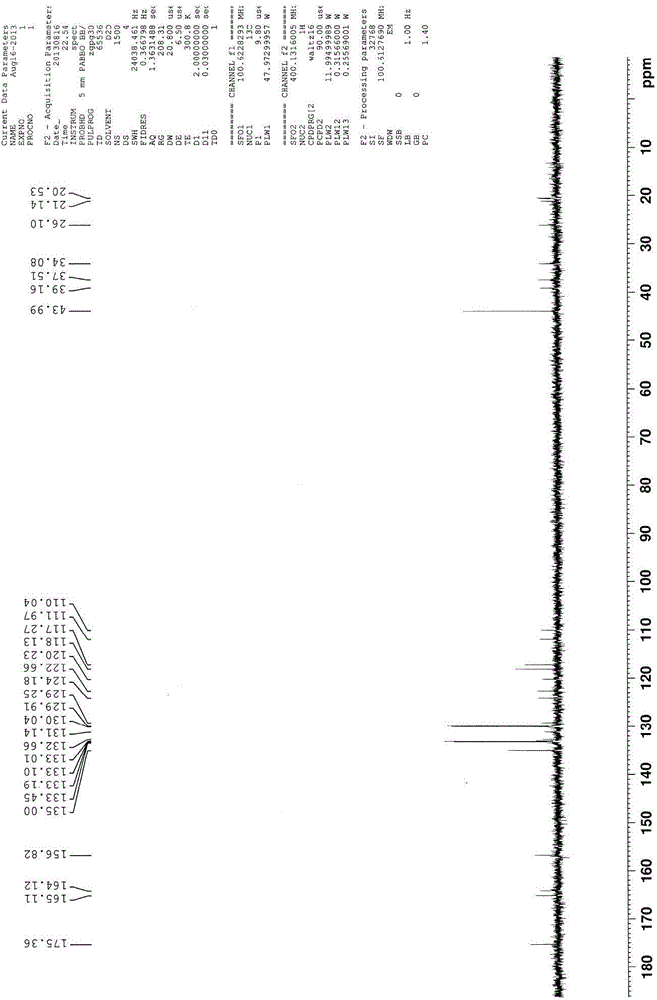
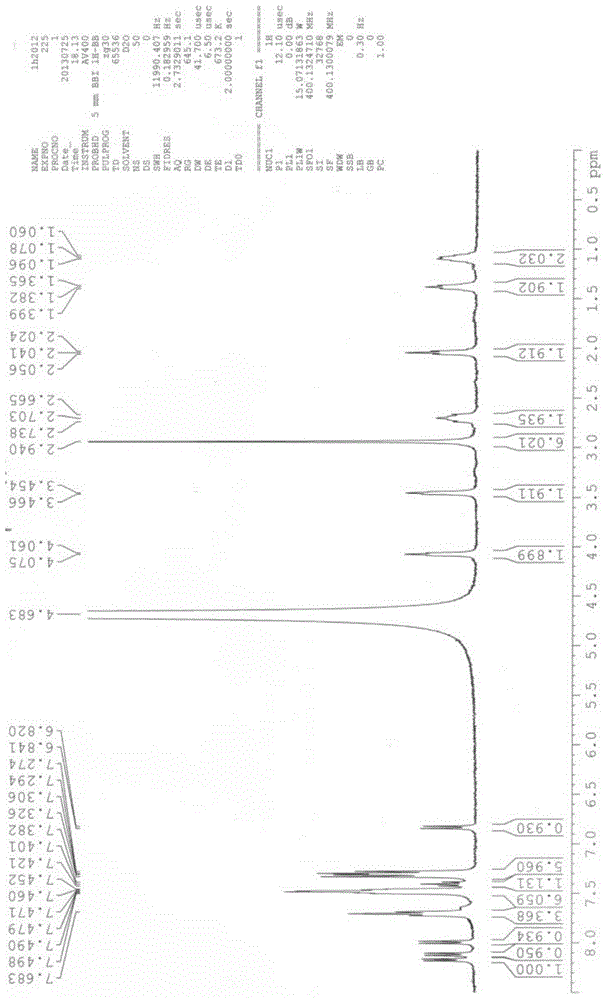
[0116] The results of structural confirmation are as follows: Mp: 205-206°C.1 HNMR (400MHz, CDCl 3 , TMS): δ8.58-8.56 (d, 1H, J = 6.4Hz), 8.50-8.45 (m, 2H, J = 8.4), 7.70-7.66 (m, 1H, J = 8.4Hz), 7.12-7.10 (1H,d,J=8.4Hz),3.18(6H,s). 13 CNMR(400MHz,DMSO),TMS):δ161.9,160.8,157.7,134.7,133.6,132.9,125.4,124.1,119.3,113.1,108.4,44.7.Calcd.M + ForC 14 h 11 NO 3 , m / z (HRMS): 241.0739, found: m / z=241.0743.
[0117] 2) Change CH 3 -NH-CH 3 The product obtained by reacting with the first step was dissolved in acetonitrile, he...
Embodiment 2
[0149] Example 2, Water-soluble mitochondrial targeting imaging probe (TPP-NMP-TPP)
[0150] (1) Preparation of water-soluble mitochondria-targeted imaging probe (TPP-NMP-TPP)
[0151] 1) put H 2 N-CH 2 CH 2 CH 2-Br and 4-bromo-1,8-naphthalene dicarboxylic anhydride were dissolved in THF, NaOH was added as an acid agent, and the reaction was stirred at -10°C for 20 hours. After the reaction was completed, the reaction solution was neutralized with glacial acetic acid, and the reaction solvent was evaporated to dryness. The product was separated and purified by column and recrystallization.
the structure of the environmentally friendly knitted fabric provided by the present invention; figure 2 Flow chart of the yarn wrapping machine for environmentally friendly knitted fabrics and storage devices; image 3 Is the parameter map of the yarn covering machine
Login to View More
PUM
Login to View More
Abstract
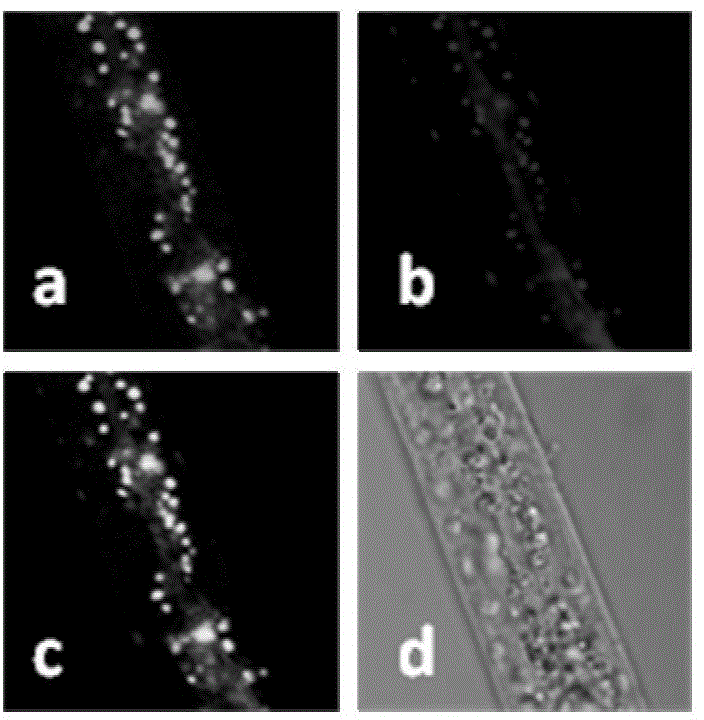
The invention discloses a water solublemitochondrial targeting imaging probe and a preparation method thereof. The structural formula of compounds that form the water solublemitochondrial targeting imaging probe can be formula (I), (II), (III), (IV), (V), or (VI). The water solublemitochondrial targeting imaging probe has the characteristics of good water solubility, high resistance to photo-bleaching, high thermal stability, low toxicity, and high sensitivity. Hela, MCF-7, and NIH-3T3 cells are taken as the models to observe the distribution situation of the fluorescent probe in cells through a laser con-focal microscopy technology; the results show that the probe is mainly distributed in mitochondrial, and the targeting property is good. The test results show that the provided probe has the characteristic of strong mitochondrial targeting imaging performance on cancer cells and non-cancer cells; thus an effective means is provided for quantitatively research superoxide radicals in cells in time and space, and thus the pathologic and physiological mechanisms of active oxygen radicals can be researched.
Description
technical field [0001] The invention relates to a water-soluble mitochondrial targeting imaging probe and a preparation method thereof, belonging to the field of molecular imaging. Background technique [0002] Mitochondria have been studied for more than 150 years since their discovery. During long-term studies, it has been found that mitochondria have a wide range of functions. Mitochondrion, as we know from the earliest, is the structural unit of energy production in cells, the site where eukaryotic organisms undergo oxidative metabolism to produce adenosine triphosphate (ATP), and the place where sugars, fats and amino acids are finally oxidized to release energy. In addition, in long-term research, scientists have discovered that mitochondria also have the functions of storing and controlling the dynamic balance of calcium ions in cells, regulating membrane potential and controlling programmed cell death, and participating in the regulation of cell proliferation and cel...
Claims
the structure of the environmentally friendly knitted fabric provided by the present invention; figure 2 Flow chart of the yarn wrapping machine for environmentally friendly knitted fabrics and storage devices; image 3 Is the parameter map of the yarn covering machine
Login to View More
Application Information
Patent Timeline
Application Date:The date an application was filed.
Publication Date:The date a patent or application was officially published.
First Publication Date:The earliest publication date of a patent with the same application number.
Issue Date:Publication date of the patent grant document.
PCT Entry Date:The Entry date of PCT National Phase.
Estimated Expiry Date:The statutory expiry date of a patent right according to the Patent Law, and it is the longest term of protection that the patent right can achieve without the termination of the patent right due to other reasons(Term extension factor has been taken into account ).
Invalid Date:Actual expiry date is based on effective date or publication date of legal transaction data of invalid patent.


 Login to View More
  Login to View More