Speedless item particle swarm optimization algorithm based on circuit breaker

A particle swarm optimization and particle swarm optimization technology, applied in the field of optimization theory, can solve problems such as slow search speed and premature algorithm, and achieve the effect of fast convergence speed, accelerated convergence speed, and excellent global search ability.

CN106096719AInactive Publication Date: 2016-11-09NANCHANG UNIV
0 Cites 2 Cited by

Patent Information

Authority / Receiving Office
CN · China
Patent Type
Applications(China)
Current Assignee / Owner
Publication Date
2016-11-09
Estimated Expiration
Not applicable · inactive patent

Smart Images

  • Figure 1
    Figure 1
  • Figure 2
    Figure 2
  • Figure 3
    Figure 3
Patent Text Reader

Abstract

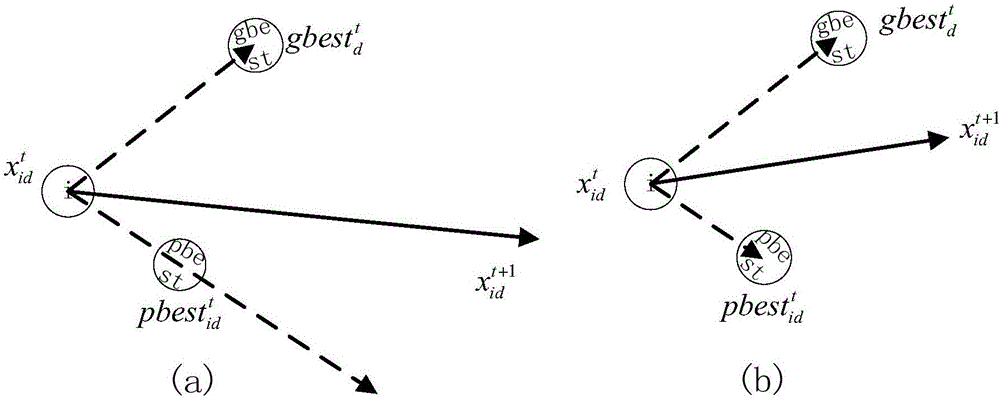
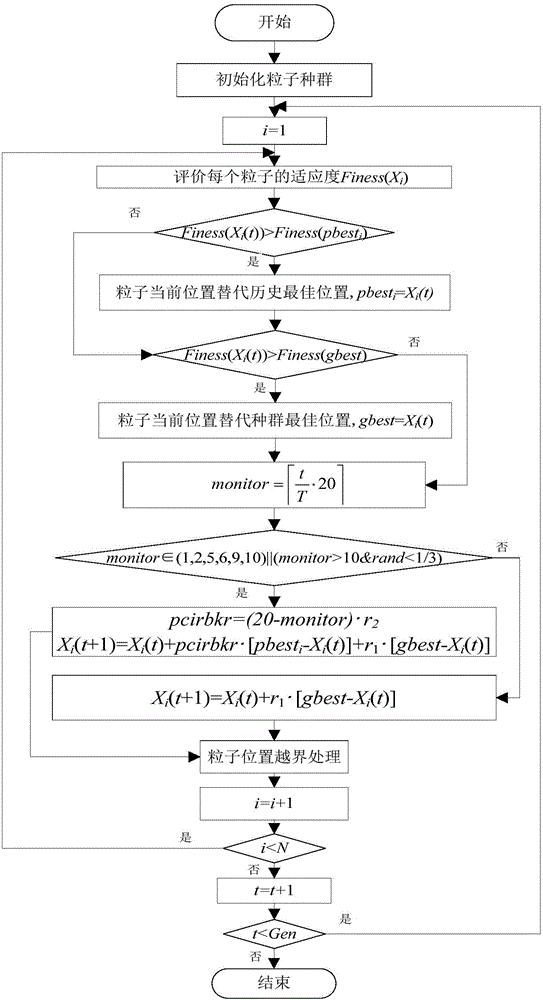
The invention discloses a speedless item particle swarm optimization algorithm based on a circuit breaker. The speedless item particle swarm optimization algorithm introduces a stock market circuit breaker by targeting defects that a traditional particle swarm algorithm is slow in convergence and easy to produce local optimization; a particle swarm iteration evolution process is divided into 20 segments; if the particle swarm evolution process is in segments (1,2,5,6,9,10) of front 10 segments or in last 10 segments and random selection probability is smaller than 1 / 3, a circuit breaker is started to update positions of particles, if not, the circuit breaker is not started; and a speedless item global optimal position gbest guiding iteration equation is adopted to update positions of the particles. The speedless item particle swarm optimization algorithm based on the circuit breaker introduces the circuit breaker to change motion directions and pace lengths of the particles, jumps out of local optimization, and adopts the speedless item global optimal position gbest guiding iteration equation to accelerate convergence speed. As a result, the speedless item particle swarm optimization algorithm has an excellent global searching capability and has fast convergence speed.
Need to check novelty before this filing date? Find Prior Art

Description

technical field

[0001] The invention relates to optimization theory, in particular to a trial particle swarm optimization algorithm based on fusing mechanism. Background technique

[0002] Particle swarm optimization algorithm (particle swarm optimization, pso) is a new evolutionary evolution algorithm. This algorithm is a stochastic optimization algorithm based on swarm intelligence proposed by J.Kennedy and R.C.Eberhart in 1995. The bionic basic point of this type of algorithm is: group animals (such as ants, birds, fish, etc.) effectively seek food and escape hunting through grouping. In this group of animals, the behavior of each individual is based on group behavior, that is, information is shared in the whole group, and there is information exchange and cooperation among individuals. For example, in an ant colony, when each individual finds food, it will recruit companions through contact or chemical signals, so that the whole colony can find food sources; in the fli...

Examples

Embodiment Construction

[0017] The present invention will be further described in conjunction with the accompanying drawings.

[0018] Step 1. Initialize the particle population, the size of the particle population is N; the position vector of each particle in the particle population Represents the current D-dimensional solution, where i=1,2,...,N, each particle has an individual history optimal pbest i The memory vector of the particle is used to store the best position that the particle has ever found, and the optimal position of the population is called gbest. particle history best pbest id Set to X id ; Initialize the historical best fitness of each particle Fitnes(pbest i ). The best fitness of population history is Fitnes(gbest) is the best fitness of all particles in history Fitnes(pbest i ) maximum value. The historical optimal position of the population gbest is the historical best fitness of all particles Fitnes(pbest i ) is the largest particle. The maximum number of loop iteratio...