
Ascorbic acid and pyraclostrobin containing crop bactericide
A technology of pyraclostrobin and ascorbic acid, which is applied in the agricultural field, can solve the problems of weak branches and roots, low crop resistance ability, etc., and achieves safe and reliable product quality, huge social and economic benefits, and application wide range of effects
- Summary
- Abstract
- Description
- Claims
- Application Information
AI Technical Summary
Problems solved by technology
Method used
Image

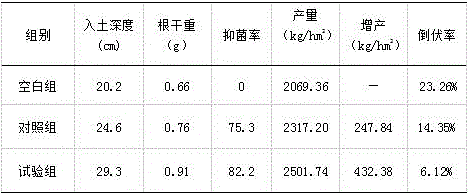
Examples
Embodiment 1
[0025] Example 1: Formula: 0.001 kg of ascorbic acid, 85 kg of pyraclostrobin, 1 kg of dispersant, 0.5 kg of co-solvent, 5 kg of stabilizer, 10 kg of solvent, and distilled water as the balance.
[0026] Preparation method, the steps are as follows:
[0027] The preparation method is:
[0028] (1) Stir the stabilizer evenly, crush it into fine powder, pass through a 100-mesh sieve, and set aside. The stabilizer is prepared from sodium alginate, microcrystalline cellulose and modified starch in a mass ratio of 3:1:0.1 ;
[0029] (2) Add pyraclostrobin into the stainless steel autoclave, then slowly add ascorbic acid and dispersant, heat in airtight to 75°C, stir for 9 hours, then add distilled water, co-solvent and solvent and the treated product in step (1) Stabilizer, keep the temperature at 33°C, continue to stir for 35 minutes to obtain a mixed solution, and use it for later use. The dispersant is prepared from sodium tripolyphosphate and monoglyceride stearate at a mass ...
Embodiment 2
[0031] Example 2: Formula: 75 kg of ascorbic acid, 0.1 kg of pyraclostrobin, 5 kg of dispersant, 0.5 kg of co-solvent, 5 kg of stabilizer, 10 kg of solvent, and distilled water as the balance.
[0032] Preparation method, the steps are as follows:
[0033] (1) Stir the stabilizer evenly, crush it into fine powder, pass through a 100-mesh sieve, and set aside. The stabilizer is prepared from sodium alginate, microcrystalline cellulose and modified starch in a mass ratio of 3:1:0.1 ;
[0034] (2) Add pyraclostrobin into the stainless steel autoclave, then slowly add ascorbic acid and dispersant, heat in airtight to 75°C, stir for 9 hours, then add distilled water, co-solvent and solvent and the treated product in step (1) Stabilizer, keep the temperature at 33°C, continue to stir for 35 minutes to obtain a mixed solution, and use it for later use. The dispersant is prepared from sodium tripolyphosphate and monoglyceride stearate at a mass ratio of 2.2:0.7. The auxiliary The so...
Embodiment 3
[0036] Example 3: 80 kg of ascorbic acid, 0.5 kg of pyraclostrobin, 1 kg of dispersant, 0.5 kg of co-solvent, 2 kg of stabilizer, 10 kg of solvent, and 100 kg of distilled water as the balance.
[0037] Preparation method, the steps are as follows:
[0038] (1) Stir the stabilizer evenly, crush it into fine powder, pass through a 100-mesh sieve, and set aside. The stabilizer is prepared from sodium alginate, microcrystalline cellulose and modified starch in a mass ratio of 3:1:0.1 ;
[0039] (2) Add pyraclostrobin into the stainless steel autoclave, then slowly add ascorbic acid and dispersant, heat in airtight to 75°C, stir for 9 hours, then add distilled water, co-solvent and solvent and the treated product in step (1) Stabilizer, keep the temperature at 33°C, continue to stir for 35 minutes to obtain a mixed solution, and use it for later use. The dispersant is prepared from sodium tripolyphosphate and monoglyceride stearate at a mass ratio of 2.2:0.7. The auxiliary The s...
PUM
 Login to View More
 Abstract
Description
Claims
Application Information
 Login to View More