
A kind of hydrodemetallization catalyst and preparation method thereof
A hydrodemetallization and catalyst technology, applied in chemical instruments and methods, organic compound/hydride/coordination complex catalysts, physical/chemical process catalysts, etc., can solve metal waste, shorten start-up time, and disperse active metals To solve problems such as poor temperature, achieve the effects of convenient storage and transportation, increase vulcanization temperature, and high demetallization activity
- Summary
- Abstract
- Description
- Claims
- Application Information
AI Technical Summary
Problems solved by technology
Method used
Image

Examples
Embodiment 1
[0050] The preparation of embodiment 1 catalyst carrier
[0051] (1) Preparation of carrier A-1
[0052] Weigh 900g of macroporous pseudoboehmite (73wt% on a dry basis), 19g of scallop powder, 32g of citric acid, 48mL of nitric acid (30wt%), 159mL of silica gel (containing 30wt% of silicon dioxide), polystyrene and Mix 20g each of polyethylene glycol 2000 and 250mL deionized water evenly, extrude into 1.2mm clover strips on an extruder, dry at 120°C for 4 hours, and roast at 600°C for 3 hours to obtain carrier A-1, and the pore volume of carrier A-1 0.7cm 3 / g, the average pore diameter is 35.6nm, and the intensity is 176N / cm.
[0053] (2) Preparation of carrier A-2
[0054] Weigh macroporous pseudo-boehmite (73wt% on a dry basis) 830g, turnip powder 19g, citric acid 32g, nitric acid (30wt%) 48mL, silica gel (containing silicon dioxide 30wt%) 200mL, alumina powder 50g, 20g each of polystyrene and polyethylene glycol 2000, and 250mL of deionized water were mixed evenly, ext...
Embodiment 2
[0055] Example 2 Preparation of Hydrodemetallization Catalyst B
[0056] Weigh 20.6 g of ammonium molybdate, 14.1 g of nickel nitrate, and 30 mL of ammonia water, and mix them with deionized water to 100 mL to obtain impregnating solution I. Measure the impregnation solution I according to the water absorption rate of 100mL / 100g and spray the impregnation carrier A-1. After spraying, heat treatment at low temperature at 80°C for 3 hours. Dissolve 20 g of 2,4,6-trimercapto-s-triazine triammonium salt in 50 mL of water to obtain impregnation solution II, spray the impregnation solution II on the low-temperature heat-treated sample, and dry it in the shade in a ventilated place to obtain the hydrodemetallization catalyst B. The physical properties are shown in Table 1.
Embodiment 3
[0057] Example 3 Preparation of Hydrodemetallization Catalyst C
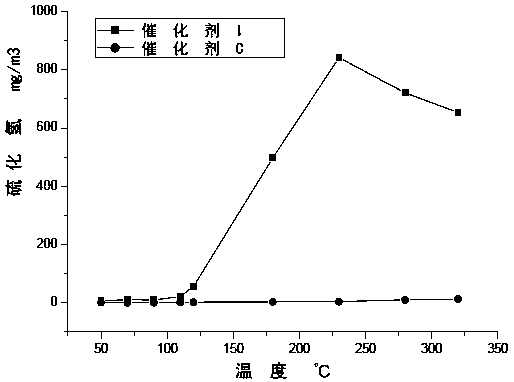
[0058] Weigh 28 g of 2,4-dimercapto-s-triazine diammonium salt and dissolve it in 100 mL of acetone solution to obtain impregnation solution I, and then spray carrier A-2 with impregnation solution I. After spraying, the first low-temperature heat treatment is carried out, and the first low-temperature heat treatment condition is: 80° C. low-temperature heat treatment for 3 hours. Then take 17.1g of molybdenum oxide, 6.1g of basic nickel carbonate, 1.5mL of phosphoric acid, and 60mL of deionized water and boil for an hour to obtain impregnation solution II. Measure the impregnation solution II according to the water absorption rate of 100mL / 100g and spray and impregnate the first low-temperature heat treatment The sample was subjected to a second low-temperature heat treatment. The second low-temperature heat treatment condition was: heat treatment at 120° C. for 5 hours to obtain a hydrodemetallization catalyst...
PUM
| Property | Measurement | Unit |
|---|---|---|
| diameter | aaaaa | aaaaa |
| diameter | aaaaa | aaaaa |
| density | aaaaa | aaaaa |
Abstract
Description
Claims
Application Information
 Login to View More