
Minimum-cost maximum-flow based large-scale resource scheduling system and minimum-cost maximum-flow based large-scale resource scheduling method
A resource scheduling and maximum flow technology, applied in the field of big data resource management, can solve problems such as low resource utilization and job performance degradation, and achieve the effect of reducing the solution time
Patent Information
- Authority / Receiving Office
- CN · China
- Current Assignee / Owner
- Publication Date
- 2017-05-24
- Estimated Expiration
- Not applicable · inactive patent
Smart Images
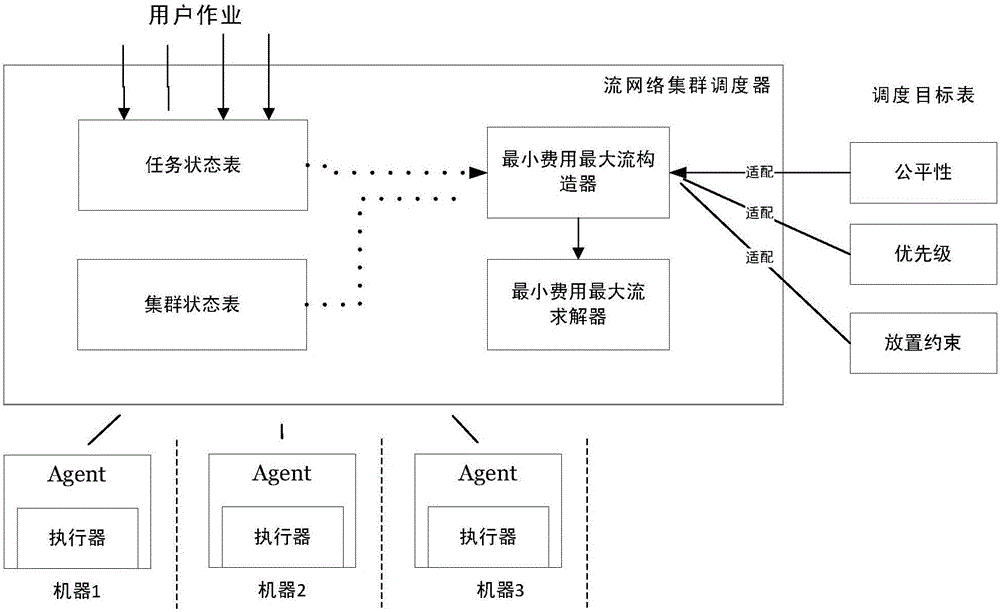
Figure 1 
Figure 2 
Figure 3
Abstract
Description
technical field
[0001] The invention relates to a large-scale resource scheduling system and method based on minimum cost and maximum flow, which belongs to the field of big data resource management, especially resource scheduling problems in large-scale environments. Background technique
[0002] With the rapid development of technologies such as the Internet (Internet) and the Internet of Things (IoT), data (Data) has begun to transform from simple processing objects to basic services, and multiple jobs (Job) are submitted at the same time and decomposed into parallel execution tasks (Task). , running processing on physical servers with a scale of at least 10,000 has become a mainstream application mode, which is called the "concurrent job" problem. For example, Github needs to process more than 20 million jobs every year, and Facebook responds to nearly 10,000 job requests every day.
[0003] Large-scale resource scheduling refers to the decision-making process of optima...
Examples
Embodiment Construction
[0035] In order to make the present invention easier to understand, the present invention will be further described in conjunction with an example, but this example does not constitute any limitation to the present invention.
[0036] as attached figure 1 , The technical solution of the present invention: a large-scale resource scheduling system based on minimum cost and maximum flow, including a task state table, a cluster state table, a scheduling target table, a minimum cost maximum flow constructor, a minimum cost maximum flow solver, and a task executor. in:
[0037] The task status table receives and saves the task status submitted by the user, including the CPU usage, memory usage, network I / O, disk I / O, and priority of the task;
[0038] The cluster status table stores cluster status information, including cluster CPU usage, memory usage, network and disk I / O, and updates the cluster status table when the cluster status changes;
[0039] Scheduling target table: stor...