Method and device for generating an excitation signal for a chemical process

An excitation signal and chemical process technology, applied in general control systems, instruments, adaptive control, etc., can solve problems such as lack of design tracking and evaluation, complex calculations, and inability to guarantee application effects, so as to reduce repeated testing and test time, Simplified algorithm, good incentive effect

CN106773676BActive Publication Date: 2019-12-24ZHEJIANG SUPCON SOFTWARE +1
5 Cites 0 Cited by

Patent Information

Authority / Receiving Office
CN · China
Patent Type
Patents(China)
Current Assignee / Owner
Publication Date
2019-12-24

Smart Images

  • Figure 1
    Figure 1
  • Figure 2
    Figure 2
  • Figure 3
    Figure 3
Patent Text Reader

Abstract

The present invention provides a method and device for generation of excitation signals for chemical process, belonging to the automation control field. The method comprises: obtaining the type of a control loop, determining a step signal parameter, and combining the step signal parameter to generate initial excitation signals; inputting the initial excitation signals into the control loop, and collecting process data in the operation process of the control loop; and extracting amplitude information in the process data, determining an area specific value, comparing the area specific value with a preset threshold value, performing regulation of the initial excitation signals according to a comparison result, and determining the regulated excitation signals. The method and device for generation of excitation signals for the chemical process can perform real-time regulation of excitation signals according to the output result in the whole regulation process to realize tracking regulation through combination of the output result and only use the type of the loop and the safe range to design reasonable step excitation signals and obtain a good excitation effect so as to reduce the repeated test and the test time to the utmost extent and simplify the algorithm.
Need to check novelty before this filing date? Find Prior Art

Description

technical field

[0001] The invention belongs to the field of automatic control, in particular to a method and a device for generating excitation signals used in chemical processes. Background technique

[0002] At present, the control algorithms of industrial processes are mainly PID control and predictive control. The implementation and maintenance of both PID controller and predictive controller are inseparable from model identification, and model identification is inseparable from the input and output data of the process. In order to obtain input and output data that reflect the true characteristics of the process, the process must be stimulated. The quality of the excitation signal design directly affects the accuracy of the final model identification.

[0003] Commonly used excitation signals that satisfy this property include filtered white noise signals, superimposed sine (cosine) wave signals, binary pseudo-random signals (PRBS), step signals, etc. The existing ex...

Examples

Embodiment 1

[0071] The embodiment of the present invention provides a method for generating an excitation signal for a chemical process. The method first designs a step signal composed of default parameters according to the control loop type, and inputs the step signal into the control loop as an initial excitation signal. In the process, the initial excitation signal is continuously adjusted according to the parameters during the operation of the control loop until a more accurate process model can be identified from the process data of the control loop, and the adjustment process of the control loop is completed.

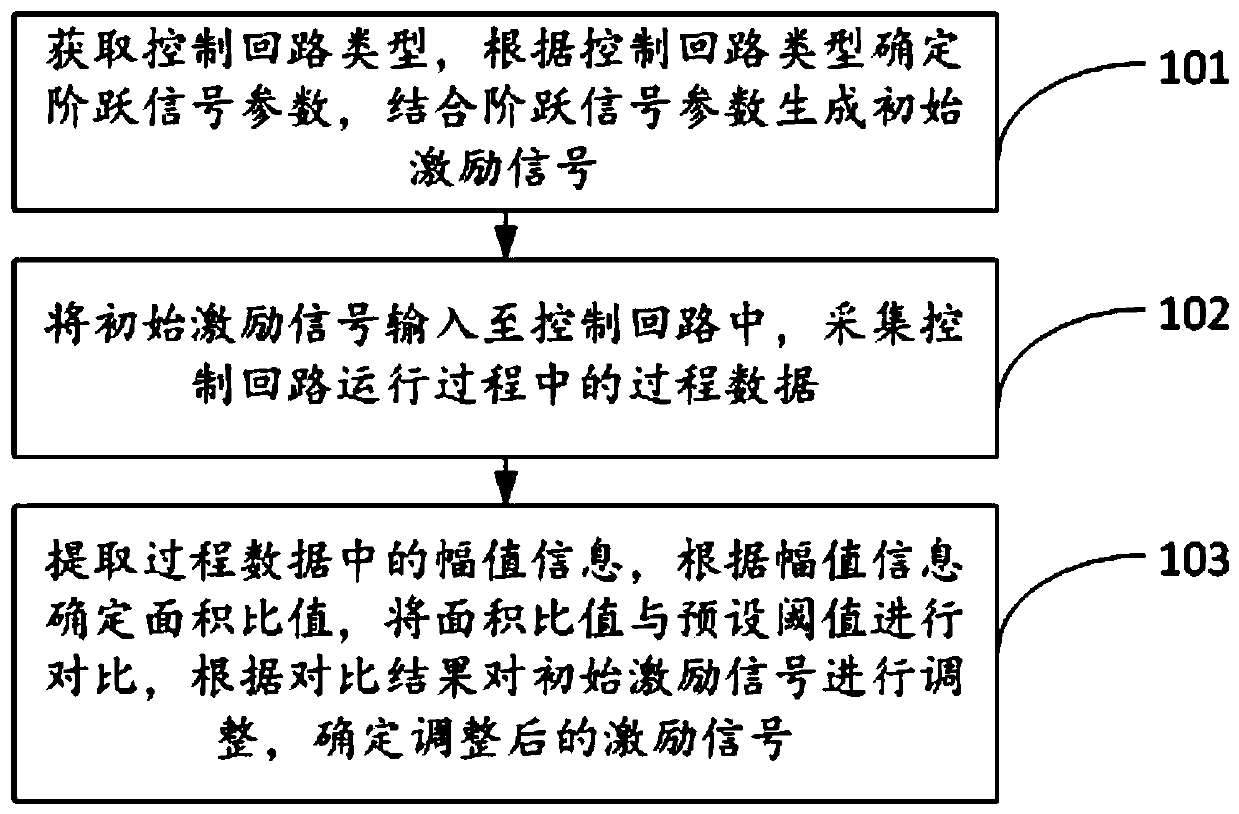
[0072] Such as figure 1 As shown, the method for generating an excitation signal for a chemical process specifically includes:

[0073] 101. Obtain the control loop type, determine the step signal parameters according to the control loop type, and generate an initial excitation signal in combination with the step signal parameters;

[0074] 102. Input the initial excitation ...