Method, device and system for service-based network slice selection
A business and network technology, applied in the field of communication, can solve the problem of not being able to choose different network shards, and achieve the effect of perfect technical solution and simple realization
- Summary
- Abstract
- Description
- Claims
- Application Information
AI Technical Summary
Problems solved by technology
Method used
Image

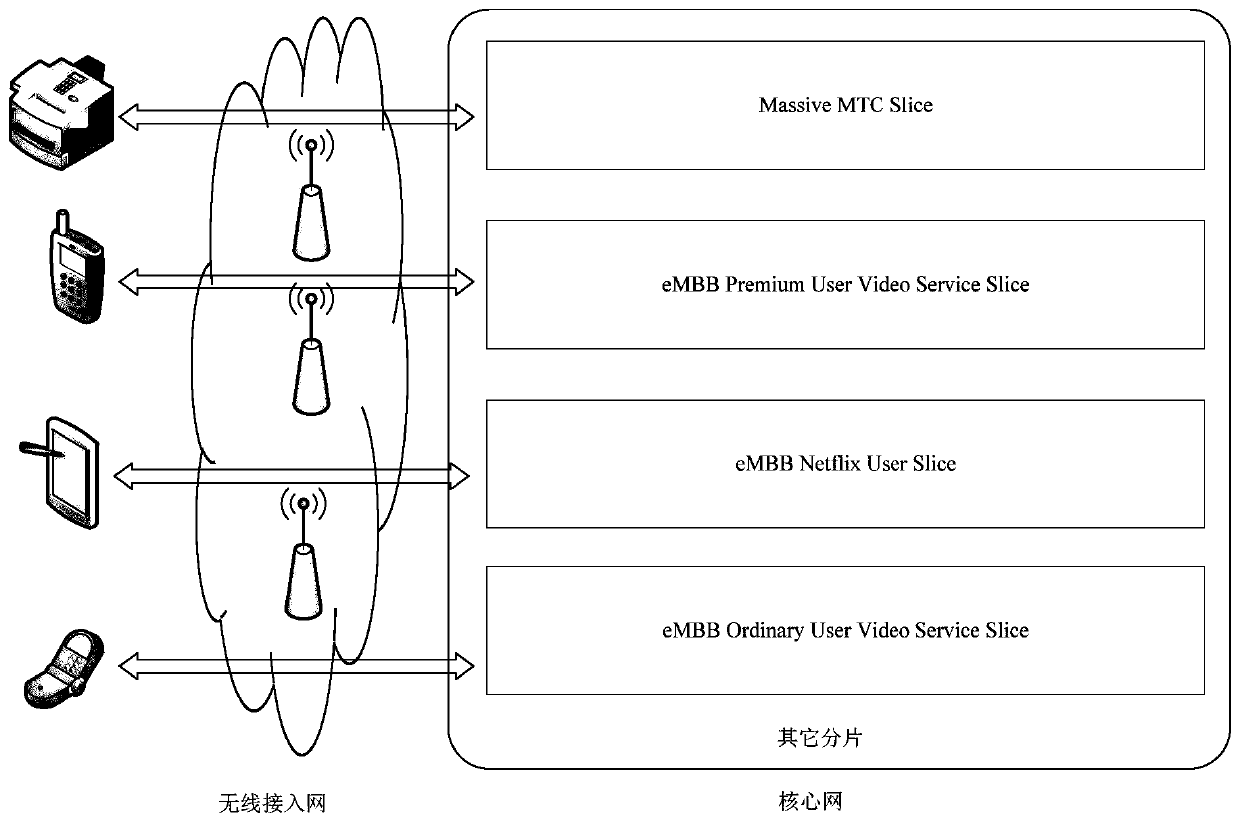


Examples
Embodiment 1
[0103] Embodiment 1: the selection process of the network control function entity whose terminal type is eMBB
[0104] Step 1. The eMBB terminal initiates the access process, and the UE access message carries the UE terminal type as eMBB or the core network control plane identifier eMBB_ID specified by the network side.
[0105] Step 2. Based on the information carried in the access message, the core network control entity selection function entity selects a network control function entity of the eMBB network for the terminal according to the mapping list configured by the network operator.
[0106] Step 3. The access message is forwarded to the network control functional entity that selects the eMBB.
[0107] Step 4. The eMBB network control function entity sends an authentication and authentication message to the HSS, including confirmation of the user's terminal type, identity and other information.
[0108] Step 5. The eMBB assigns default network slices and IP addresses ...
Embodiment 2
[0110] Embodiment 2: Triggered by the eMBB user side, initiated by the network, and selected for network fragmentation of the Video Call service (not a service provided by a third-party service provider)
[0111] Step 1. The UE initiates an IMS-based Video Call service request, and sends an application layer signaling message based on the default network slice. The request carries UE terminal type information and application service type information, and the information is sent by the P-CSCF of the IMS. intercepted.
[0112] Step 2. P-CSCF sends session-related information to the policy and pricing functional entity, including terminal type eMBB, and QoS parameters required by the service, including specific QoS indicators such as packet loss rate 0.0001, delay 150ms, and GBR 0.5Mbps.
[0113] Step 3, the policy and pricing functional entity requests the HSS to obtain the user's subscription information.
[0114] Step 4. The policy and pricing functional entity formulates QoS...
Embodiment 3
[0119] Embodiment 3: User-triggered, user-initiated user video-on-demand (VoD) service network segment selection (service provided by a third-party service provider)
[0120] Step 1. A user wants to access Netflix's VoD service, and sends a service request message to the AF through the default network slice. The request carries UE terminal type information and application service type information, and the information is received by the AF.
[0121] Step 2. The AF sends service-related information to the policy and pricing functional entity of the core network based on the application information, including information about the terminal type eMBB, the application, and its service provider Netflix.
[0122] Step 3. The policy and pricing functional entity requests the HSS to obtain the user's subscription information, and determines that there is a payment agreement between Netflix and the operator.
[0123] Step 4. Apply the service-related QoS indicators requested by the user...
PUM
 Login to View More
 Abstract
Description
Claims
Application Information
 Login to View More