
Method for tracking target object
A target and object technology, applied in the field of tracking, can solve problems such as simple algorithms, features being affected by the background, and complex TLD calculations, and achieve the effect of strong practicability and full-automatic tracking
- Summary
- Abstract
- Description
- Claims
- Application Information
AI Technical Summary
Problems solved by technology
Method used
Image



Examples
Embodiment 1
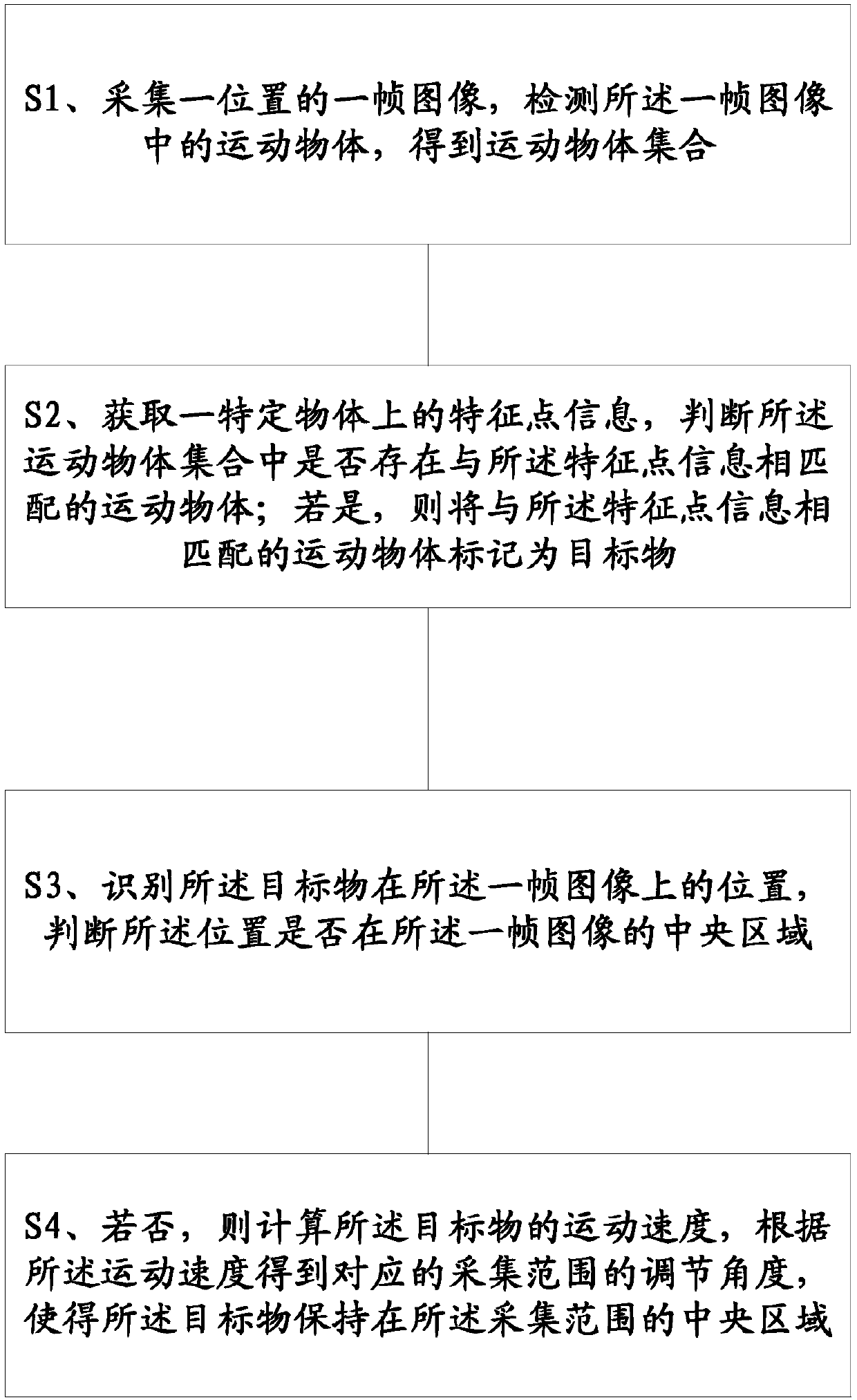
[0046] Please refer to figure 1 , Embodiment 1 of the present invention is:
[0047] A method for tracking a target, comprising the following steps:
[0048] S1. Pre-acquisition of multiple frames of images at one position, performing average calculation on the gray value of the same pixel in each frame of images, and calculating the first image, which is marked as a background image. This embodiment collects 20 frame image;
[0049] Collecting a frame of images at the one position, detecting moving objects in the one frame of images, and obtaining a set of moving objects;
[0050] Comparing the one-frame image with the background image, judging whether there is an object in the one-frame image that does not exist in the background image, and if so, the object is a moving object;
[0051] judging whether there is the same object whose vector displacement difference between the one frame image and the background image is greater than the first preset value, if so, judging th...
PUM
 Login to View More
 Abstract
Description
Claims
Application Information
 Login to View More