Cultivation method of cotton embryogenic callus and embryoid body
What is AI technical title?
AI technical title is built by PatSnap AI team. It summarizes the technical point description of the patent document.
A technology of embryogenic callus and culture method, which is applied in the field of biotechnology tissue culture, and can solve the problems of increasing the burden on the temperature control system
Active Publication Date: 2021-08-20
INST OF COTTON RES CHINESE ACAD OF AGRI SCI
View PDF2 Cites 0 Cited by
Summary
Abstract
Description
Claims
Application Information
AI Technical Summary
This helps you quickly interpret patents by identifying the three key elements:
Problems solved by technology
Method used
Benefits of technology
Problems solved by technology
[0004] Plant tissue culture requires a controllable light source. The traditional light source is mainly a fluorescent lamp, and most of the energy will be converted into heat energy, which increases the burden on the temperature control system; while the LED light source is a cold light source, which can supplement the light at a short distance, and the light energy utilization efficiency is as high as 80. %-90%
Method used
the structure of the environmentally friendly knitted fabric provided by the present invention; figure 2 Flow chart of the yarn wrapping machine for environmentally friendly knitted fabrics and storage devices; image 3 Is the parameter map of the yarn covering machine
View more
Image
Smart Image Click on the blue labels to locate them in the text.
Viewing Examples
Smart Image
Click on the blue label to locate the original text in one second.
Reading with bidirectional positioning of images and text.
Smart Image
Examples
Experimental program
Comparison scheme
Effect test
Embodiment 1
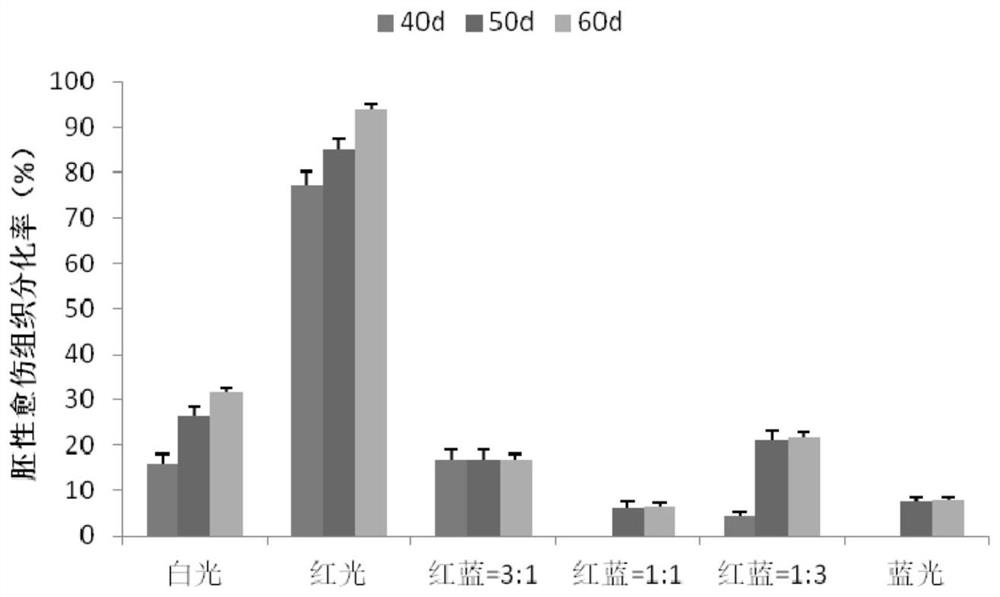
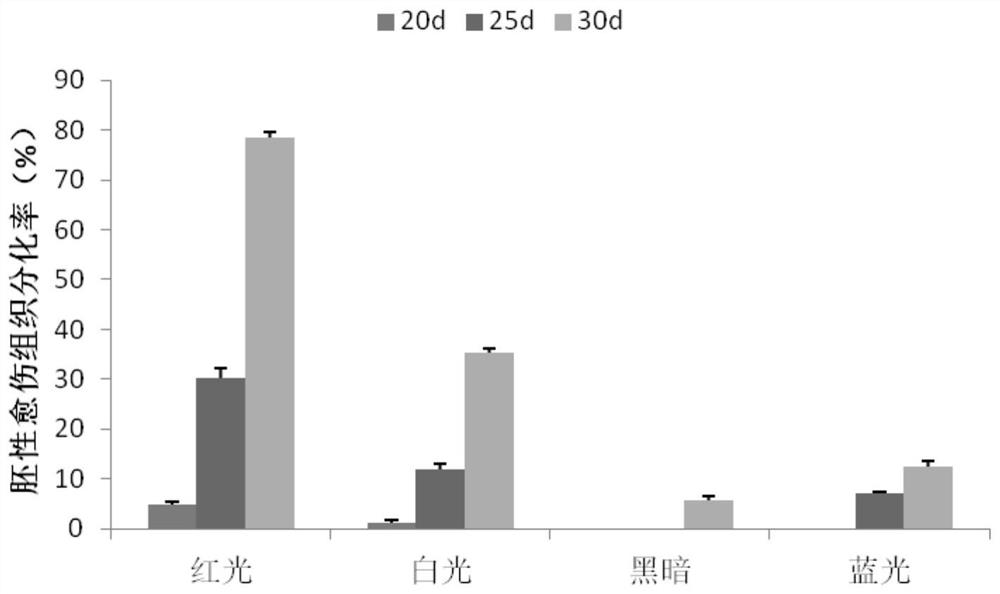
[0028] Example 1. Light quality can regulate the differentiation of cotton embryogenic callus
[0029] Materials used: China Cotton Institute 24
[0030] 1. Preparation of explants
[0031] Choose the seed of cotton delinting, put it into 0.1% (mass percentage) HgCl 2 Soak in aqueous solution for 4 to 5 minutes to sterilize, then rinse with sterilized distilled water 5 times to completely remove residual HgCl 2 , to obtain sterilized seeds; the sterilized seeds are placed in sterile seedling medium (MS medium) to cultivate, to obtain cotton sterile seedlings;
[0032] 2. Differentiation of embryogenic callus
[0033] 1. Comparison with white light
[0034] Get the hypocotyls of the 7 days (starting to calculate from the seed insertion culture medium) that step one obtains aseptic cotton seedlings, cut it into 0.5cm long cutting sections, then insert the cutting sections obtained into No. 2 callus induction After submerged in the culture medium, connect 5-6 sections in eac...
Embodiment 2
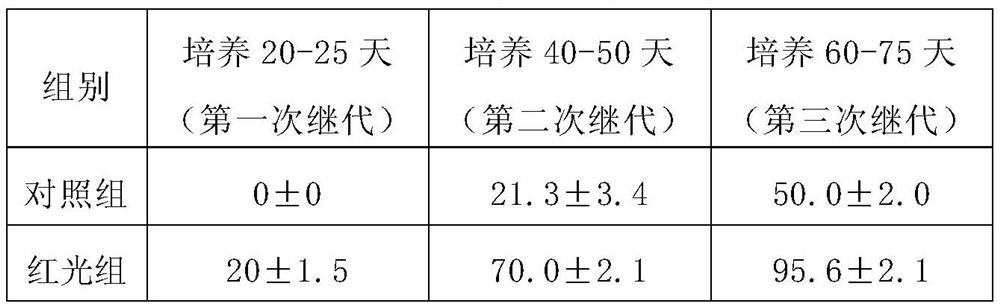
[0055] Example 2, light quality can regulate the differentiation and seedling formation of cotton embryoid bodies
[0056] 1. Differentiation of embryoid bodies
[0057] Select the embryogenic callus with substantially the same texture obtained in Example 1 and place it in MSB medium (this medium is made up of solvent and solute, solvent is water, solute and its concentration are respectively IAA 0.025mg / L, KT 0.01mg / L, sucrose 30g / L, Gelrite 2g / L, pH 6.2, add 50mg to each culture medium, inoculate evenly with a distance of about 5-8mm; Two groups, each with three culture media, were then cultured under different light qualities, and the rest of the culture conditions were the same, with a temperature of 25±2°C and a humidity of 65%. The experiment was repeated three times. Subculture once every 20-25 days, generally Generation 2-3 times. Subculture conditions are: when the embryogenic callus presents bright yellow, granular (when the culture time is about 20-30 days), it ne...
the structure of the environmentally friendly knitted fabric provided by the present invention; figure 2 Flow chart of the yarn wrapping machine for environmentally friendly knitted fabrics and storage devices; image 3 Is the parameter map of the yarn covering machine
Login to View More
PUM
Login to View More
Abstract
The invention discloses a method for cultivating cotton embryogenic callus and embryoid bodies. The method for cultivating cotton embryogenic callus disclosed by the invention comprises: cultivating cotton explants under red light to obtain cotton callus; the callus is embryogenic callus; the light quantum flux density of red light 40‑65μmol / m 2 .s; The medium used is composed of solvent and solute, the solvent is water, the solute and the concentration in the medium are IAA 0.02mg / L, KT 0.06mg / L, sucrose 30g / L, Gelrite 2g / L, MgCl 2 0.5g / L, pH 5.8. The method of the invention can precisely regulate each period of cotton, can greatly improve the differentiation efficiency of each period, shorten the differentiation cycle, greatly improve the efficiency of the cotton regeneration system, and improve the transformation efficiency for the cotton genetic transformation method.
Description
technical field [0001] The invention relates to a method for cultivating cotton embryogenic callus and embryoid bodies in the field of biotechnology tissue culture. Background technique [0002] An efficient cotton regeneration system is crucial for cotton genetic transformation and biotechnology research. In the cotton regeneration system, the differentiation of embryogenic callus and normal embryoid body development are the two main bottlenecks in its regeneration. In the current culture system , The differentiation of embryogenic callus takes a long time, usually more than 2 months; and the state of embryogenic callus is not uniform, and the difference in size and color is relatively large. The problem in the embryoid body development stage is that it takes a long time to differentiate the embryoid body, and it usually takes more than 3 months to subculture before the embryoid body differentiation reaches 50%. There are many deformed embryos, and the common deformed embry...
Claims
the structure of the environmentally friendly knitted fabric provided by the present invention; figure 2 Flow chart of the yarn wrapping machine for environmentally friendly knitted fabrics and storage devices; image 3 Is the parameter map of the yarn covering machine
Login to View More
Application Information
Patent Timeline
Application Date:The date an application was filed.
Publication Date:The date a patent or application was officially published.
First Publication Date:The earliest publication date of a patent with the same application number.
Issue Date:Publication date of the patent grant document.
PCT Entry Date:The Entry date of PCT National Phase.
Estimated Expiry Date:The statutory expiry date of a patent right according to the Patent Law, and it is the longest term of protection that the patent right can achieve without the termination of the patent right due to other reasons(Term extension factor has been taken into account ).
Invalid Date:Actual expiry date is based on effective date or publication date of legal transaction data of invalid patent.



 Login to View More
  Login to View More