signal processing device
A signal processing device and signal technology, applied in the direction of speaker distribution signal, electrical components, frequency response correction, etc., to achieve the effect of reducing inappropriate phenomena
- Summary
- Abstract
- Description
- Claims
- Application Information
AI Technical Summary
Problems solved by technology
Method used
Image

Examples
Embodiment approach 1
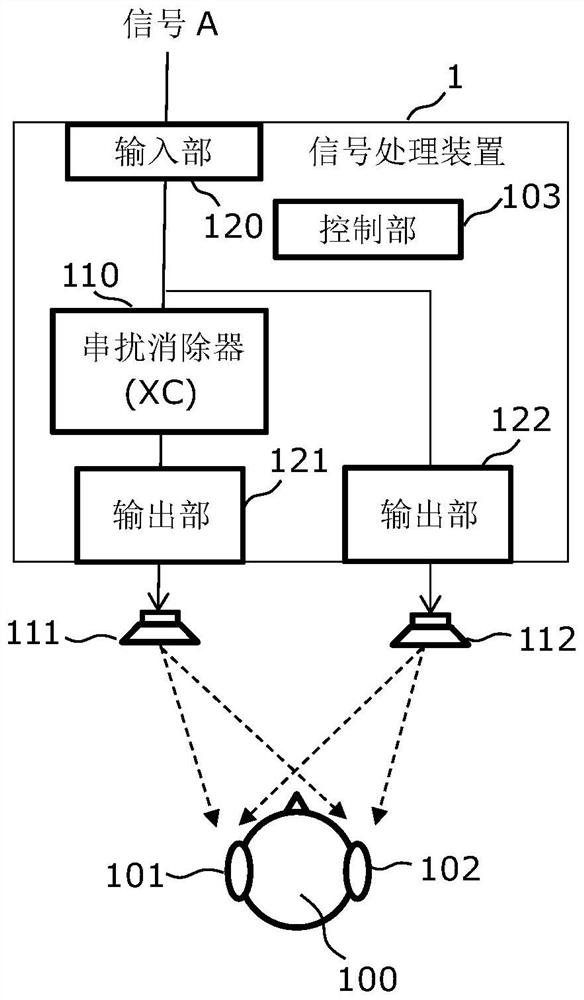
[0065] figure 1 A configuration example of the signal processing device 1 in this embodiment, a speaker, and a listener 100 are shown. In this figure, the signal processing device 1 includes a control unit 103 , a crosstalk canceller 110 , an input unit 120 , an output unit 121 , and an output unit 122 . The signal processing device 1 processes the audio signal input from the input unit 120 by using the crosstalk canceller 110 or the like under the control of the control unit 103 , and outputs the output sound for output from the left speaker 111 from the output unit 121 . The signal is an output audio signal for output from the right speaker 112 from the output unit 122 , and both the speaker 111 and the speaker 112 are located outside the signal processing device 1 .
[0066] Here, the control unit 103 controls the crosstalk canceller 110, the output unit 121, and the output unit 122 so that the sound signal A to be reproduced is input, and only the sound reaches the left e...
Embodiment approach 2
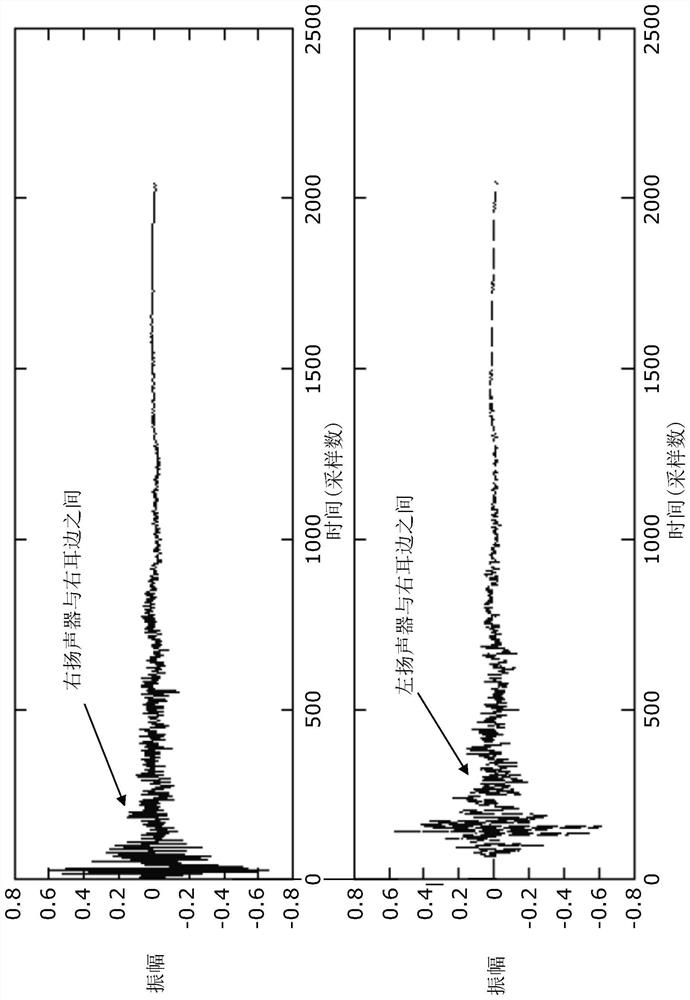
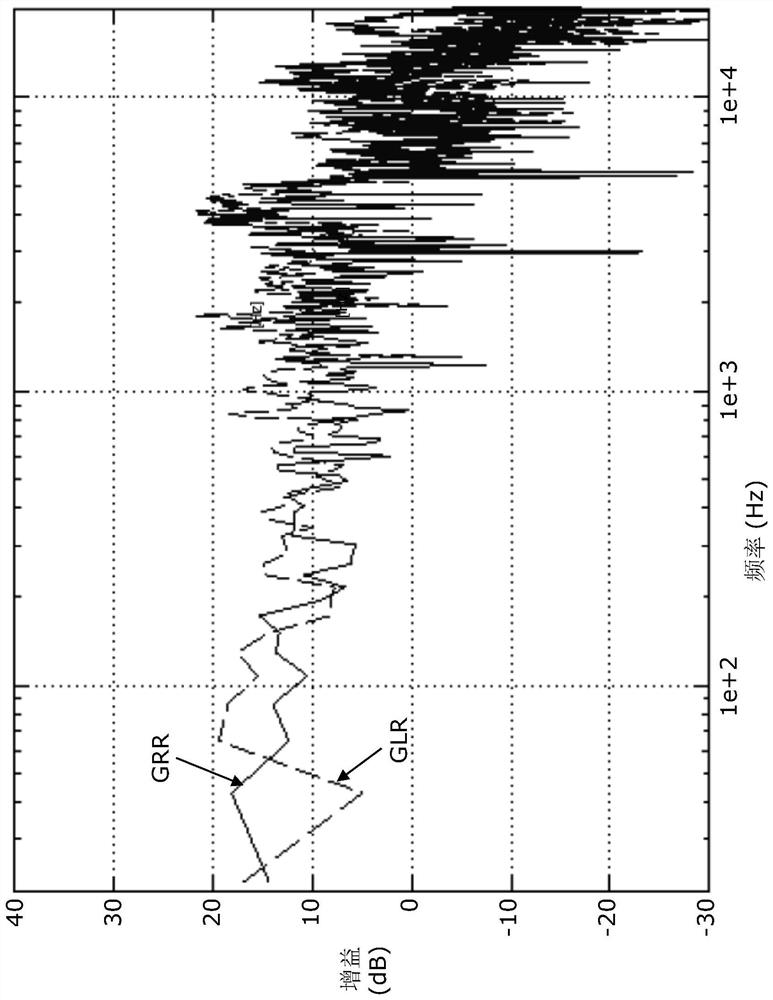
[0086] As in Embodiment 1 Figure 2C As shown, in the acoustic characteristics actually measured, not only |GRR||GLR| are included.
[0087] In this case, if figure 1 It can be seen that the gain |XC| of the crosstalk canceller 110 becomes greater than 1 at frequencies satisfying |GRR|>|GLR| by (Equation 5).
[0088] XC=-GRR / GLR...(Formula 5)
[0089] exist Figure 2C In the frequency band above 5 kHz, although there are many frequencies where |XC|>1 is included, this is because the corresponding frequency is |GRR|>|GLR|.
[0090] Therefore, by Figure 3A The composition shown, to achieve the most appropriate control. Figure 3A A configuration example of the signal processing device 3 in Embodiment 2, speakers 111 and 112 and a listener 100 are shown. exist Figure 3A Among them, the respective input signals of speakers 111 and 112 are processed by crosstalk cancellers 201 and 202 . Let the transfer functions of the crosstalk cancellers 201 and 202 be XCL and XCR, res...
Embodiment approach 3
[0109] The control device described so far is used to process the input signal with the designed crosstalk canceller, and reproduce and control it through the speaker. It is also effective to use the device and reproduce the processed signal according to the reproduction needs.
[0110] Figure 7 Its block diagram is shown. Figure 7 A configuration example of the signal processing device 7 in Embodiment 3, speakers 111 and 112 , and a listener 100 are shown. The audio signal A is signal-processed by the crosstalk cancellers 201 (XCL) and 202 (XCR) designed by the method described above, and is recorded in the recording device 701 as an output signal. The output signal recorded on the recording device 701 is read from the recording device 701 at a predetermined timing, and reproduced by the left speaker 111 and the right speaker 112 . The playback timing can be set using, for example, an event such as a user operation or a time stamp as a trigger.
[0111] Here, the genera...
PUM
 Login to View More
 Abstract
Description
Claims
Application Information
 Login to View More
 - R&D
- Intellectual Property
- Life Sciences
- Materials
- Tech Scout
- Unparalleled Data Quality
- Higher Quality Content
- 60% Fewer Hallucinations
Browse by: Latest US Patents, China's latest patents, Technical Efficacy Thesaurus, Application Domain, Technology Topic, Popular Technical Reports.
© 2025 PatSnap. All rights reserved.Legal|Privacy policy|Modern Slavery Act Transparency Statement|Sitemap|About US| Contact US: help@patsnap.com