
Emergency stop warning device for sedan cars
A technology of emergency parking and warning devices, which is applied to portable emergency signal devices, signal devices, vehicle components, etc., and can solve problems such as inability to significantly shorten time, high risk, and misoperation
- Summary
- Abstract
- Description
- Claims
- Application Information
AI Technical Summary
Problems solved by technology
Method used
Image

Examples
Embodiment 1
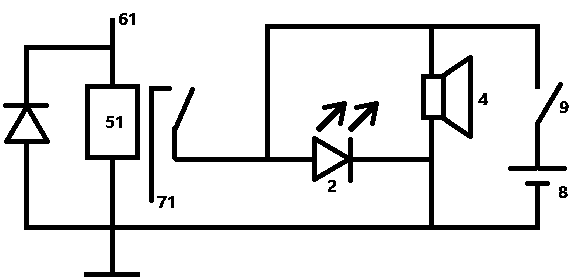
[0022] The lamps and lanterns of most of automobiles double as control line with power line, double flashing lights flicker is realized by intermittent power supply. The present embodiment is aimed at this kind of vehicle. The warning component includes a display component 2 and a horn 4 . The display part 2 is made of LED (Light Emitting Diode), and is fixed on the inner surface of the flat top portion of the trunk lid 3 by means of glue, screws or rivets. In the figure, for the sake of clarity, the display part 2 is drawn far away from the case cover 3, but they are actually close together. Loudspeaker 4 is installed in case cover corner. When the case cover 3 was opened, the display part 2 and the loudspeaker 4 were all naturally backward. The parts of the complete system except the display part 2 and the loudspeaker 4 are all accommodated in the electrical box 1, and the electrical box 1 is also contained in the trunk. Relay 51 is as control part, and its coil 61 is co...
Embodiment 2
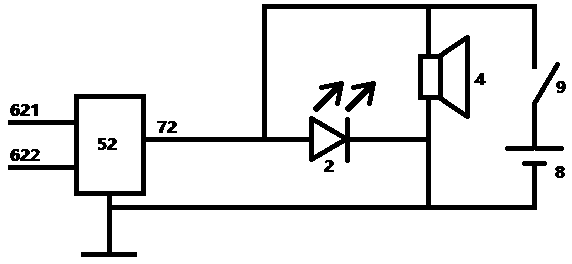
[0025] This embodiment is basically the same as Embodiment 1, the difference is that: the monostable trigger 52 is used as the control component, its enable end 621 is connected with the trunk lock switch state line, the trigger input end 622 is connected with the double flashing power line, and The output terminal 72 is connected with the display part 2 and the speaker 4 . The transient state duration of the monostable flip-flop 52 is slightly longer than the period of the double flash. The monoflop 52 is enabled when the trunk is opened. If the double flash is also turned on at this time, the output terminal 72 will make the display part 2 and the speaker 4 work. Compared with the first embodiment, the display unit 2 and the horn 4 are continuously working in this example, which is conducive to sending clearer and more legible warnings.
Embodiment 3
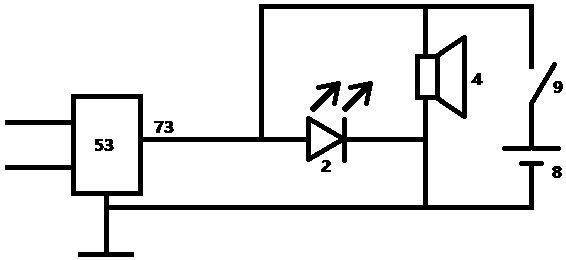
[0027] The lights of some automobiles have dedicated control lines, and this embodiment is aimed at such vehicles. Basically the same as Embodiment 1, the difference is that there is no loudspeaker, and the single-chip microcomputer 53 is used as the control unit, and its two input terminals are connected with the trunk light control line and the double flash control line respectively, while the output terminal 73 is connected with the display unit 2. When the trunk is opened and the double flash is also opened, the single-chip microcomputer 53 can make the display part 2 work. In addition, the display part 2 includes two triangles on the left and right and a horizontal line in the middle.
PUM
 Login to View More
 Abstract
Description
Claims
Application Information
 Login to View More