Method and system for detecting adjacent splicing mirrors
What is AI technical title?
AI technical title is built by Patsnap AI team. It summarizes the technical point description of the patent document.
A detection method and prism technology, which is applied in the field of optics, can solve the problems of difficult splicing and alignment of splicing mirrors, and achieve the effects of convenient disassembly and maintenance, strong feasibility, and simple structure
Active Publication Date: 2021-05-18
CHANGCHUN INST OF OPTICS FINE MECHANICS & PHYSICS CHINESE ACAD OF SCI
View PDF11 Cites 0 Cited by
Summary
Abstract
Description
Claims
Application Information
AI Technical Summary
This helps you quickly interpret patents by identifying the three key elements:
Problems solved by technology
Method used
Benefits of technology
Problems solved by technology
[0005] Embodiments of the present invention provide a method and system for detecting adjacent splicing mirrors, so as to at least solve the technical problem of difficult splicing alignment of existing splicing mirrors
Method used
the structure of the environmentally friendly knitted fabric provided by the present invention; figure 2 Flow chart of the yarn wrapping machine for environmentally friendly knitted fabrics and storage devices; image 3 Is the parameter map of the yarn covering machine
View more
Image
Smart Image Click on the blue labels to locate them in the text.
Viewing Examples
Smart Image
Click on the blue label to locate the original text in one second.
Reading with bidirectional positioning of images and text.
Smart Image
Examples
Experimental program
Comparison scheme
Effect test
Embodiment 1
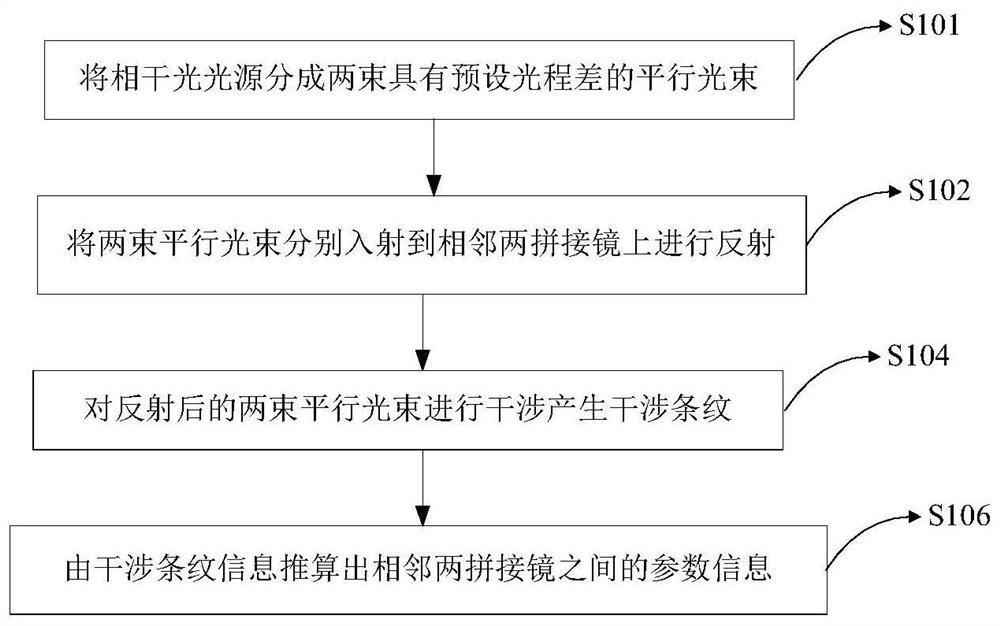
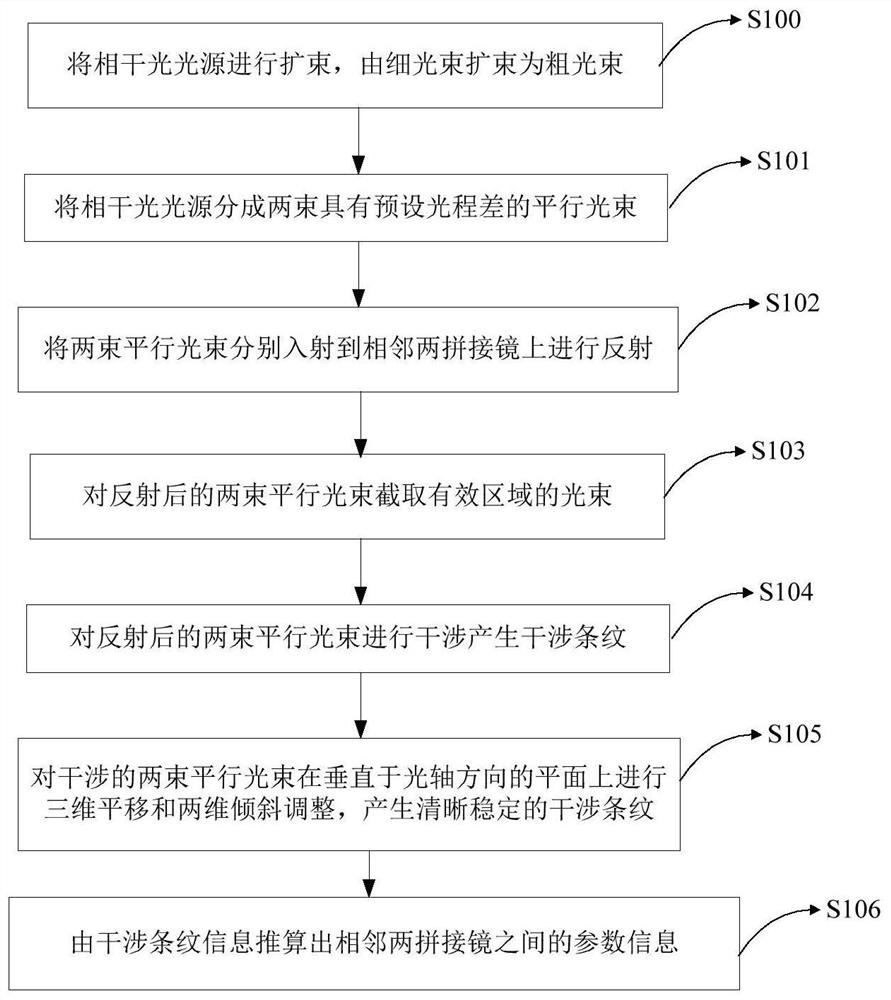
[0041] According to an embodiment of the present invention, a method for detecting adjacent spliced mirrors is provided, which is suitable for confocal / co-phase spliced mirrors, see figure 1 , including the following steps:
[0042] S101: Divide the coherent light source into two parallel beams with a preset optical path difference;
[0043] S102: two beams of parallel light beams are respectively incident on two adjacent splicing mirrors for reflection;
[0044] S104: Interfering the reflected two beams of parallel light beams to generate interference fringes;
[0045] S106: Deduce the parameter information between two adjacent splicing mirrors from the interference fringe information.
[0046] In the method for detecting adjacent splicing mirrors in the embodiment of the present invention, the parameter information between two adjacent splicing mirrors is calculated from the interference fringe information, and the parameter information between two adjacent splicing mi...
Embodiment 2
[0055] According to another embodiment of the present invention, see Figure 4 , provides an adjacent stitching mirror detection system, comprising:
[0056] Laser 1, used to generate a coherent light source;
[0057] The beam splitter is used to split the coherent light source into two parallel beams with a preset optical path difference and incident them on two adjacent splicing mirrors for reflection;
[0058] The beam interferometer is used to interfere the reflected two beams of parallel beams to generate interference fringes;
[0059] The parameter calculation unit is used to calculate the parameter information between two adjacent splicing mirrors from the interference fringe information.
[0060] As a preferred technical solution, the beam splitter includes: a right-angled triangular prism 3, a parallelogram prism 5, the right-angled triangular prism 3 is glued to the parallelogram prism 5 whose angle is complementary to it, and the glued layer 4 realizes semi-transm...
the structure of the environmentally friendly knitted fabric provided by the present invention; figure 2 Flow chart of the yarn wrapping machine for environmentally friendly knitted fabrics and storage devices; image 3 Is the parameter map of the yarn covering machine
Login to View More
PUM
Login to View More
Abstract
The present invention relates to the field of optics, in particular to a method and system for detecting adjacent splicing mirrors. In the method and system, a coherent light source is divided into two parallel beams with a preset optical path difference; Reflection is performed on two adjacent splicing mirrors; interference fringes are generated by interfering the reflected two parallel beams; parameter information between two adjacent splicing mirrors is calculated from the information of the interference fringes. Compared with the existing edge sensor detection method, the present invention has higher precision, is convenient for disassembly and maintenance and is not affected by factors such as ambient temperature, humidity, dust, etc., and is easy to operate during the assembly and adjustment process, solving the problem of the traditional edge sensor. Difficulties affected by environmental temperature, humidity, dust and other factors are suitable for splicing telescope mirrors that require high-precision confocal conphase alignment. It has a simple structure, strong feasibility, convenient installation, and has the function of unit integration.
Description
technical field [0001] The invention relates to the field of optics, in particular to a method and system for detecting adjacent splicing mirrors. Background technique [0002] In the application of deep space exploration, in order to observe more distant and fainter targets, the aperture of the telescope needs to be continuously upgraded. However, due to factors such as processing and manufacturing, design risks, transportation and adjustment, the aperture of the telescope cannot be infinitely increased. At present, the diameter of the largest single telescope in the world is about 8.4m. The optical system of a telescope with a larger diameter can only be realized by splicing sub-mirrors. For example, telescopes such as Keck and HET that have been built and TMT, E-ELT, and JWST that are currently under construction are all in the form of spliced mirrors. [0003] The main feature of the spliced mirrors of the spliced telescope is that each spliced mirror has three ...
Claims
the structure of the environmentally friendly knitted fabric provided by the present invention; figure 2 Flow chart of the yarn wrapping machine for environmentally friendly knitted fabrics and storage devices; image 3 Is the parameter map of the yarn covering machine
Login to View More
Application Information
Patent Timeline
Application Date:The date an application was filed.
Publication Date:The date a patent or application was officially published.
First Publication Date:The earliest publication date of a patent with the same application number.
Issue Date:Publication date of the patent grant document.
PCT Entry Date:The Entry date of PCT National Phase.
Estimated Expiry Date:The statutory expiry date of a patent right according to the Patent Law, and it is the longest term of protection that the patent right can achieve without the termination of the patent right due to other reasons(Term extension factor has been taken into account ).
Invalid Date:Actual expiry date is based on effective date or publication date of legal transaction data of invalid patent.
Login to View More
Patent Type & AuthorityPatents(China)
IPC IPC(8): G01B11/24
CPCG01B11/2441
Inventor安其昌曹海峰杨飞张景旭
OwnerCHANGCHUN INST OF OPTICS FINE MECHANICS & PHYSICS CHINESE ACAD OF SCI


 Login to View More
  Login to View More