
Method for controlling a rear axle steering system of a motor vehicle
A technology for motor vehicles and rear axles, which is applied to steering mechanisms, steering rods, and automatic steering control components. It can solve problems such as loss of control and inward deflection of motor vehicles, and achieve steering movement prevention, increased driving safety, and improved driving performance. safety effect
- Summary
- Abstract
- Description
- Claims
- Application Information
AI Technical Summary
Problems solved by technology
Method used
Image

Examples
Embodiment Construction
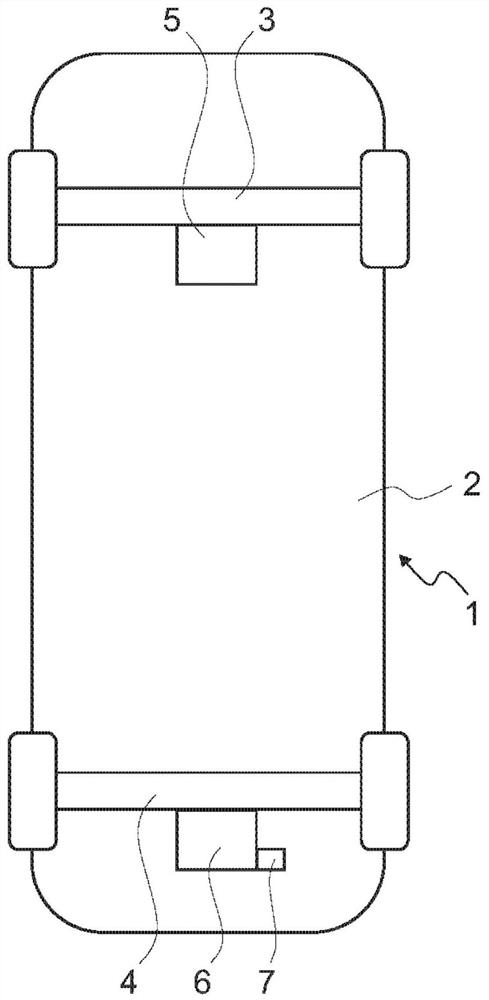
[0021] figure 1 A motor vehicle 1 is shown very schematically, which has a body 2 , a front axle 3 and a rear axle 4 in a known manner. In this case both the front axle 3 and the rear axle 4 are steering axles. The manner and method of how the front axle 3 and the rear axle 4 turn will not be described in detail here. However, a corresponding steering system is also shown very schematically, which is assigned to the front axle 3 or the rear axle 4 and with which the front axle 3 and the rear axle 4 are steered. The steering system of the front axle 3 is referred to here as the front axle steering system 5 and the steering system of the rear axle 4 as the rear axle steering system 6 . The front-axle steering system 5 is here in principle independent of the rear-axle steering system 6 , but it is also possible to establish a specific correlation, which is not mechanical but electronic.
[0022] The rear axle steering system 6 has a steering angle adjusting device 7 , which ba...
PUM
 Login to View More
 Abstract
Description
Claims
Application Information
 Login to View More