
Drainage device capable of regulating drainage area
An adjustable and regional technology, applied in suction devices, hypodermic injection devices, extraction and pumping systems, etc., can solve the problems of organ damage, limited adsorption range, poor drainage effect, etc., and achieve low cost and high economic benefits. Effect
- Summary
- Abstract
- Description
- Claims
- Application Information
AI Technical Summary
Problems solved by technology
Method used
Image

Examples
Embodiment 1
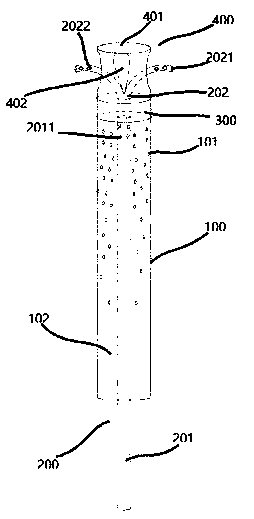
[0057] Please refer to figure 1 , 2 In this embodiment, the adjusting tube 401 at least includes:
[0058] Side wall; and
[0059] Blind end 4013, both ends of the blind end 4013 are fixedly connected with the side wall, and the bottom surface of the blind end 4013 is fixedly connected with an adjusting member 402.
[0060] At the same time, it should be noted that the user can increase / decrease the number of branches according to the number of bifurcated ends, so as to effectively make the bifurcated ends pass through the space formed between the respective branches, so that the bifurcated ends are in different areas , So as to carry out negative pressure drainage to different areas.
Embodiment 2
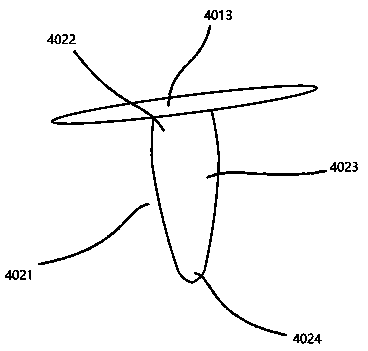
[0062] Please refer to figure 1 , 2 In this embodiment, the adjusting component 402 is an adjusting block 4021, and the top end of the adjusting block 4021 is fixedly connected to the bottom surface of the blind end 4013.
[0063] The adjusting block 4021 is divided into a top section 4022, a middle section 4023, and a bottom section 4024 from top to bottom; the bottom section 4024 has a smaller cross-sectional diameter than the middle section 4023; one end of the top section away from the middle section 4023 and a blind end The bottom surface of 4013 is fixedly connected. When in use, the lower part of the bottom section 4024 is the bifurcation structure 202. When the user pushes the inner tube 201, the bottom section 4024 contacts the bifurcation ends 2021 of the bifurcation structure 202, and the user continues to push the inner tube 201, thereby The bottom section 4024 is inserted into each of the bifurcated ends 2021. Since the cross-sectional diameter of the middle section 4...
Embodiment 3
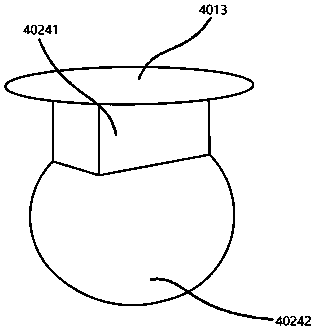
[0065] Please refer to image 3 In this embodiment, the adjusting component 402 is an airbag member 4124, and one end of the airbag member 4124 is fixedly connected to the bottom surface of the blind end 4013.
[0066] The airbag component 4124 includes:
[0067] An airbag seat 40241, one end of which is fixedly connected to the bottom surface of the blind end 4013; and
[0068] The airbag 40242 is installed at the bottom end of the airbag seat 40241, and the installation method of the airbag 40242 and the airbag seat 40241 is common in the prior art; and
[0069] Inflatable tube, one end of the inflatable tube passes through the outer sleeve 100 in turn, the connecting through hole is connected with the airbag seat 40241, and the other end is connected with the inflator.
PUM
 Login to View More
 Abstract
Description
Claims
Application Information
 Login to View More