Large-span suspension bridge main cable shape and stress calculation method and application thereof

A calculation method and technology for suspension bridges, applied in suspension bridges, bridge forms, bridges, etc., can solve problems such as difficulty in achieving design alignment, cable length and cable force errors, and inconsistency in structural force and shape of long-span suspension bridges.

CN110765519AActive Publication Date: 2020-02-07湖北省路桥集团有限公司
4 Cites 12 Cited by

Patent Information

Authority / Receiving Office
CN · China
Current Assignee / Owner
Publication Date
2020-02-07

Smart Images

  • Figure 1
    Figure 1
  • Figure 2
    Figure 2
  • Figure 3
    Figure 3
Patent Text Reader

Abstract

The invention relates to a large-span suspension bridge main cable shape and stress calculation method and application thereof, and the method comprises the steps: obtaining a large-span suspension bridge main cable nonlinear static analysis equation based on a new deflection theory, solving the unstressed length of a main cable and a suspension rod through the volume flexibility conversion, and enabling the structural force and shape of a large-span suspension bridge to be unified. Compared with the error caused by assumed approximate calculation of the cable length and the cable force by adopting parabolas, segmented catenaries, unchanged main cable volume and the like in the prior art, the calculation method provided by the invention can improve the construction control precision of thelarge-span suspension bridge to a millimeter level, and provides a new theoretical support for the design and monitoring of the extra-large-span suspension bridge cable.
Need to check novelty before this filing date? Find Prior Art

Description

technical field

[0001] The invention relates to an accurate calculation method for a main cable of a suspension bridge, in particular to a method for calculating the shape and stress of a main cable of a long-span suspension bridge and an application thereof, belonging to the technical field of engineering construction. Background technique

[0002] Theoretical research on suspension bridges probably started at the end of the 18th century and the beginning of the 19th century, and cable calculation theories such as parabolic cables, equal-section catenary cables, and uniform stress catenary cables appeared successively. The continuum analysis method of the main structure of the suspension bridge has experienced the development stages of elastic theory and classical deflection theory. With the popularity of computers and computational mechanics, various discrete analysis methods have developed rapidly, which has effectively promoted the practice of modern long-span suspension...

Examples

Embodiment Construction

[0099] Below in conjunction with embodiment the present invention is described in further detail.

[0100] The new deflection theory compares the suspenders of suspension bridges to membranes that only have resistance in the vertical direction, and solves the main cable shape through differential equations. There is no stress in the stiffened beam, the suspenders are vertical, densely distributed along the span, and the stress-length relationship between the main cable and suspenders The volume compliance is converted and closed in order to achieve the unity of force and shape.

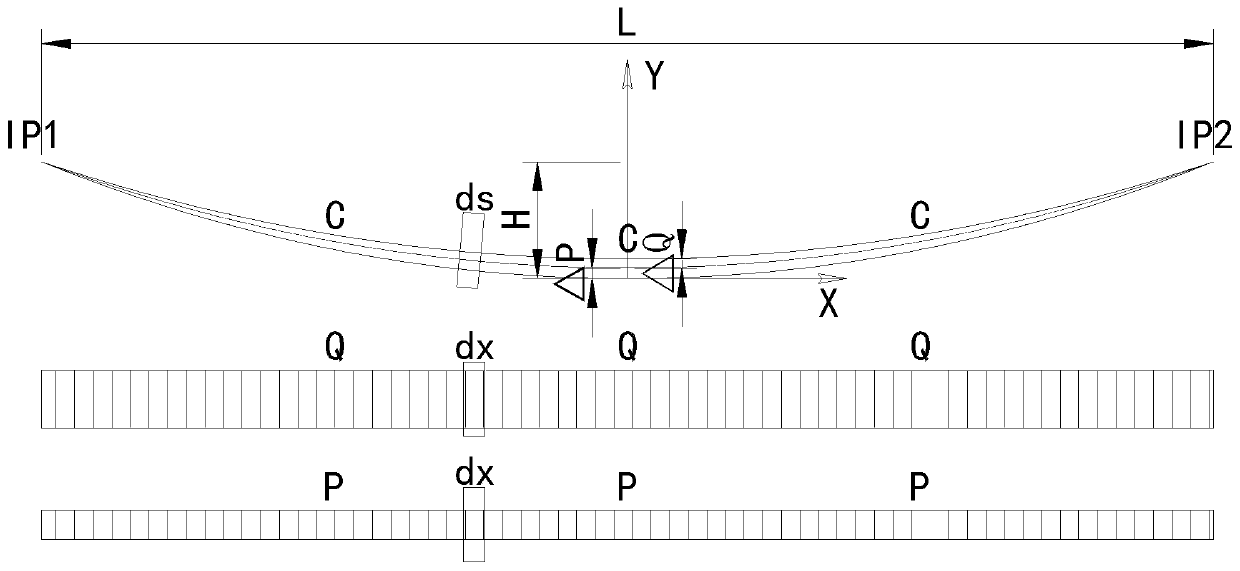
[0101] Such as figure 1 As shown, a calculation method for the main cable shape and stress of a long-span suspension bridge. Under the action of any IP point, the line shape of the main cable of the suspension bridge is a catenary under the action of self-weight C per linear meter. After adding the uniform load Q of the main girder, the main cable The sag increases by ΔQ, and after adding the uniform...