
An endophytic Bacillus amyloliquefaciens jl-b05 and its application
A technology of Bacillus amylogenus and JL-B05, applied in the field of microorganisms, can solve the problem of scarcity of edible fungus biocontrol bacteria and achieve the effect of good strain resources
- Summary
- Abstract
- Description
- Claims
- Application Information
AI Technical Summary
Problems solved by technology
Method used
Image

Examples
Embodiment 1
[0030] Example 1 Screening of endogenous antagonistic Bacillus amyloliquefaciens
[0031] (1) Screening process:
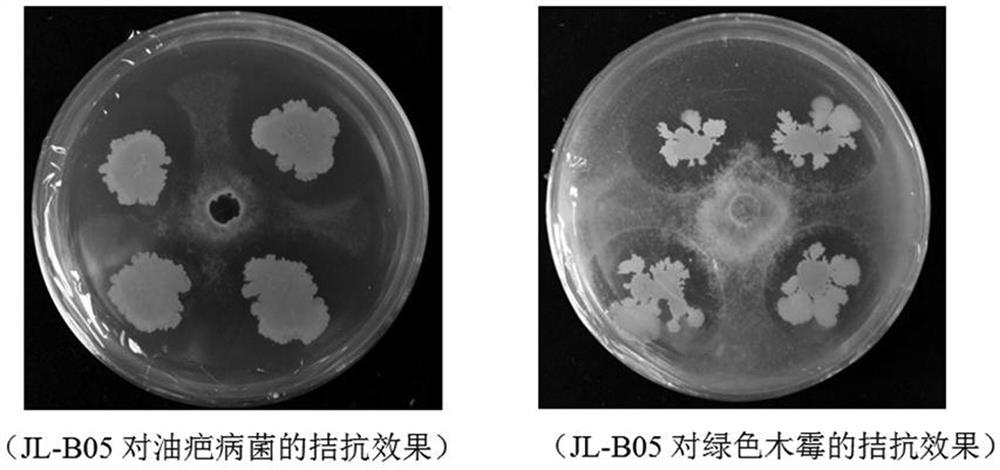
[0032] By gradient dilution method, 82 isolates were isolated from Moso bamboo central production areas of Wuyishan City, Changting County and Jiangle County, Fujian Province. The isolated endophytic bacteria were purified by the three-section line method, and whether the strain was purified was judged by microscopic examination. The purified bacteria were numbered, and single colonies were picked and transferred to the NA slope for future use. The pathogenic bacteria of 6 kinds of edible fungi (Pseudomonas oleifera ( Scytalidium lignicola ), cobweb germs ( Cladobotryum semicirculare ), Myxomycetes ( Comatrichapulchell (C.Bab) Rost sp. ), Trichoderma viride ( Trichoderma pleuroticola ), Penicillium ( Penicillium cyclopium ), yellow mold ( Disporotrichum dimorphosporum )) to carry out confrontation culture, and initially screen endophytic bacteria that ...
Embodiment 2
[0071] Example 2 Experiment of the Inhibitory Effect of Endogenous Bacillus amyloliquefaciens Fermentation Filtrate on the Growth of Pathogen Mycelia
[0072] The endogenous Bacillus amyloliquefaciens strain JL-B05 was selected, a single colony was picked with a sterile inoculation loop, and inoculated into a 250 mL Erlenmeyer flask containing 100 mL of LB liquid medium, and each treatment was repeated three times. Cultivate at 28°C, 180r / min for 3 days, obtain the supernatant by centrifugation (4°C, 10000r / min, 15min), filter the obtained filtrate through a 0.22 μm microporous membrane under sterile conditions spare.
[0073] The antibacterial activity of the filtrate was determined by the colony growth method, and the above-mentioned endophytic bacteria filtrate was mixed with the PDA medium according to different volume percentages (5%, 10%, 15%, 20%) to make a mixed plate, without filtering Liquid PDA plates were used as controls. The original piece of pathogenic bacteri...
Embodiment 3
[0079] Example 3 Experiment of the Inhibitory Effect of Endogenous Bacillus amyloliquefaciens Fermentation Sterilization Liquid on Pathogen Mycelium Growth
[0080] Adopt colony growth method to measure the bacteriostatic activity of sterilizing solution, put the endophytic Bacillus amyloliquefaciens JL-B05 bacterium liquid cultivated in the LB culture solution of embodiment 2 into autoclave, sterilize under 121 ℃ of conditions for 30min, Then the above-mentioned endophytic bacteria sterilizing solution is mixed with the PDA medium according to the volume percentage of four ratios of 5%, 10%, 15%, and 20% to make a mixed medium plate, and the PDA plate without sterilizing solution is used as control. The original piece of pathogenic bacteria was inserted in the center of the plate, and each treatment was repeated 3 times, cultured at a constant temperature of 28°C, and then the mycelium growth of the pathogenic bacteria was observed. When the control CK plate was full, the myc...
PUM
| Property | Measurement | Unit |
|---|---|---|
| diameter | aaaaa | aaaaa |
Abstract
Description
Claims
Application Information
 Login to View More