An Early Termination Iterative Method for Belief Propagation Decoding of Polar Codes
A technology of belief propagation and early termination, applied in the direction of error prevention, transmission system, digital transmission system, etc., can solve the problems of reducing the number of iterations, unsatisfactory, high decoding complexity, etc., to reduce the number of iterations, reduce complexity and The effect of delay and improving decoding efficiency
- Summary
- Abstract
- Description
- Claims
- Application Information
AI Technical Summary
Problems solved by technology
Method used
Image

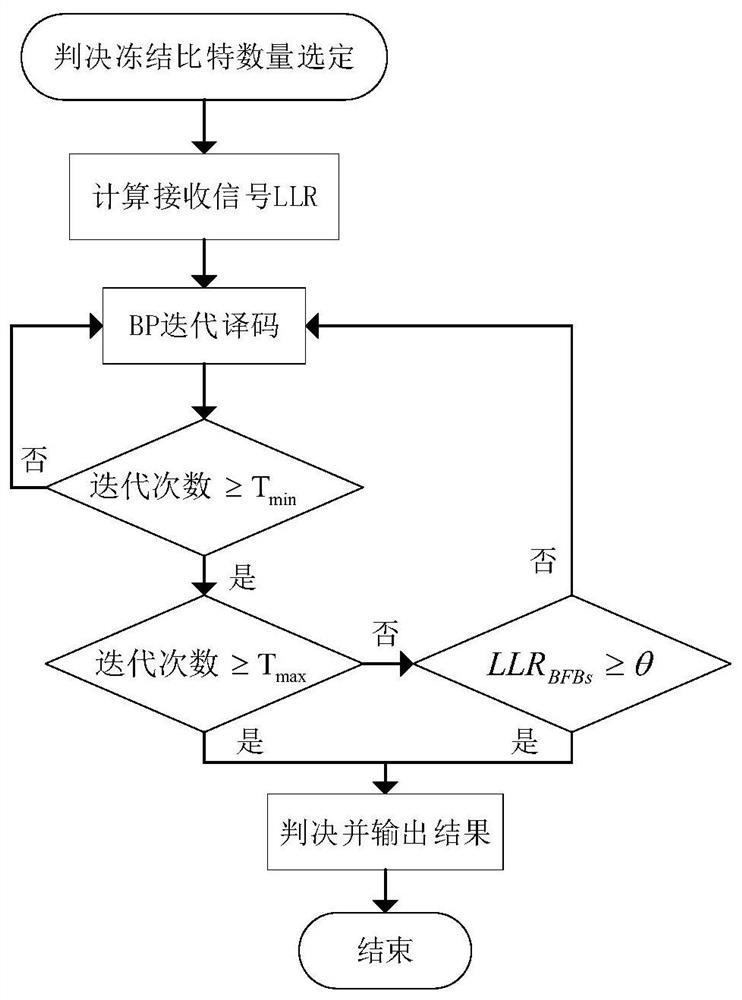


Examples
Embodiment Construction
[0070]
[0072]
[0074]
[0076]
[0079] The LLR is then calculated according to the received signal, and the BP decoding iteration is performed.
[0081]
[0083]
[0086]
[0087] Wherein, the g(·) function is expressed as g(a, b)=sign(a) sign(b) min(|a|, |b|), a and b are both real numbers,
[0090] The decision threshold θ is the optimal θ value that minimizes the bit error rate (BER) of BP decoding. The solution of the decision threshold θ adopts the following
[0091]
[0094] When the number of iterations is greater than or equal to T
[0095]
[0097] Substitute the corresponding α into the formula (21) to obtain the relationship curve between the bit error rate and α. then the lowest bit error in the curve
[0100]
[0103]
[0106]
[0110] FIG. 4 is a BER comparison of three different BP decoding methods. When the polar code length is 1024 and the code rate is 0.5,
[0111] FIG. 5 is a comparison of the number of iterations using different BP decoding methods. The ...
PUM
 Login to View More
 Abstract
Description
Claims
Application Information
 Login to View More