Unlock instant, AI-driven research and patent intelligence for your innovation.

Underwater target radiation noise LOFAR spectrogram line spectrum extraction method based on convolutional residual network

A technology for radiating noise and underwater targets, applied in the field of underwater target feature extraction optimization and artificial intelligence, can solve problems such as poor stability, and achieve the effect of strong nonlinear data processing capabilities

Pending Publication Date: 2020-11-13
THE 715TH RES INST OF CHINA SHIPBUILDING IND CORP
View PDF0 Cites 2 Cited by
  • Summary
  • Abstract
  • Description
  • Claims
  • Application Information

AI Technical Summary

Problems solved by technology

[0005] The present invention aims at the shortcomings of traditional methods for extracting weak line spectrum of LOFAR spectrum of target radiation noise in water, and provides a method for extracting line spectrum of LOFAR spectrum of target radiation noise in water based on convolutional residual network. The convolutional residual network is applied to line spectrum feature extraction, and the deep-level features are extracted from the LOFAR spectrum through the powerful nonlinear computing capability of the convolutional residual regression network's extremely deep structure, and the tolerant extraction of line spectrum sequences is realized.

Method used

the structure of the environmentally friendly knitted fabric provided by the present invention; figure 2 Flow chart of the yarn wrapping machine for environmentally friendly knitted fabrics and storage devices; image 3 Is the parameter map of the yarn covering machine
View more

Image

Smart Image Click on the blue labels to locate them in the text.
Viewing Examples
Smart Image
  • Underwater target radiation noise LOFAR spectrogram line spectrum extraction method based on convolutional residual network
  • Underwater target radiation noise LOFAR spectrogram line spectrum extraction method based on convolutional residual network
  • Underwater target radiation noise LOFAR spectrogram line spectrum extraction method based on convolutional residual network

Examples

Experimental program
Comparison scheme
Effect test

Embodiment Construction

[0039] The present invention will be described in detail below in conjunction with accompanying drawing and embodiment:

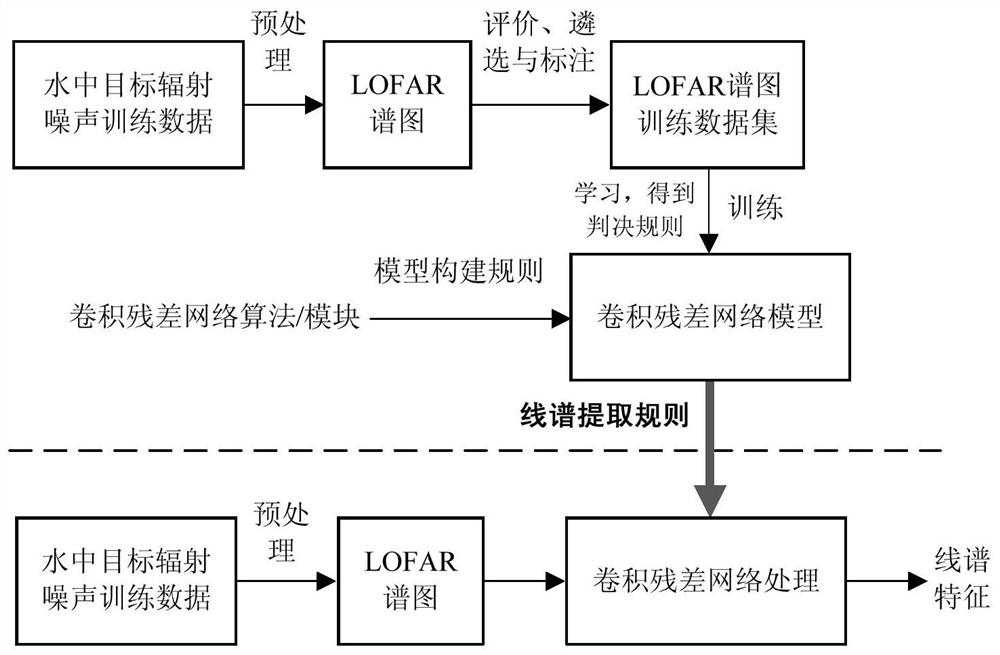
[0040] As shown in the figure, the present invention discloses a method for extracting line spectrum of LOFAR spectrum of target radiation noise in water based on convolutional residual network. The method includes the following steps:

[0041] (1) Construct the LOFAR spectrum training data set of target radiation noise in water, the basic process is as follows:

[0042] (1.1) Preprocess the radiation noise of the target in the water to generate the LOFAR spectrogram rolling by batch. The frequency resolution of the LOFAR spectrogram is 0.1 Hz. The spectrogram display batch is 150 batches. The LOFAR spectrogram is divided into Several LOFAR spectrogram subblocks of 150×400 size.

[0043] (1.2) Generate a batch of LOFAR spectrogram samples after every 50 batches of data refresh and store them in a 4-dimensional matrix.

[0044] (1.3) Label the LOFAR spectr...

the structure of the environmentally friendly knitted fabric provided by the present invention; figure 2 Flow chart of the yarn wrapping machine for environmentally friendly knitted fabrics and storage devices; image 3 Is the parameter map of the yarn covering machine
Login to View More

PUM

No PUM Login to View More

Abstract

The invention discloses an underwater target radiation noise LOFAR spectrogram line spectrum extraction method based on a convolution residual network. The method comprises the following steps: constructing an LOFAR spectrogram training data set, carrying out the processing of underwater acoustic target data, and generating a labeled LOFAR spectrogram sample; constructing a convolution residual regression network model for the characteristics of the LOFAR spectrogram; training the convolutional residual regression network model based on the existing labeled LOFAR spectrogram data; and performing line spectrum extraction on the unknown underwater acoustic target noise LOFAR spectrogram, and processing the LOFAR spectrograms of the respective corresponding frequency bands based on the trained convolutional residual regression network model. The beneficial effects of the invention are that the method employs the convolution residual network algorithm for the line spectrum sequence extraction of the high-dimensional water target radiation noise LOFAR spectrogram, is higher in nonlinear data processing capability, is more adaptive to the features of a real LOFAR spectrogram, and can achieve the effective extraction of the line spectrum sequence. The method is applied to line spectrum feature extraction of the LOFAR spectrogram of the target radiation noise in the simulated water, and a good effect is achieved.

Description

technical field [0001] The invention belongs to the technical field of underwater target feature extraction optimization and artificial intelligence, and in particular relates to a method for extracting LOFAR spectrogram line spectrum of underwater target radiation noise based on convolutional residual network. Background technique [0002] Passive target recognition technology mainly uses passive target radiation noise signals received by sonar and other sensor information to identify target types, which can provide sonar operators with target feature information and is an important basis for comprehensive decision-making. At present, underwater target detection and recognition is an important research direction for the modernization of naval weaponry and equipment, and it is also one of the key technologies for the intelligence of sonar and weapon systems. [0003] The core of passive target recognition technology is the extraction and expression of target acoustic signal ...

Claims

the structure of the environmentally friendly knitted fabric provided by the present invention; figure 2 Flow chart of the yarn wrapping machine for environmentally friendly knitted fabrics and storage devices; image 3 Is the parameter map of the yarn covering machine
Login to View More

Application Information

Patent Timeline
no application Login to View More
IPC IPC(8): G06K9/62G06N3/04G06N3/08
CPCG06N3/08G06N3/045G06F18/21
Inventor 陈越超尚金涛
Owner THE 715TH RES INST OF CHINA SHIPBUILDING IND CORP
Features
  • R&D
  • Intellectual Property
  • Life Sciences
  • Materials
  • Tech Scout
Why Patsnap Eureka
  • Unparalleled Data Quality
  • Higher Quality Content
  • 60% Fewer Hallucinations
Social media
Patsnap Eureka Blog
Learn More