
Application of pharmaceutical compositions containing mesenchymal stem cell exosomes in the treatment of diseases
A technology of mesenchymal stem cells and compositions, applied in the field of biopharmaceuticals, can solve the problems of unfavorable clinical application and promotion, high production and management costs, and low therapeutic targeting, so as to avoid transplantation versus host effect, easy production and preparation, Improve the effect of treatment
- Summary
- Abstract
- Description
- Claims
- Application Information
AI Technical Summary
Problems solved by technology
Method used
Image

Examples
Embodiment 1
[0036] Example 1 Preparation of single domain antibody targeting IL-13
[0037] Human IL-13 protein was used to immunize alpacas, and a single domain antibody targeting IL-13 was screened through a phage display library. The specific methods included:
[0038] (1) Alpaca antigen immunization.
[0039] Mix 100 μg of human IL-13 protein with 100 μL of Freund’s complete adjuvant to make an emulsified mixture, select healthy adult dromedary camels, and use the emulsified mixture to immunize alpacas by subcutaneous injection at multiple points on the back. The first two immunizations Freund's complete adjuvant was used, and the subsequent immunization was enhanced with an emulsified mixture of Freund's incomplete adjuvant and human IL-13 protein. A total of 8-10 immunizations were performed, and the immunization interval was 2 weeks. One week after each immunization, collect 100mL of peripheral blood, detect the titer of antiserum by ELISA, coat the detection plate with human IL-1...
Embodiment 2
[0052] Example 2 Isolation, culture and exosome acquisition of human umbilical cord MSCs
[0053] 2.1 Isolation and culture of human umbilical cord MSCs
[0054] (1) Collect fresh umbilical cords in the aseptic environment of the operating room, and quickly place the whole umbilical cord in a sterile PBS solution containing 0.5% penicillin and 0.5% streptomycin sulfate;
[0055] (2) In the biological safety cabinet, take out the umbilical cord tissue and place it in sterile PBS solution, rinse the umbilical cord repeatedly to remove the remaining blood and other impurities;
[0056] (3) Cut the umbilical cord into several sections, cut it longitudinally, and remove two umbilical arteries and one umbilical vein;
[0057] (4) Cut the umbilical cord to about 1mm with sterile surgical scissors 3 The size of the tissue block, the obtained tissue block was filtered with a 200-mesh filter to remove smaller tissue debris and cell debris;
[0058] (5) Spread the above tissue blocks ...
Embodiment 3
[0067] Example 3 The co-culture of human umbilical cord MSCs and A549 cells and the acquisition of exosomes
[0068] 3.1 Co-culture of human umbilical cord MSCs and A549 cells
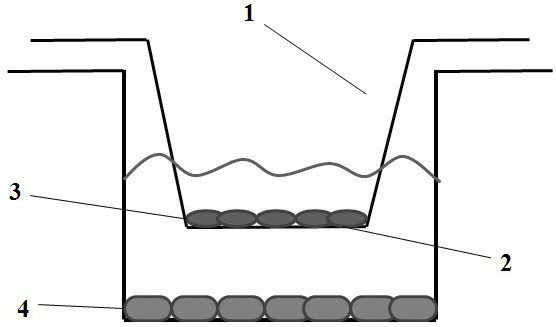
[0069] The co-culture of human umbilical cord MSCs and A549 cells is carried out in a Transwell culture chamber. The bottom of the culture chamber is equipped with a semi-permeable membrane, which allows the exchange of nutrients, but the cells cannot pass through.
[0070] (1) Take A549 alveolar epithelial cells preserved in liquid nitrogen (preserved in our laboratory), revive them quickly in warm water, then add RPMI1640 medium, mix well, collect cells by centrifugation at 2000 rpm for 5 min, and wash with fresh medium for 3- 5 times, then add RPMI1640 containing 10% FBS and culture at 37°C, 5% CO 2 Cultivate 3-5 passages under certain conditions in order to fully activate A549 cells;
[0071] (2) As described in Section 2.1, culture human umbilical cord MSCs and pass them down to 3-5 generations; ...
PUM
| Property | Measurement | Unit |
|---|---|---|
| diameter | aaaaa | aaaaa |
Abstract
Description
Claims
Application Information
 Login to View More