
Covalent organic framework fluorescent test paper for detecting palladium ions in water and preparation method thereof
A covalent organic framework, palladium ion technology, used in fluorescence/phosphorescence, chemical instruments and methods, luminescent materials, etc., to achieve wide application prospects, low detection limits, and fast analysis.
- Summary
- Abstract
- Description
- Claims
- Application Information
AI Technical Summary
Problems solved by technology
Method used
Image

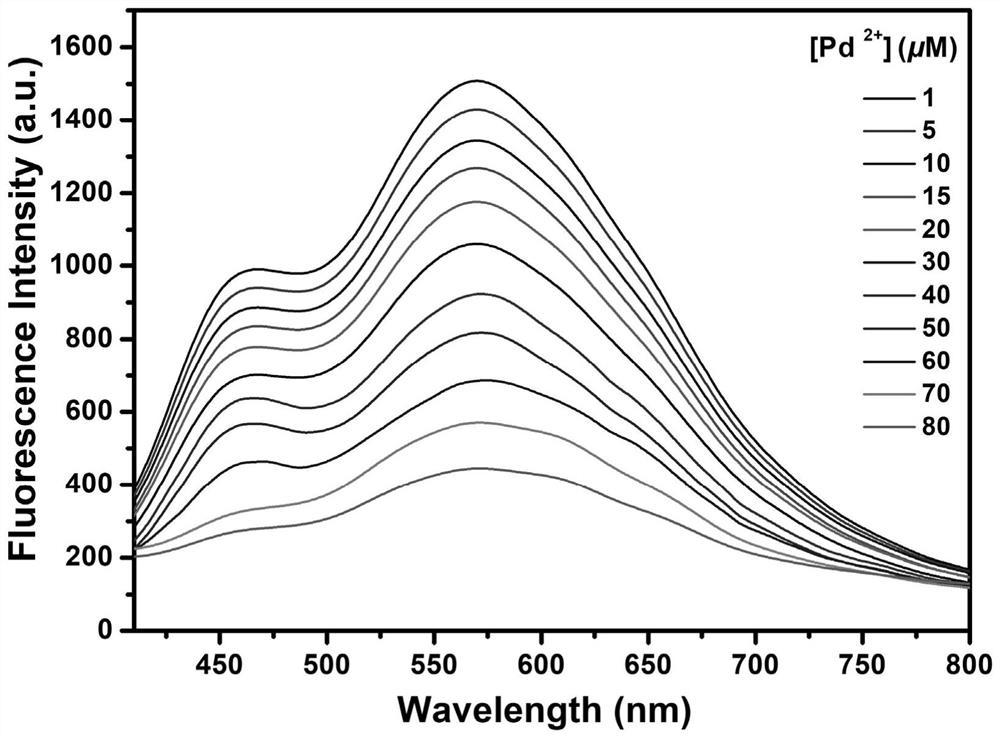
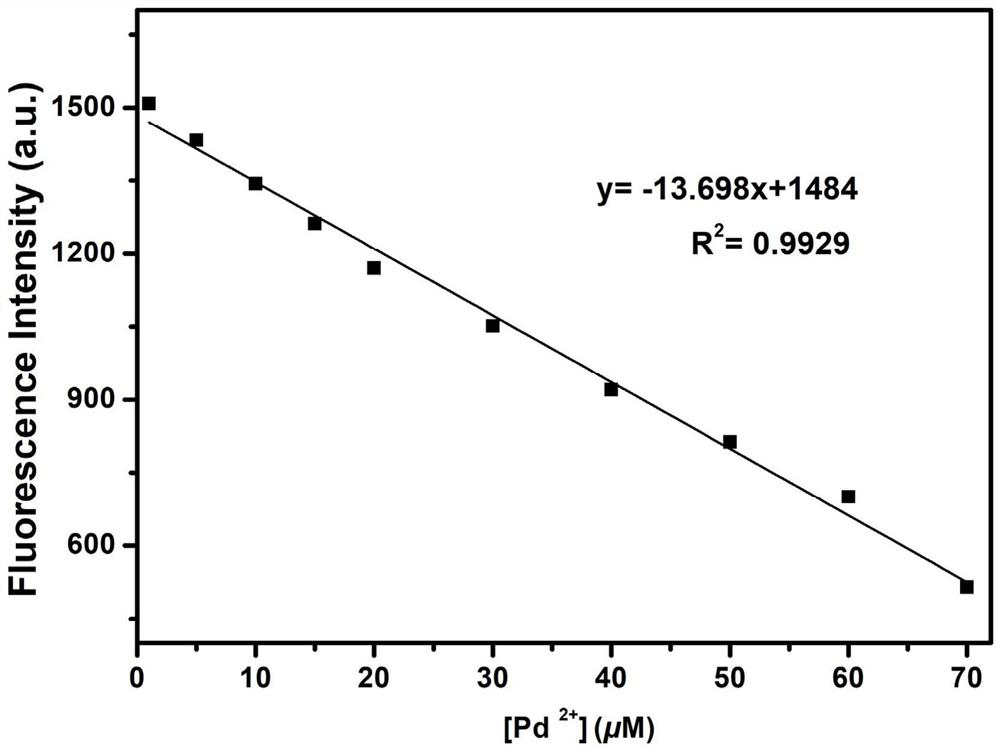
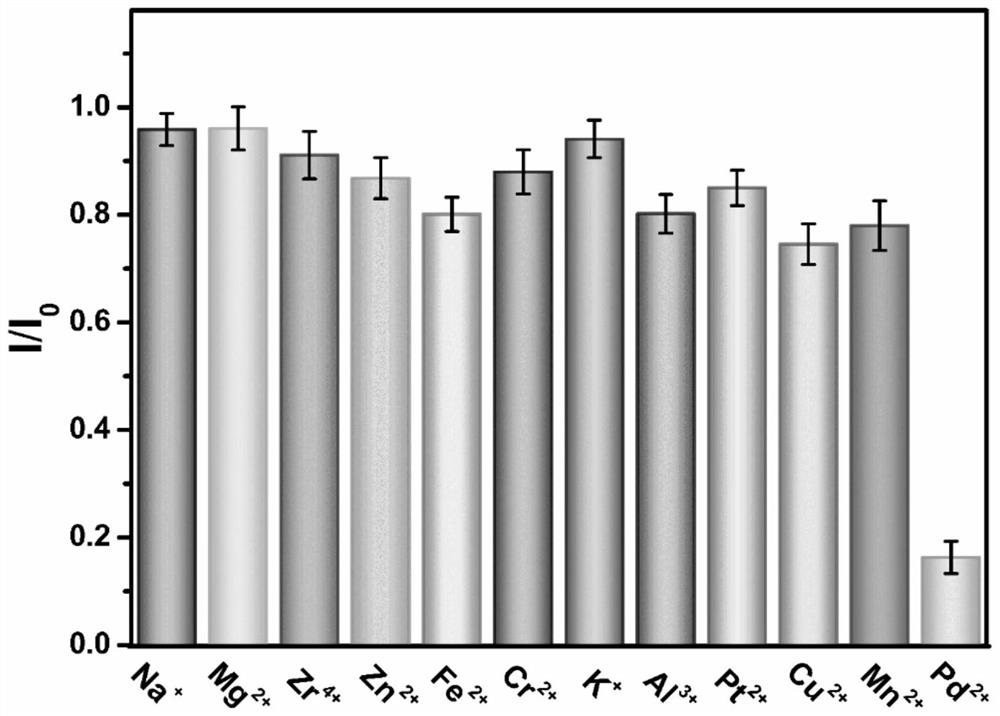
Examples
Embodiment 1
[0044] A method for preparing a covalent organic framework fluorescent test paper for detecting palladium ions in water, comprising the following steps:
[0045] (1) Soak the blank filter paper in the dioxane solution and mesitylene mixed with 0.025mmol organic small molecule tritylaldehyde, 2,5-bis(allyloxy)terephthalic hydrazide In the ampoule bottle of solution 3mL; The dioxane solution of described 2,5-bis(allyloxyl) terephthalic hydrazide is 2,5-bis(allyloxyl) terephthalamide of 9mg Prepared by dissolving hydrazide in 0.8mL of dioxane;
[0046] (2) Add 0.1mL acetic acid to the bottle, and ultrasonically disperse the solvent for 10 minutes; the concentration of the acetic acid solution is 3M;
[0047] (3) After the refrigeration cycle pumps air three times, seal the ampoule bottle and react at 120°C for 3 days;
[0048] (4) After the filter paper is taken out, wash it with acetone for 3 times, place it in a clean and ventilated place, and let it dry naturally to obtain t...
Embodiment 2
[0050] A method for preparing a covalent organic framework fluorescent test paper for detecting palladium ions in water, comprising the following steps:
[0051] (1) Soak blank filter paper in dioxane solution and mesitylene mixed with 0.03mmol organic small molecule tritylaldehyde, 2,5-bis(allyloxy)terephthalic hydrazide In the ampoule bottle of solution 3.5mL; The dioxane solution of described 2,5-bis(allyloxyl) terephthalhydrazide is 10mg of 2,5-bis(allyloxyl) terephthalamide Prepared by dissolving formylhydrazide in 1mL of dioxane;
[0052] (2) Add 0.15mL acetic acid to the bottle, and ultrasonically disperse the solvent for 10 minutes; the concentration of the acetic acid solution is 4.5M;
[0053] (3) After the refrigeration cycle pumps air three times, seal the ampoule bottle and react at 120°C for 3 days;
[0054] (4) After the filter paper is taken out, wash it with acetone for 3 times, place it in a clean and ventilated place, and let it dry naturally to obtain the...
Embodiment 3
[0056] A method for preparing a covalent organic framework fluorescent test paper for detecting palladium ions in water, comprising the following steps:
[0057] (1) Soak blank filter paper in dioxane solution and mesitylene mixed with 0.038mmol organic small molecule tritylaldehyde, 2,5-bis(allyloxy)terephthalic hydrazide In the ampoule bottle of solution 4.5mL; The dioxane solution of described 2,5-bis(allyloxyl) terephthalhydrazide is 11.5mg of 2,5-bis(allyloxyl)p-phenylene Prepared by dissolving dimethylhydrazide in 1.5mL of dioxane;
[0058] (2) Add 0.2mL acetic acid to the bottle, and ultrasonically disperse the solvent for 10 minutes; the concentration of the acetic acid solution is 6M;
[0059] (3) After the refrigeration cycle pumps air three times, seal the ampoule bottle and react at 120°C for 3 days;
[0060] (4) After the filter paper is taken out, wash it with acetone for 3 times, place it in a clean and ventilated place, and let it dry naturally to obtain the ...
PUM
 Login to View More
 Abstract
Description
Claims
Application Information
 Login to View More