Check patentability & draft patents in minutes with Patsnap Eureka AI!

Radar HRRP target category labeling method based on convolutional self-encoding

A technology of convolutional self-encoding and target classification, which is applied in the field of automatic radar target recognition, can solve the problems of low efficiency and poor accuracy of manual labeling, and achieve the effect of improving labeling efficiency and accuracy, and improving labeling accuracy

Active Publication Date: 2021-04-23
NAVAL AERONAUTICAL UNIV
View PDF6 Cites 1 Cited by
  • Summary
  • Abstract
  • Description
  • Claims
  • Application Information

AI Technical Summary

Problems solved by technology

[0003] The purpose of the present invention is to provide a radar HRRP target category labeling method based on convolutional self-encoding, which greatly improves the accuracy of sample labeling, in view of the problems of low manual labeling efficiency and poor accuracy during the establishment of the radar target sample database. efficiency and accuracy

Method used

the structure of the environmentally friendly knitted fabric provided by the present invention; figure 2 Flow chart of the yarn wrapping machine for environmentally friendly knitted fabrics and storage devices; image 3 Is the parameter map of the yarn covering machine
View more

Image

Smart Image Click on the blue labels to locate them in the text.
Viewing Examples
Smart Image
  • Radar HRRP target category labeling method based on convolutional self-encoding
  • Radar HRRP target category labeling method based on convolutional self-encoding
  • Radar HRRP target category labeling method based on convolutional self-encoding

Examples

Experimental program
Comparison scheme
Effect test

Embodiment Construction

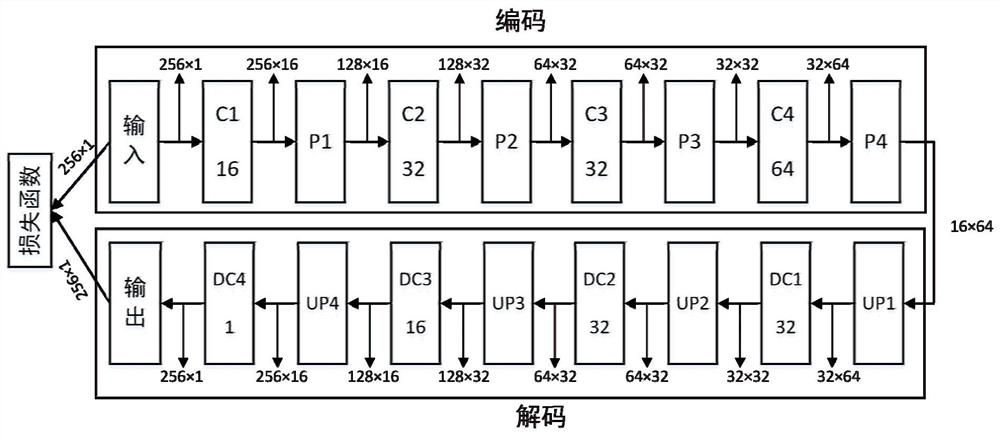
[0019] The present invention will be described in further detail below in conjunction with the accompanying drawings. With reference to the accompanying drawings in the description, the model constructed by the present invention is described as follows:

[0020] The present invention is mainly divided into three stages. In the first stage, the convolutional self-encoding is constructed, and all samples are used to train the convolutional self-encoding model until the model converges. Compared with traditional convolutional neural networks, convolutional self-encoding does not require sample labels to extract sample features, which can greatly improve the utilization of unlabeled samples. In the second stage, the convolutional self-encoding encoder is used as a feature extractor to construct a convolutional neural network, and the convolutional neural network is trained using labeled samples to obtain an initial labeling model. In the third stage, the unlabeled samples are inp...

the structure of the environmentally friendly knitted fabric provided by the present invention; figure 2 Flow chart of the yarn wrapping machine for environmentally friendly knitted fabrics and storage devices; image 3 Is the parameter map of the yarn covering machine
Login to View More

PUM

No PUM Login to View More

Abstract

The invention provides a radar HRRP target category labeling method based on convolutional self-coding, and aims to solve the problems of low manual interpretation efficiency and low accuracy of massive HRRP samples. The method is mainly divided into three stages: stage 1, constructing convolution self-coding, and training the convolution self-coding to convergence by using all HRRP samples; 2, constructing a convolutional neural network by taking a convolutional self-encoding encoder as a feature extractor, and training the convolutional neural network by utilizing a labeled HRRP sample to obtain an initial labeling model; 3, labeling the label-free HRRP sample of which the one-hot coding meets the labeling condition, performing parameter updating on the labeling model by using the label-free HRRP sample, and repeating the step 3 until the HRRP sample meeting the condition is not increased any more to obtain a final labeling model. Compared with a traditional labeling method, the method has the advantages that label-free HRRP sample information is fully utilized, the labeling efficiency and accuracy are greatly improved, and the labeling problem of massive HRRP samples is solved.

Description

technical field [0001] The invention belongs to radar target automatic recognition technology, and aims at the problems of low efficiency and poor accuracy of manual interpretation of massive sample data, and proposes a radar HRRP target category labeling method based on convolutional self-encoding. Background technique [0002] HRRP (High Resolution Range Profiles) contains a large amount of target structure, target scattering point intensity and other information to build a target HRRP sample library. In actual situations, most of the targets to be identified are non-cooperative targets, and their HRRP labels require manual interpretation by professionals. In the face of massive data, the efficiency of manual labeling is low and the accuracy rate is poor. In view of the above situation, the present invention proposes a radar HRRP target category labeling method based on convolutional self-encoding. Compared with traditional labeling methods, this method makes full use of ...

Claims

the structure of the environmentally friendly knitted fabric provided by the present invention; figure 2 Flow chart of the yarn wrapping machine for environmentally friendly knitted fabrics and storage devices; image 3 Is the parameter map of the yarn covering machine
Login to View More

Application Information

Patent Timeline
no application Login to View More
IPC IPC(8): G06K9/62G06N3/04G06N3/08
CPCG06N3/08G06N3/045G06F18/214
Inventor 郭晨王海鹏孙顺潘新龙郭强刘颢黄友澎贾舒宜唐田田任利强
Owner NAVAL AERONAUTICAL UNIV
Features
  • R&D
  • Intellectual Property
  • Life Sciences
  • Materials
  • Tech Scout
Why Patsnap Eureka
  • Unparalleled Data Quality
  • Higher Quality Content
  • 60% Fewer Hallucinations
Social media
Patsnap Eureka Blog
Learn More