Self-adaptive neural network training method for image recognition

A neural network training and image recognition technology, applied in the field of image recognition, can solve problems such as long training time, distance amplification, and difficulty in convergence.

CN112766399AActive Publication Date: 2021-05-07UNIV OF ELECTRONIC SCI & TECH OF CHINA
8 Cites 6 Cited by

Patent Information

Authority / Receiving Office
CN · China
Current Assignee / Owner
Publication Date
2021-05-07

Smart Images

  • Figure 1
    Figure 1
  • Figure 2
    Figure 2
  • Figure 3
    Figure 3
Patent Text Reader

Abstract

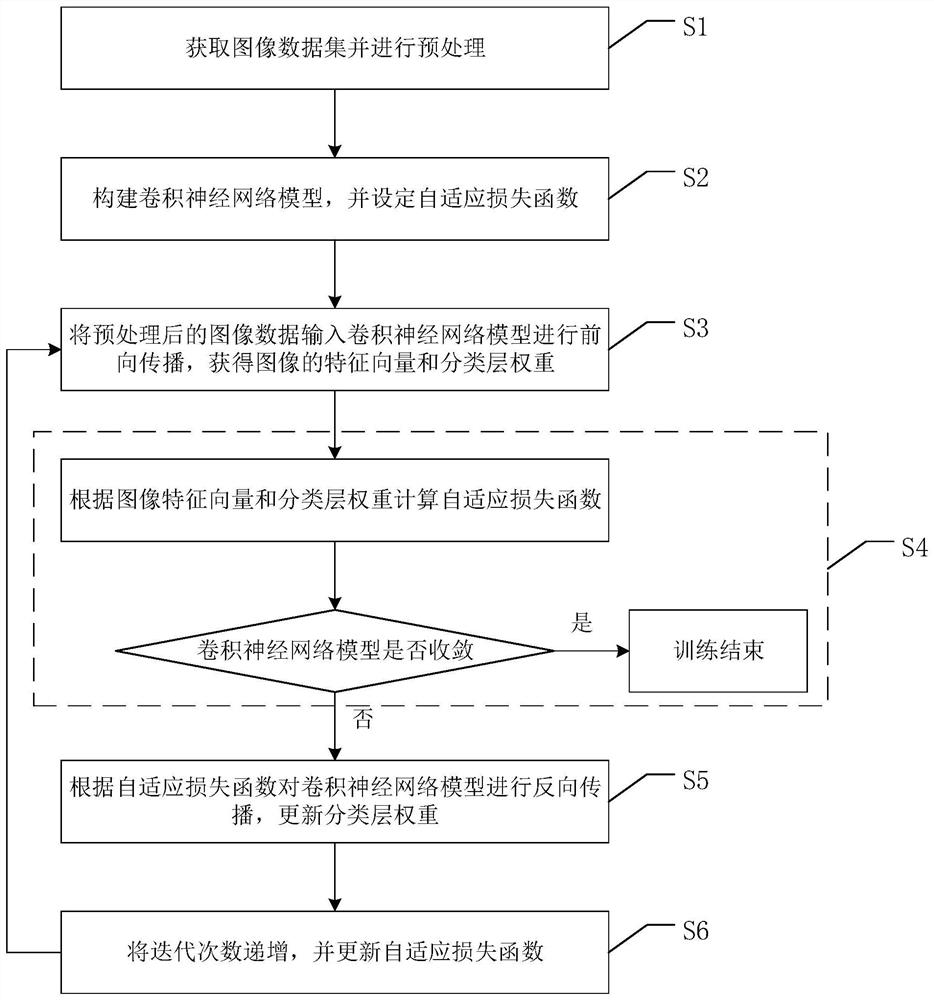
The invention discloses a self-adaptive neural network training method for image recognition. The method comprises the steps: acquiring and preprocessing an image data set; constructing a convolutional neural network model, and setting an adaptive loss function; inputting the preprocessed image data into a convolutional neural network model for forward propagation to obtain a feature vector and a classification layer weight of the image; calculating an adaptive loss function according to the image feature vector and the classification layer weight, and judging whether the convolutional neural network model converges; performing back propagation on the convolutional neural network model according to the adaptive loss function, and updating the weight of the classification layer; and progressively increasing the number of iterations, and updating the adaptive loss function. Compared with a softmax-based classification loss function training method, the method provided by the invention has the advantages that the setting of hyper-parameters is reduced, the convergence speed of the convolutional neural network model can be accelerated, and the image classification and recognition accuracy can be improved.
Need to check novelty before this filing date? Find Prior Art

Description

technical field

[0001] The invention relates to the technical field of image recognition, in particular to an image recognition-oriented adaptive neural network training method. Background technique

[0002] The success of convolutional neural networks (CNNs) in image classification and recognition is mainly due to: massive training data, network architecture, and reasonable loss function (loss function). Among them, designing a reasonable loss function according to the characteristics of the data is a key step to improve the image recognition ability.

[0003] Softmax function is the most important loss function used in image classification and recognition, and its recognition effect on difficult samples is not good. Through research, it is found that when the intra-class distance of the sample is greater than the inter-class distance, although the softmax loss function can distinguish the inter-class distance, it cannot effectively distinguish the intra-class distance. Th...

Examples

Embodiment Construction

[0037] The specific embodiments of the present invention are described below so that those skilled in the art can understand the present invention, but it should be clear that the present invention is not limited to the scope of the specific embodiments. For those of ordinary skill in the art, as long as various changes Within the spirit and scope of the present invention defined and determined by the appended claims, these changes are obvious, and all inventions and creations using the concept of the present invention are included in the protection list.

[0038] The current image classification methods based on deep learning all use softmax and its deformation as the loss function. The softmax loss function will divide the entire feature space according to the number of categories to ensure that the categories are separable. This is very suitable for multi-classification tasks such as MNIST and ImageNet, because the test category must be in the training category. Softmax doe...