End-to-end routing relay link selection method, system and device based on branch and bound method
A branch-and-bound method and relay link technology, which is applied in the field of end-to-end routing relay link selection, can solve the problem of changing the number and location of relay nodes, difficulty in obtaining optimal network throughput, and mobile ad hoc network routing. Fast node changes and other issues, to achieve the effect of achieving throughput, minimizing data transmission delay, and optimizing transmission rate
- Summary
- Abstract
- Description
- Claims
- Application Information
AI Technical Summary
Problems solved by technology
Method used
Image

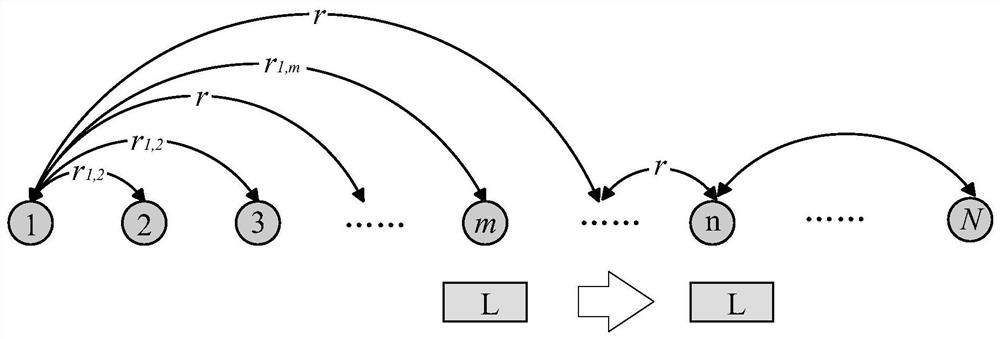


Examples
specific Embodiment approach 1
[0015] Specific implementation mode 1: The specific process of the method for selecting an end-to-end routing relay link based on the branch and bound method in this implementation mode is as follows:
[0016] Step 1: Determine the number of nodes and related parameters of the network according to the needs, and establish a data transmission model; figure 1 As shown, the actual physical position relationship of the nodes is not considered;
[0017] Step 2: According to actual needs, based on step 1, set the threshold value interval and the transmission rate corresponding to this interval (there are five speed gears in step 1, there are five intervals), calculate the signal-to-noise ratio between each node, and determine The threshold interval corresponding to the signal-to-noise ratio between each node and the transmission rate corresponding to this interval;
[0018] Step 3: According to the research objectives, perform mathematical modeling based on Step 3 to obtain an opti...
specific Embodiment approach 2
[0035] Specific embodiment 2: The difference between this embodiment and specific embodiment 1 is that in the step 1, the number of nodes and related parameters of the network are determined according to the needs, and a data transmission model is established; figure 1 As shown, the actual physical position relationship of the nodes is not considered. The specific process is:
[0036] The relevant parameters are: interval thresholds and transmission rates corresponding to different transmission rate files, transmission data packet size, maximum hop value, source node and destination node;
[0037] The data transfer model is:
[0038] A network main chain is formed by N nodes. According to different positions between nodes, there are different transmission rates of C files between nodes.
[0039] Assume that the transmission rate is divided into 5 levels, that is, C=5, and there are 10 nodes in total, that is, N=10.
[0040] Other steps and parameters are the same as those i...
specific Embodiment approach 3
[0041] Specific embodiment three: the difference between this embodiment and specific embodiment one or two is that in the step two, according to the actual needs, the threshold value interval and the interval are set based on the step one (there are five speed gears in the step one, There are five intervals) corresponding to the transmission rate, calculate the signal-to-noise ratio between each node, determine the threshold value interval corresponding to the signal-to-noise ratio between each node and the transmission rate corresponding to this interval; the specific process is:
[0042] Considering that there are N nodes in the mobile ad hoc network, i, j∈N represents the nodes in the network, when the value of the signal-to-noise ratio SNR between nodes i and j is greater than or equal to the set threshold γ 0 , then it is considered that node i and node j can communicate directly; if the value of SNR is less than the set threshold γ 0 , it is considered that node i and n...
PUM
 Login to View More
 Abstract
Description
Claims
Application Information
 Login to View More