
RGBT visual tracking method and system based on two-stage fusion structure search
A visual tracking and stage technology, applied in the field of computer vision, can solve a lot of repeated experiments, consume a lot of manpower and material resources, ignore the potential benefits of cross-layer integration, etc., to avoid repeated experiments and improve tracking performance
- Summary
- Abstract
- Description
- Claims
- Application Information
AI Technical Summary
Problems solved by technology
Method used
Image

Examples
Embodiment 1
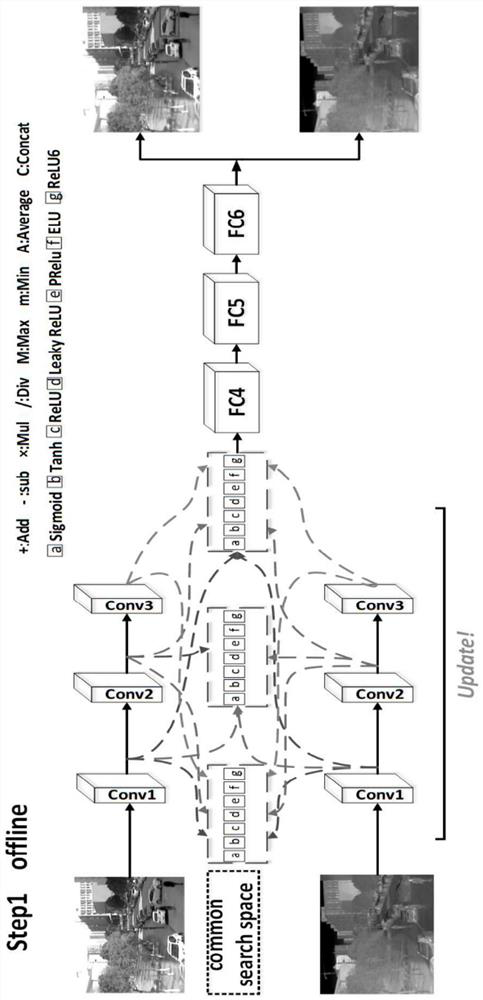
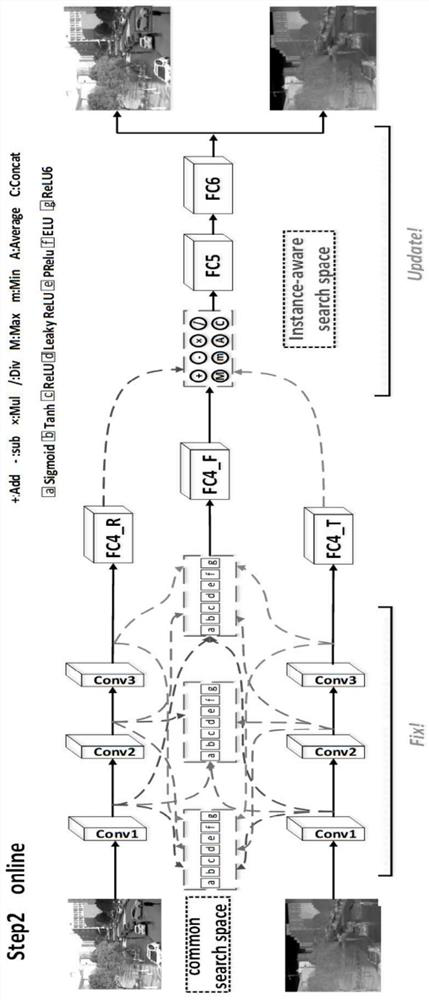
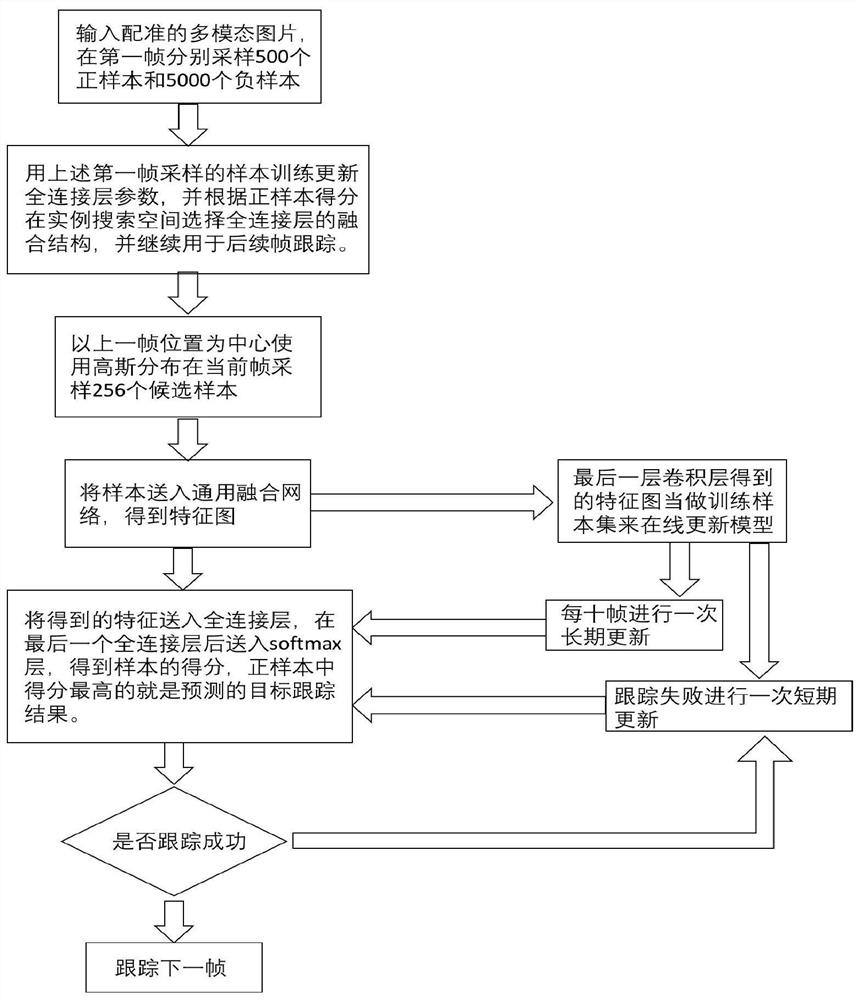
[0037] Such as figure 1 , 2As shown, a RGBT visual tracking method based on two-stage fusion structure search, which specifically includes two stages of offline search and online tracking:
[0038] Such as figure 1 As shown, a general search space is designed in the offline search stage, including different fusion methods of the VGG-M convolutional layer, and five activation functions Tanh, ReLU, PReLU, LReLU, and ReLU6. The size of the search space is exponentially related to the number of possible fusion layers, so the search space is gradually explored according to the number of fusion layers, which is consistent with the idea of progressive neural structure search, starting from a simple fusion layer of 1, and sequentially expanding the fusion number of layers. Train a proxy function to further guide the exploration of the search space. In order to learn the commonality of targets in different videos, a multi-domain learning training method is used. Assume that K vi...
PUM
 Login to View More
 Abstract
Description
Claims
Application Information
 Login to View More