VSP accurate horizon calibration method and system based on ray theory
A technology of horizon calibration and ray theory, applied in the VSP precise horizon calibration method and system field based on ray theory, can solve problems such as difficult calibration results, inapplicability to complex structures, and impact on seismic interpretation, and achieve high computational efficiency
- Summary
- Abstract
- Description
- Claims
- Application Information
AI Technical Summary
Problems solved by technology
Method used
Image



Examples
Embodiment 1
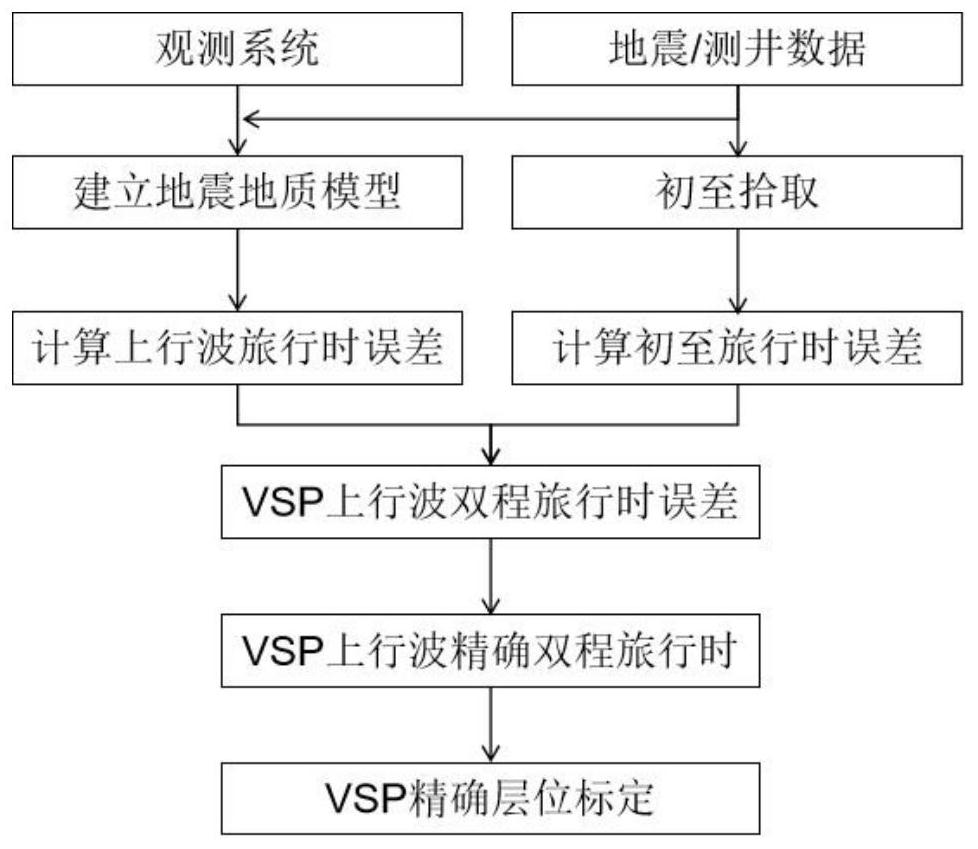
[0066] Such as figure 1 As shown, the method includes:
[0067] Step 1: Establish a seismic forward modeling model based on the seismic data observation system and logging data:
[0068] The seismic data observation system can determine the relationship between the source excitation and the receiving position of the geophone, and the formation dip angle and velocity model can be determined by using VSP data and logging data, so as to establish the seismic forward modeling model. The method of establishing the seismic forward modeling model is realized by the existing technology That is, it will not be repeated here.
[0069] Step 2: According to the seismic forward modeling model, calculate the accurate travel time t of the upgoing wave by the ray minimum travel time method acc and VSP upgoing wave travel time t VSP ,
[0070] t acc =2H d / v (1)
[0071]
[0072] Among them, H d is the formation depth, v is the seismic wave propagation velocity, θ is the formation d...
Embodiment 2
[0092] The system includes: a memory, a processor, and a computer program stored on the memory, and the computer program is executed by the processor to perform the following steps:
[0093] Step 1: Establish a seismic forward modeling model based on the seismic data observation system and logging data:
[0094] Step 2: Calculate and obtain accurate upgoing wave travel time and VSP upgoing wave travel time according to the seismic forward modeling model;
[0095] Step 3: Using the precise up-going wave travel time t acc and VSP upgoing wave travel time t VSP Obtain the travel time error of the up-going wave;
[0096] Step 4: Pick up the first arrival to obtain the travel time error of the first arrival;
[0097] Step 5: Obtain the precise round-trip travel time of VSP according to the up-going wave travel time error obtained in the third step and the first arrival travel time error obtained in the fourth step.
[0098] Step 6: Use the VSP to obtain the correct time-depth r...
Embodiment 3
[0132] Select the Marmousi model, the schematic diagram is as follows diagram 2-1 with Figure 2-2 as shown, diagram 2-1 is the leveling model established according to the model data (black vertical lines) at the well position, Figure 2-2 is the actual slope model.
[0133] use diagram 2-1 with Figure 2-2 The two models in the model respectively do VSP seismic wave forward modeling, and the obtained forward modeling records are as follows: Figure 3-1 with Figure 3-2 as shown, Figure 3-1 is the VSP seismic forward modeling record of the leveling model, Figure 3-2 It is the VSP earthquake forward modeling record of the actual model. According to the inclination angle of the interface, the time error of the upgoing wave is obtained through step three, and the two-way travel time is obtained by using the principle of first arrival pick-up by the energy ratio method in step four. In actual use, the VSP data is used as the basis for horizon calibration. When the mo...
PUM
 Login to View More
 Abstract
Description
Claims
Application Information
 Login to View More
 - R&D
- Intellectual Property
- Life Sciences
- Materials
- Tech Scout
- Unparalleled Data Quality
- Higher Quality Content
- 60% Fewer Hallucinations
Browse by: Latest US Patents, China's latest patents, Technical Efficacy Thesaurus, Application Domain, Technology Topic, Popular Technical Reports.
© 2025 PatSnap. All rights reserved.Legal|Privacy policy|Modern Slavery Act Transparency Statement|Sitemap|About US| Contact US: help@patsnap.com