Traditional
surgical removal of third molars, however, is a highly invasive, painful, and complication-ridden procedure.
Further, third
molar extraction represents the only procedure in the United States and Europe where it is considered “normal” to subject patients of any age group to such a highly invasive prophylactic
surgery that carries significant lifelong risks for the excision of asymptotic or non-
pathologic tissue.
Dental practitioners (e.g. general dentists, pediatric dentists, and oral surgeons) have been trained to remove children's wisdom teeth (third molars) before the wisdom teeth cause problems, but this
surgery carries significant pain, risks and costs.
At least two thirds of these extractions, associated costs, and injuries are unnecessary, constituting a silent epidemic of
iatrogenic injury that afflicts tens of thousands of people with lifelong discomfort and disability.”
In addition to fee inflation, it has been shown that “upcoding” of wisdom teeth extraction (i.e. using an insurance code for
payment of a higher fee than is clinically justified) has become an increasing problem for insurers.
There has been considerable controversy for the past fifty years regarding prophylactic extraction of third molars.
In third-world countries, where prophylactic extraction of wisdom teeth is simply not performed, a high percentage of patients will present with acute infections, decay, gum
disease and other problems later in life.
Numerous studies show that third molars are hard to clean, generally do not erupt fully, and are the single most-likely teeth to have problems associated with them.
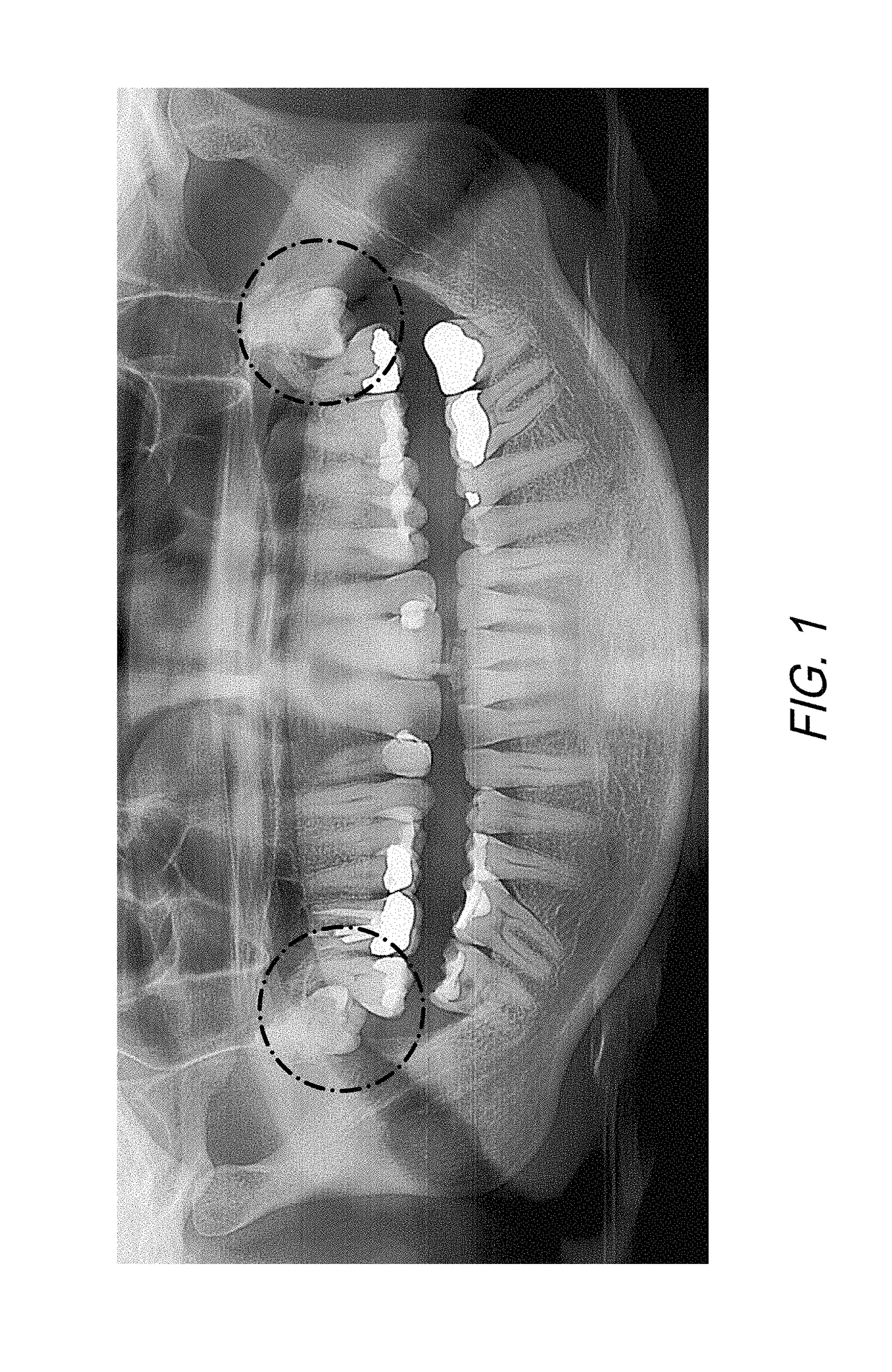
The lower third molars are horizontally impacted and show no signs of infection, but if they become infected, then the patient will almost certainly loose the adjacent second molars because of the
bone damage that will occur.
The problem all practitioners face is that it is practically impossible to tell in advance which impacted wisdom teeth will ultimately cause future
pathology.
If a patient is presenting later in life to have one or more third molars extracted, it is because active
pathology has been diagnosed, making
surgery no longer elective.
The incidence of litigation over permanent numbness of the lip has dramatically increased in recent years.
If the wisdom teeth are not extracted in adolescence, the roots will fully form, making future extraction difficult and dramatically increasing the incidence of serious complications if surgery should later be required.
Additional complications include the reduced healing response of adults as compared to adolescents, and the economic hardship induced by having to miss work.
Complications can be severe, even requiring hospitalization when teeth have been extracted on an out-patient basis.
However, at the NIH Conference On Third Molars in 1979 it was concluded that “[a]though there are cogent reasons for early removal of third molars, the group felt that the suggested practice of enucleation of third molar tooth buds, based on predictive studies at age 7 to 9, is not currently acceptable.” (National Institutes of Health—Removal Of Third Molars
Consensus Development Conference Statement—1979.)
However, it is still highly invasive and generally requires IV
sedation of the teenage patient.
The White Paper understates the obvious conclusions associated with early intervention: “It does appear that early third molar removal may be associated with a
lower incidence of morbidity and also less economic hardship from time off work for the patient.” However, it can also be concluded that there was a tremendous conflict of interest because this paper was written by oral surgeons.
All but the first three ablation procedures have significant limitations due to being highly invasive, high in cost, requiring cumbersome equipment, or due to the limited means of mechanical access in the
oral cavity.
It was recognized, however, that electrosurgical energy was too powerful and uncontrollable to reliably confine its damage to only the tooth-forming tissues.



 Login to View More
  Login to View More