
Display device
a display panel and display technology, applied in the field of electronic devices, can solve the problems of significantly affecting the optical property (e.g., the viewing angle) of the display panel, and the performance/or ips mode is inferior to that of the display panel in va mod
- Summary
- Abstract
- Description
- Claims
- Application Information
AI Technical Summary
Benefits of technology
Problems solved by technology
Method used
Image

Examples
first embodiment
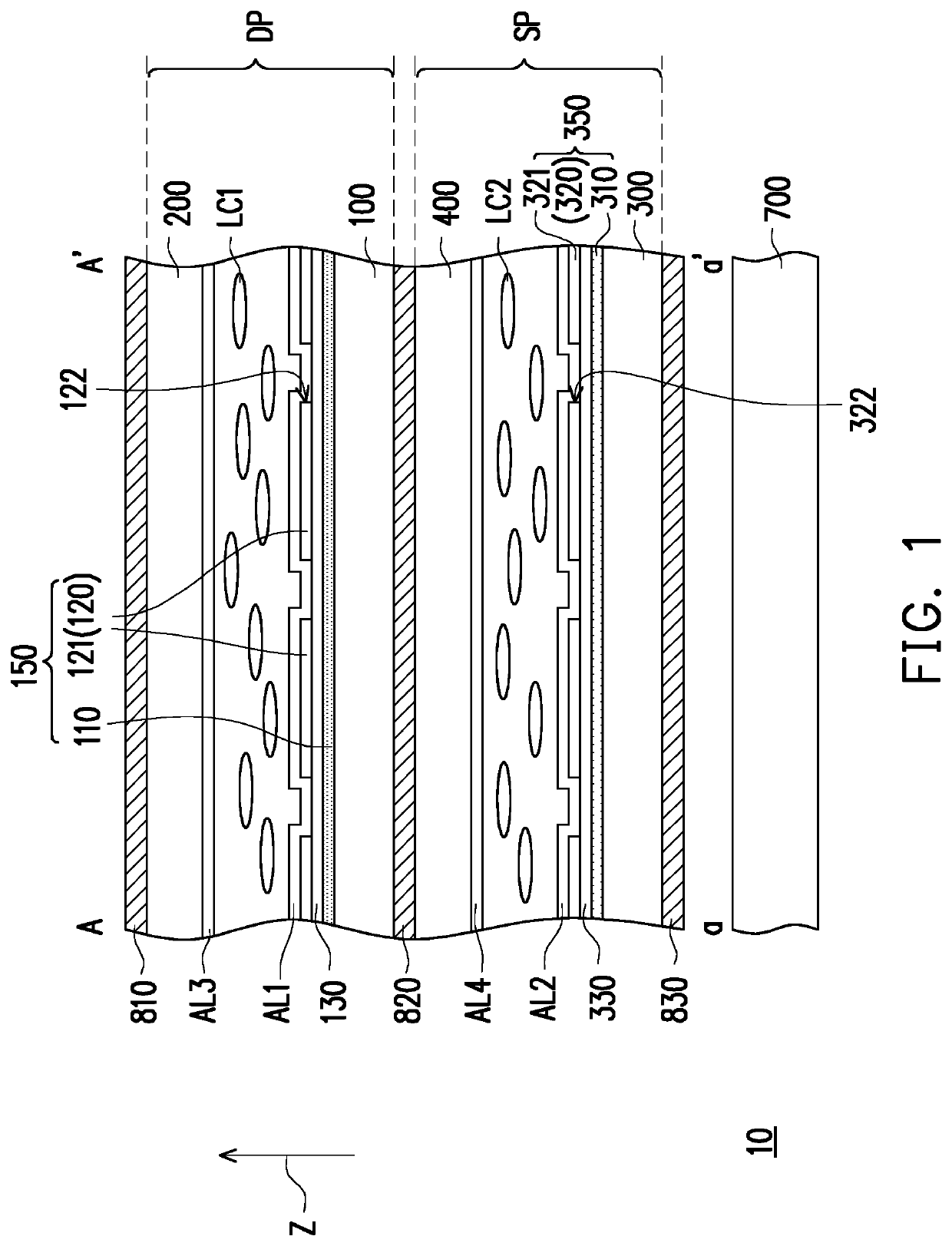
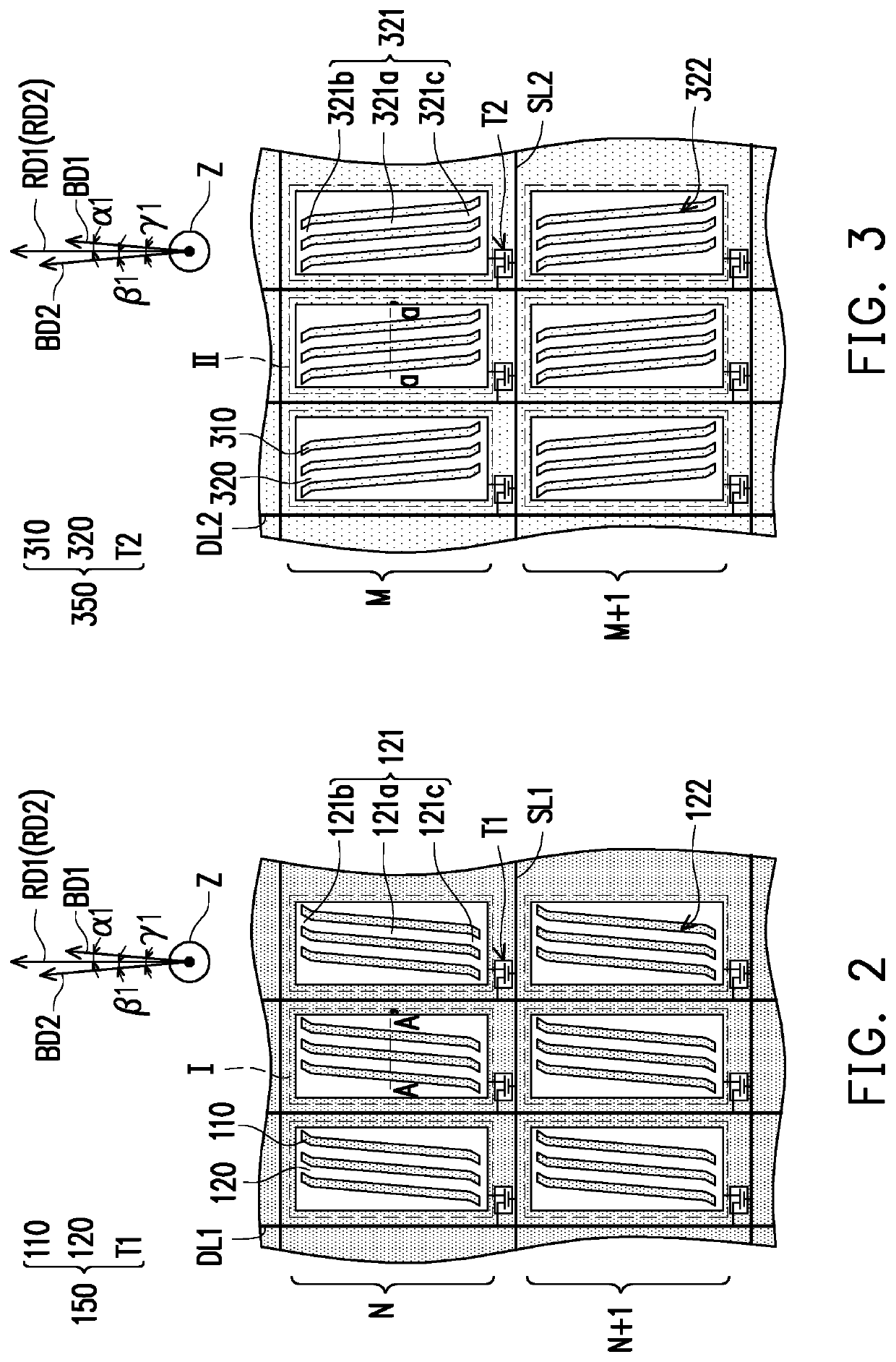
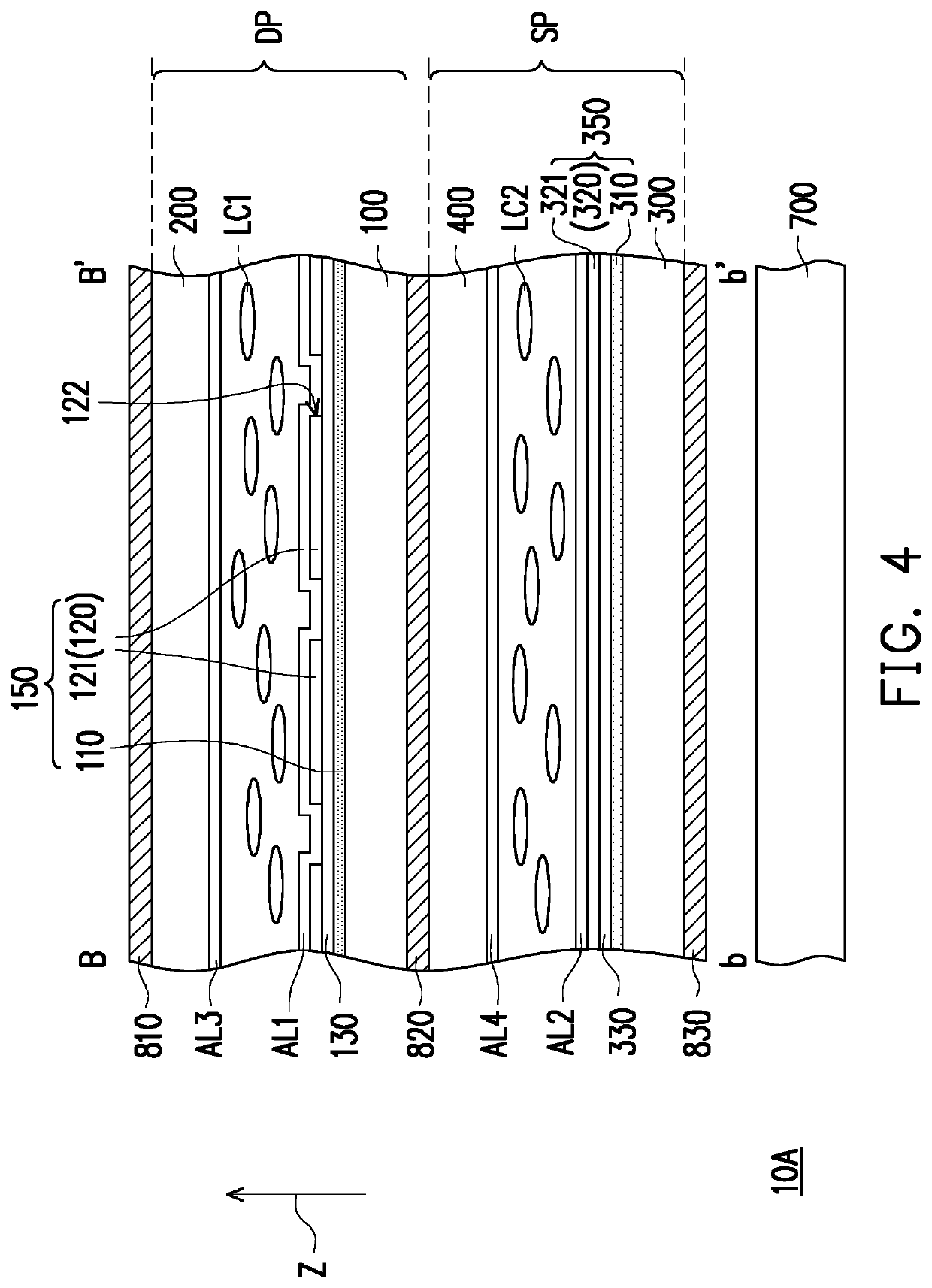
[0075]Referring to FIG. 4, FIG. 5 and FIG. 6, first liquid crystal molecules LC1 and second liquid crystal molecules LC2 of the display device 10A in the embodiment are positive-type liquid crystal molecules. The difference between the display device 10A in the embodiment and the display device 10 in the first embodiment is that the first rubbing direction RD1 of the first alignment film AL1 of the display device 10A in the embodiment is substantially perpendicular to the second rubbing direction RD2 of the second alignment film AL2, and the first extending direction BD1 of each of the pixel structures 150 is substantially perpendicular to the second extending direction BD2 of each of the light valves 350.
[0076]Referring to FIG. 5 and FIG. 6, in the embodiment, an included angle α2 is formed between the first rubbing direction RD1 and the first extending direction BD1, and an included angle β2 is formed between the second rubbing direction RD2 and the second extending direction BD2....
second embodiment
[0086]Referring to FIG. 16, FIG. 17 and FIG. 18, the difference between the display device 10E in the embodiment and the display device 10A in the second embodiment is that the second extending direction BD2 of the light valve 350 of the display device 10E in the embodiment is parallel with the first extending direction BD1 of the pixel structure 150, the plurality of first liquid crystal molecules LC1 are positive-type liquid crystal molecules, and the plurality of second liquid crystal molecules LC2 are negative-type liquid crystal molecules.
[0087]Referring to FIG. 17 and FIG. 18, in the embodiment, an included angle α4 is formed between the first rubbing direction RD1 and the first extending direction BD1, and an included angle β4 is formed between the second rubbing direction RD2 and the second extending direction BD2. Specifically, in the embodiment, the included angle β4 is larger than the included angle α4, and the included angle β4 satisfies the equation below: β4=90°+α4, wh...
sixth embodiment
[0089]Referring to FIG. 19, FIG. 20 and FIG. 21, the difference between the display device 10F in the embodiment and the display device 10E in the sixth embodiment is that the plurality of first liquid crystal molecules LC1 of the display device 10F in the embodiment are negative-type liquid crystal molecules, and the plurality of second liquid crystal molecules LC2 are positive-type liquid crystal molecules, which should not be construed as a limitation to the disclosure.
[0090]Referring to FIG. 20 and FIG. 21, in the embodiment, an included angle α4 between the first rubbing direction RD1 and the first extending direction BD1 is larger than an included angle β4 between the second rubbing direction RD2 and the second extending direction BD2. Specifically, in the embodiment, the included angle α4 satisfies the equation below: α4=90°+β4. In the embodiment, the display device 10F has effects and advantages similar to that of the display device 10 in the first embodiment, and thus no re...
PUM
| Property | Measurement | Unit |
|---|---|---|
| included angle | aaaaa | aaaaa |
| light transmittance | aaaaa | aaaaa |
| light transmittance | aaaaa | aaaaa |
Abstract
Description
Claims
Application Information
 Login to View More