

Image processing apparatus and image processing method
a technology of image processing and image processing, applied in the field of image processing, can solve the problems of excessive inflated shape of objects generated with the lower number of viewpoints, and the inability to generate three-dimensional shapes approximating the real object,
- Summary
- Abstract
- Description
- Claims
- Application Information
AI Technical Summary
Benefits of technology
Problems solved by technology
Method used
Image



Examples
first embodiment
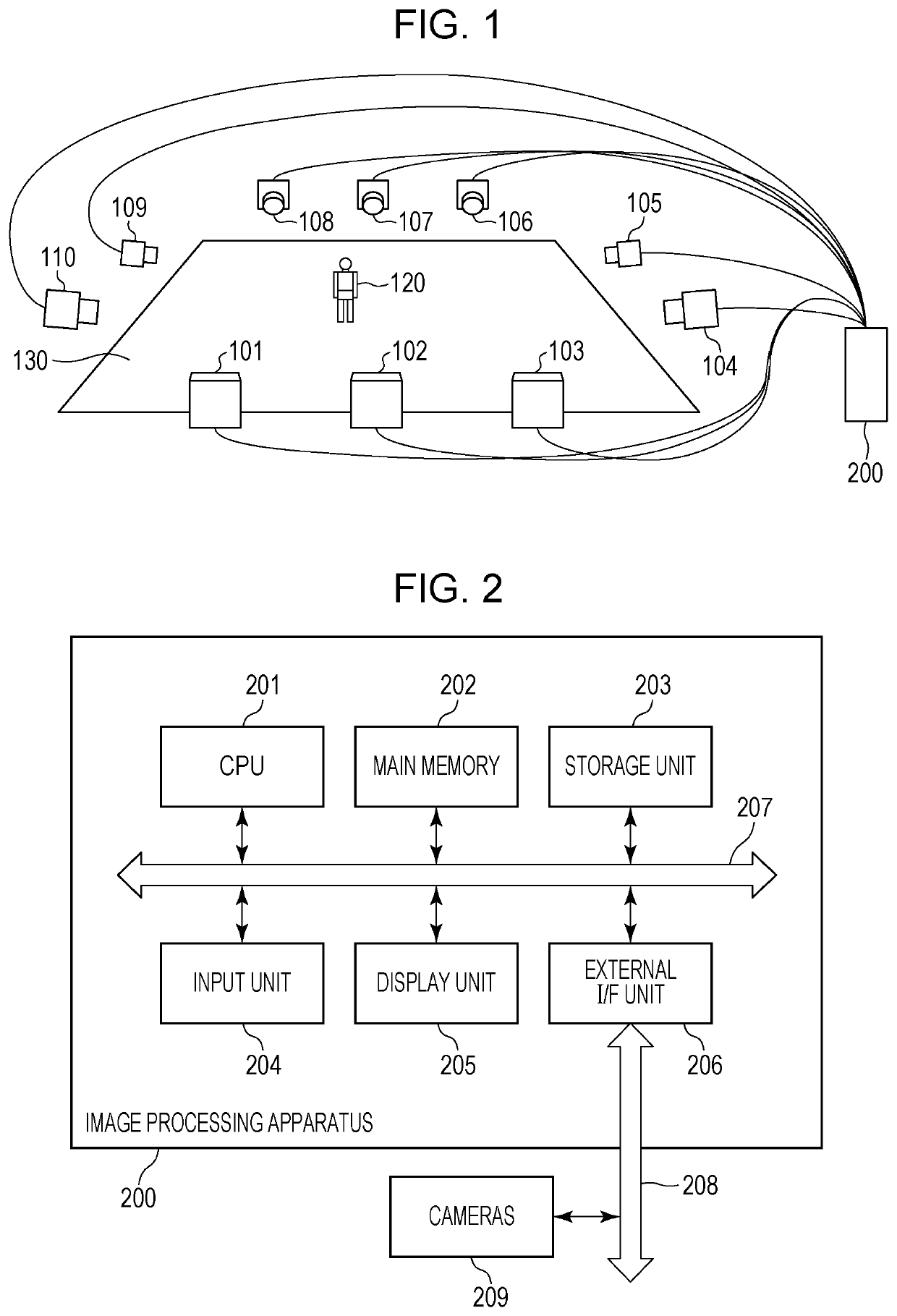
[0018]According to a first embodiment, in response to a user's operation through a GUI (graphical user interface), an unnecessary part of geometric data (data representing a three-dimensional shape of an object) is deleted based on the number of valid cameras.
[0019]FIG. 1 illustrates a layout example of cameras included in a camera group. An example will be described in which ten cameras are placed in a stadium where Rugby is played. A player as an object 120 exists on a field 130 where a game is played, and ten cameras 101 to 110 are arranged to surround the field 130. Each of the cameras in the camera group is set to have a camera orientation, a focal length, and exposure control parameters appropriate for catching, within an angle of view, the whole field 130 or a region of interest within the field 130. Illustrating a stadium in FIG. 1, the technology according to this embodiment is applicable to any arbitrary scene in which cameras are arranged to surround an object to generate...
second embodiment
[0043]Another implementation example of the Silhouette Volume Intersection according to a second embodiment will be described. Space Carving Method (SCM) is known as one implementation of the volume intersection method. SCM projects an arbitrary one voxel V to image planes of all cameras and keeps the voxel V if all of the projected points are within a silhouette corresponding to each of the cameras and deletes the voxel V if even one point is off the silhouette. This process may be performed on all voxels within a certain range so that a set of the kept voxels can form a Visual Hull. VIM is suitable for parallel processing while SCM consumes a less space of memory. Thus, one of them suitable for a given apparatus configuration may be used.
third embodiment
[0044]A method for determining a reliability according to this embodiment will be described in detail. Hereinafter, the expression a “valid camera for the voxel of interest” is defined as a “camera capturing an image of the voxel of interest”. FIG. 8A is a schematic diagram of a result of generation of geometric data based on the Silhouette Volume Intersection of an object with two valid cameras, and FIG. 8B is a schematic diagram in a case where the number of valid cameras is equal to four and the valid cameras are distributed partially unevenly. Referring to FIG. 8A, C1 to C4 are camera centers, R1 to R4 are rays passing through a silhouette outline of an object, OB is a real section of an object, and VH is a Visual Hull. Unlike FIGS. 5A and 5B, the image planes P1 and P2 are not illustrated for convenience of illustration.
[0045]FIG. 8A illustrates a lower number of valid cameras, like the first embodiment, while FIG. 8B illustrates an equal number of valid cameras to that in FIG....
PUM
 Login to View More
 Abstract
Description
Claims
Application Information
 Login to View More