Pre-loading drivetrain to minimize electric vehicle rollback and increase drive responsiveness

a pre-loading and electric vehicle technology, applied in the field of electric vehicles, can solve the problems of less responsive vehicles and additional delay between the application of torque at the motor, and achieve the effects of reducing or minimizing vehicle rollback, increasing drive responsiveness, and eliminating slack in components

US10821977B1Active Publication Date: 2020-11-03MOTIV POWER SYST
2 Cites 2 Cited by

Patent Information

Authority / Receiving Office
US · United States
Patent Type
Patents(United States)
Current Assignee / Owner
Publication Date
2020-11-03

Smart Images

  • Figure 1
    Figure 1
  • Figure 2
    Figure 2
  • Figure 3
    Figure 3
Patent Text Reader

Abstract

Pre-loading drivetrain to minimize electric vehicle rollback and increase drive responsiveness. In an exemplary embodiment, a method includes (a) detecting that an electric vehicle is stationary, a brake is engaged, and an accelerator is not engaged, and (b) controlling a vehicle motor to transition from a first mode to a second mode in response to (a). In the first mode, the motor is controlled to output torque in response to the accelerator position, and in the second mode, the motor is controlled to output torque sufficient to preload the electric vehicle. The method also includes (c) detecting the brake is transitioning away from being engaged and the accelerator is not engaged, and (d) controlling the motor to operate in a third mode in response to (c). In the third mode the motor is controlled to output torque sufficient to maintain the electric vehicle stationary.
Need to check novelty before this filing date? Find Prior Art

Description

CROSS REFERENCE TO RELATED APPLICATIONS

[0001] This application claims the benefit under 35 U.S.C. § 119 from U.S. Provisional Patent Application Ser. No. 62 / 586,877, entitled “Pre-Loading Drivetrain To Minimize Electric Vehicle Rollback And Increase Drive Responsiveness,” filed on Nov. 15, 2017, the subject matter of which is incorporated herein by reference.TECHNICAL FIELD

[0002] The described embodiments relate to electric vehicles, and more particularly the drivetrain system within electric vehicles.BACKGROUND INFORMATION

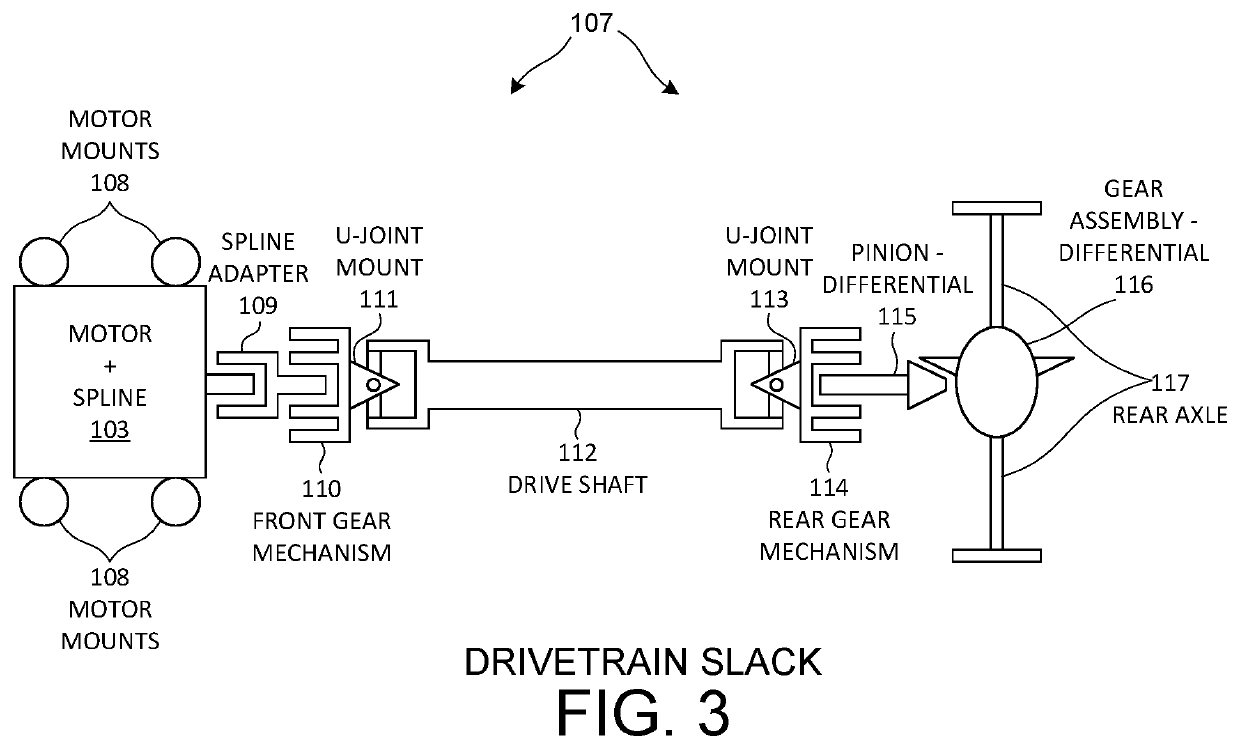
[0003] A typical electric vehicle drivetrain includes an electric motor coupled through a series of mechanical components to the vehicle's wheels. The coupling of these components has an inherent slack that must be taken up before torque at the motor shaft will be applied to the vehicle's wheels. During operation of the vehicle, torque is not applied while the vehicle is stationary and the driver is holding the vehicle with the service brakes. Thus at launch, there i...

Examples

Embodiment Construction

[0019]Reference will now be made in detail to some exemplary embodiments of the invention, examples of which are illustrated in the accompanying drawings.

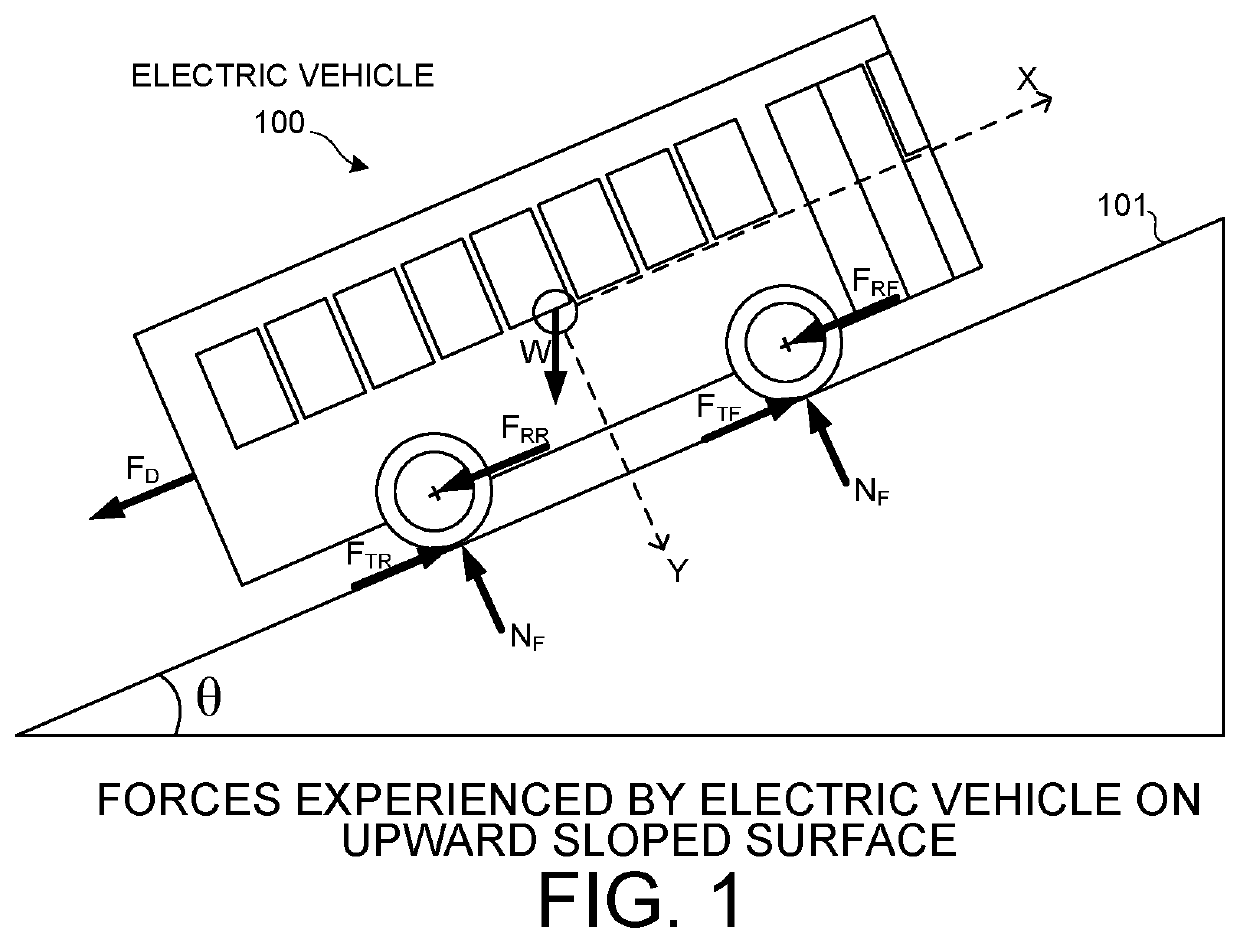
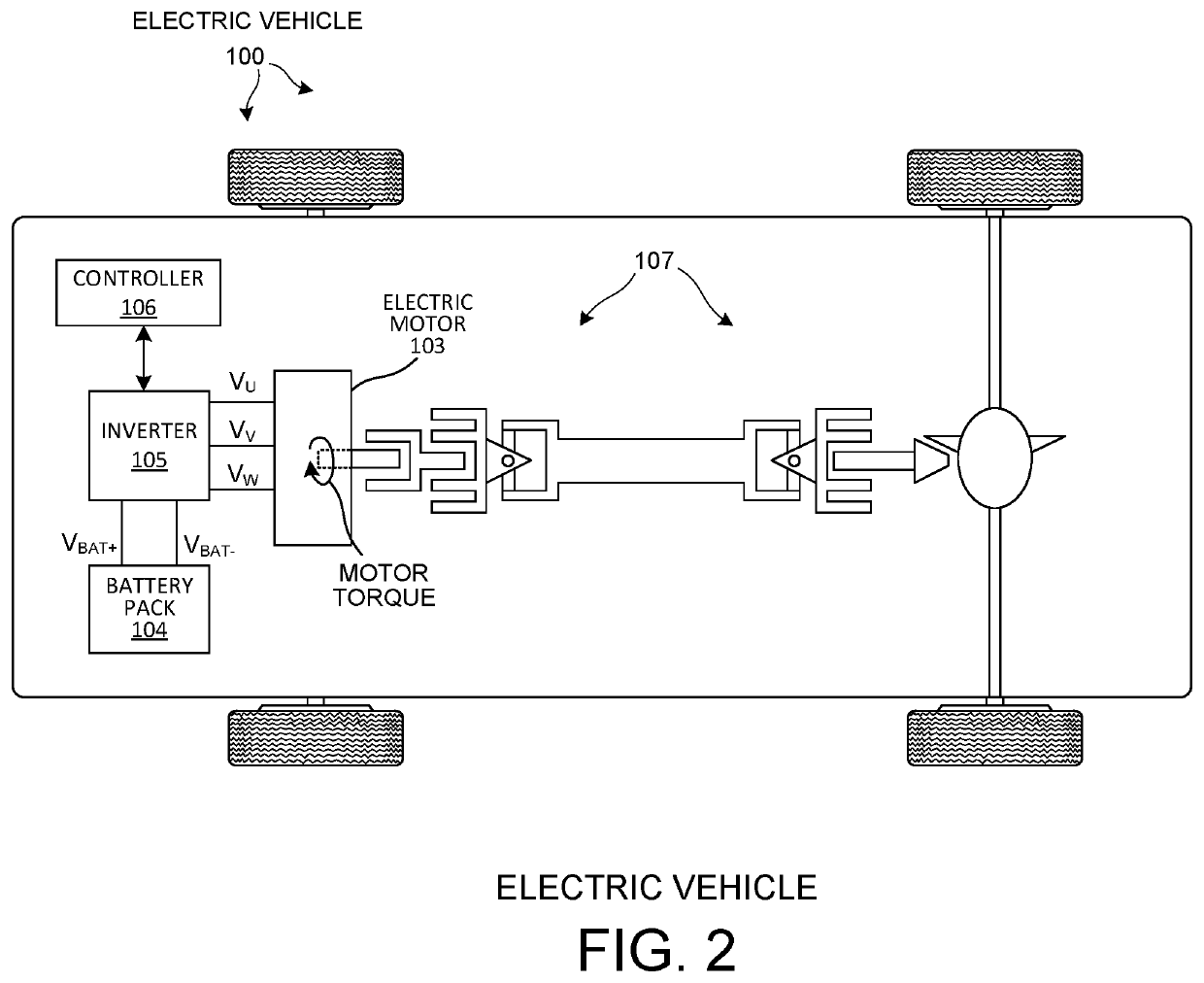
[0020]FIG. 1 is a diagram of the forces experienced by an electric vehicle 100 on an upward sloped surface 101. As illustrated in FIG. 1, the electric vehicle 100 is on the surface 101. The electric vehicle 100 includes a drivetrain that comprises an electric motor coupled through a series of mechanical components to the vehicle's wheels.

[0021]The surface 101 is sloped upward at an angle theta θ. A force representing the weight W of the vehicle 100 due to gravity is shown. A downward force FD acts on the electric vehicle 100 forcing the vehicle backwards down the upward sloped surface 101. A traction force FTR and a rolling force FRR act upon the rear wheel. A traction force FTF and a rolling force act on the front wheel FRF. Normal force NF opposes gravity and is shown acting on the front wheel and rear wheel. The downward force F...