[0005]Thus, this invention is based on one object of providing a device for coating seeds that emits as little dust as possible and can be operated efficiently.
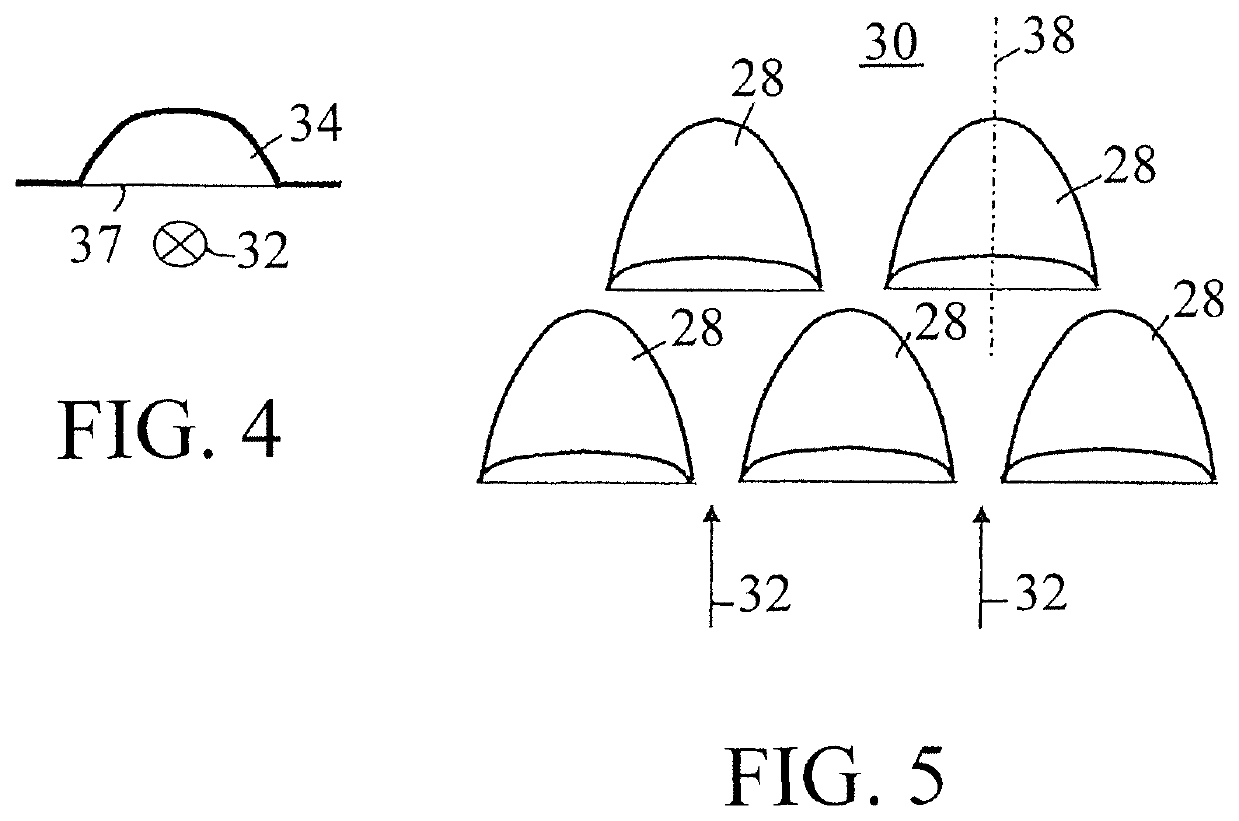
[0009]Because the projection rises sharply in the direction of the outer face, the rim delimiting the opening outlet has a strongly rounded edge, or smooth transition, from the metal sheet plane to the projection. A significantly reduced abrasion of the individual seed grains wetted or coated with the dressing solution can thus be achieved, which rub along the perforated metal sheet during the operation of the device. It was found that, in the device with the annular screening surface known from the prior art, a not inconsiderable proportion of the dust emission can be ascribed to the abrasion of the seed grains caused by precisely the annular screening surface. The particular shape of the perforated metal sheet has thus proved to be an effective option for reducing dust emission.
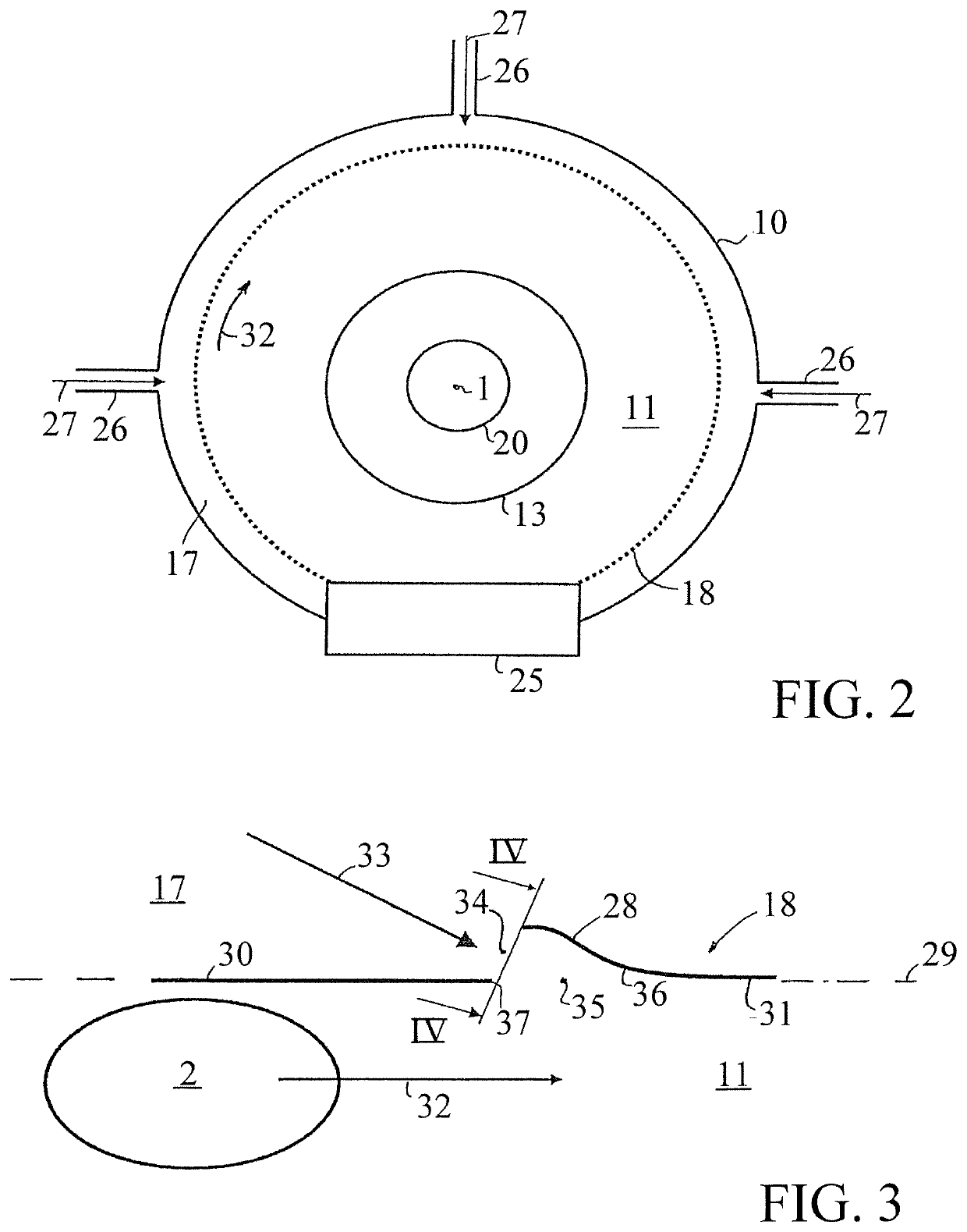
[0013]In one embodiment of this invention, a main axis of the projection substantially extends in the circumferential direction of the jacket surface. Thus, the main axis is oriented approximately parallel to the direction in which the seed grains slide along the inner face of the perforated metal sheet. In the process, a seed grain sliding along the inner face of the profiled metal sheet preferably first passes a comparatively sharp edge of the rim of the opening outlet, which, however, is not particularly relevant with regard to abrasion. Then, it passes the strongly rounded edge of the rim of the opening outlet. The special shaping of the rim caused by the obliquely rising projection does not result in any sharp-edged contact surfaces for the seed grains that could lead to a high level of abrasion. This is not only conducive to the reduction of the dust emission but also prevents the individual holes in the perforated metal sheets from clogging up after a short time. Thus, the dust emissions can be reduced and the operating life of the air-permeable separating unit can be increased by the special shaping of the perforated metal sheet.
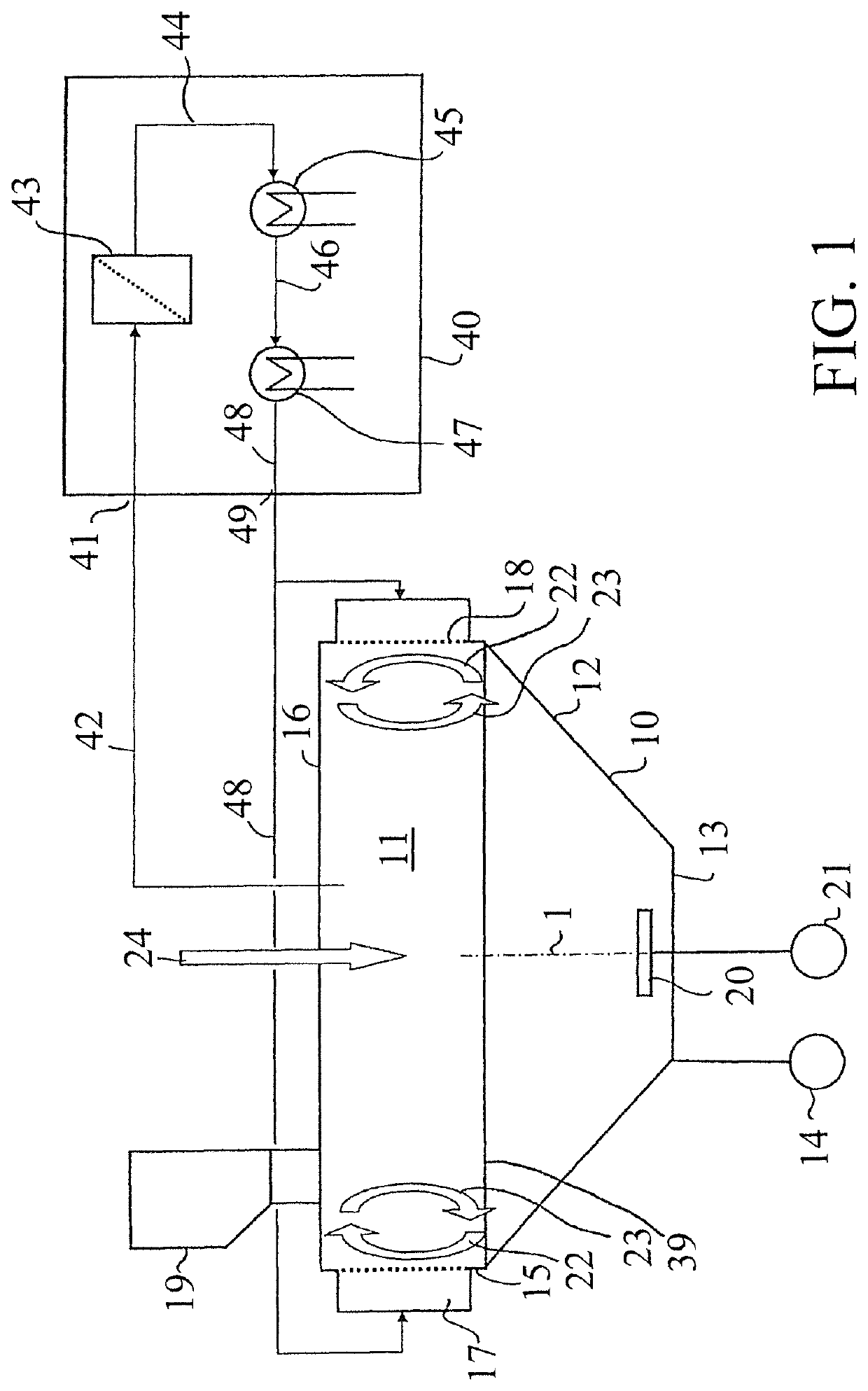
[0018]One or more guide vanes for the seeds may be provided, by which the seeds are better mixed in order to achieve a wetting or coating with the dressing solution that is as uniform as possible and an efficient drying. Preferably, they are stationary guide vanes attached to the inner face of the cylindrical housing part or to the inner face of the lid. During operation of the device, when the rotatable housing part rotates, the seeds are pressed so far up that they move into the stationary guide vanes that divide the seeds into individual seed strands.
[0026]A part of the filtered, dried and re-heated air from the air treatment system may be guided into the chamber through an annular gap between the cylindrical housing part and the rotatable housing part. It can thus be avoided that the dust-laden discharged air escapes from the chamber into the environment through the annular gap. In addition, the effectivity of the drying process can be increased further by feeding the conditioned air from the air treatment system through the annular gap.
[0027]According to another object of this invention, the provision of a method for coating seeds, according to this specification and the claims. A device in one of the embodiments described is used, wherein the rotating system for mixing seeds and dressing solution are set in rotation, wherein the seeds are moved along the inner face of the perforated metal sheets by the rotating system, and wherein the obliquely rising projections substantially oppose the main direction of movement of the seeds, so that it is prevented that the seeds hit sharp edges while moving along the inner face of the metal sheet. The direction of rotation of the rotating system, and thus the direction of rotation of the seeds, and the projections are orientated in such a way that the seeds on the inner face of the perforated metal sheet first slide along the comparatively sharp edge of the rim of the opening outlet, wherein this sharp edge, however, does not pose an obstacle viewed in the direction of movement. After passing this rather uncritical edge, the seed grain passes the more strongly rounded edge of the rim. The abrasion of the seeds, and thus the dust emission, can be significantly reduced by such an orientation of the perforated metal sheet relative to the main direction of movement of the seeds. In addition, the danger of the perforated metal sheet clogging up with the abraded material can be significantly reduced.


 Login to View More