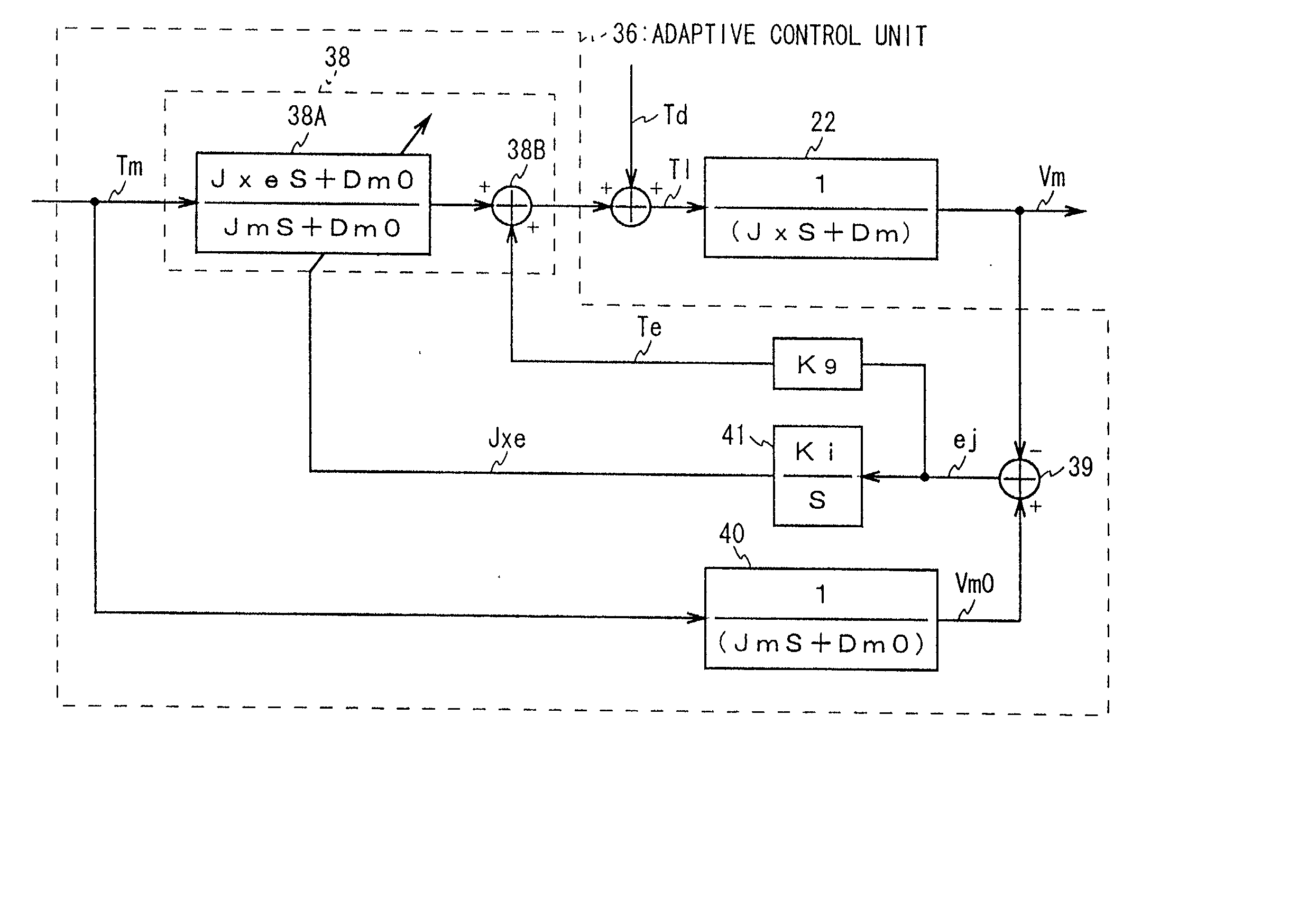
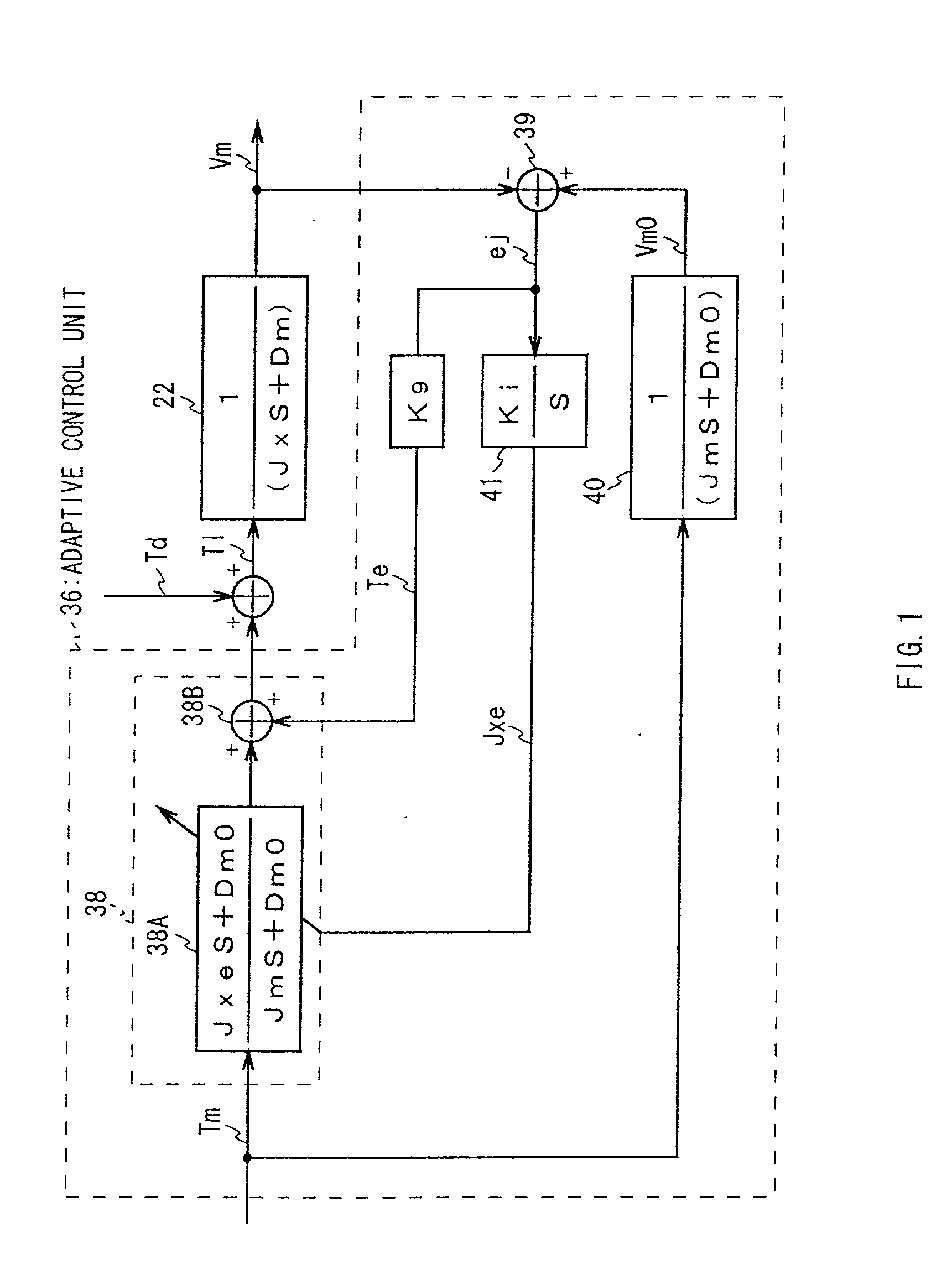
[0021] As a result, by correcting a control value to be input to an actuator driving
system and / or a model driving system so that responses from an actuator and a model coincide with each other, the robot can detect a moment of inertia of the actuator in real-
time based on a result of the correction with a moment of inertia set for the model as a reference. Thereby, by correcting the control value based on the detection result, it is possible to cope with an unpredictable disturbance without providing a special sensor.
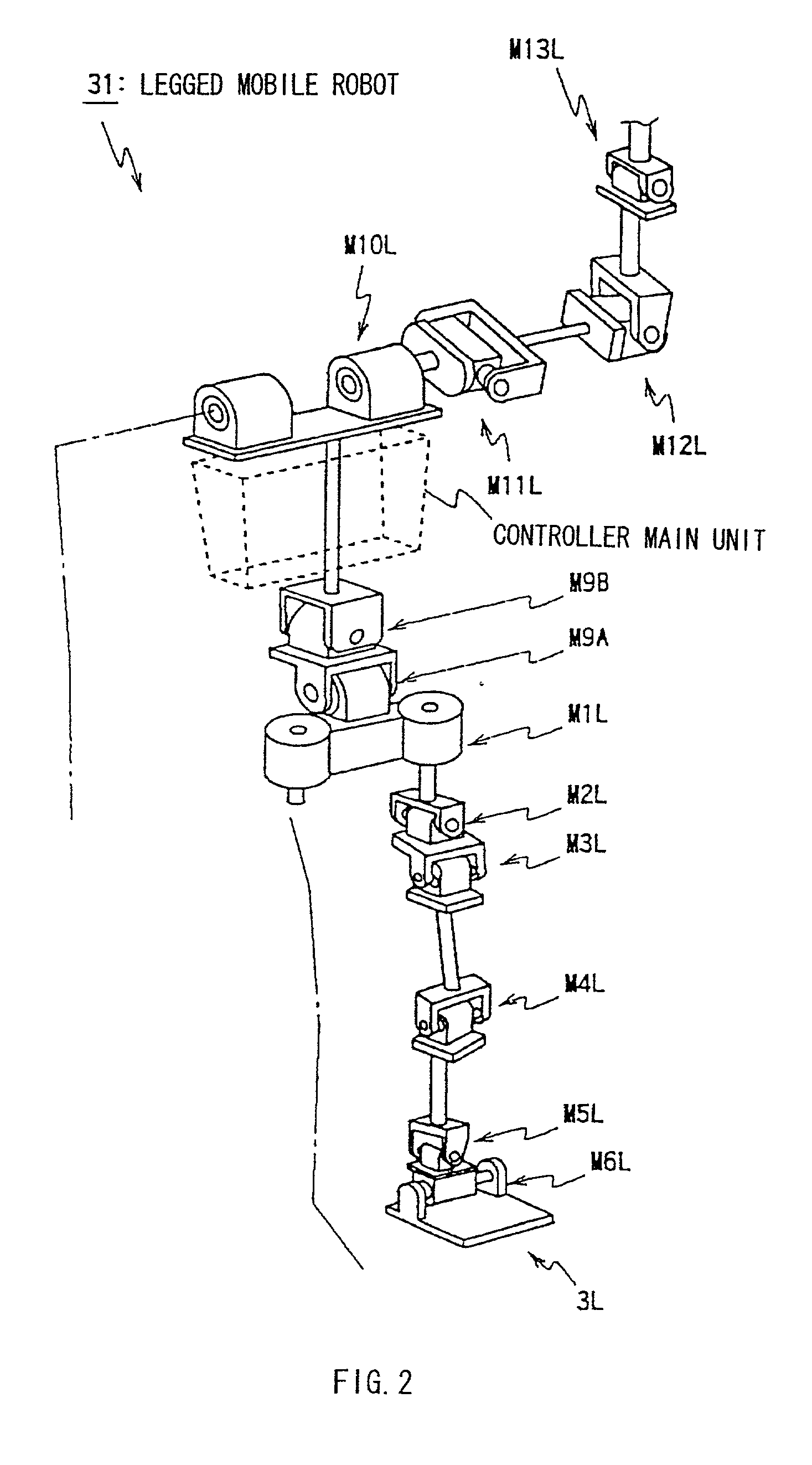
[0045] In the legged
mobile robot 31, the actuator M6L is joined to the actuator M5L by a joiner, and the
rotational axis of the actuator M6L is positioned to be perpendicular to the
rotational axis of the actuator M6L. This enable the legged
mobile robot 31 to rotate the sole right and left by driving the actuator M5L, as denoted by reference numeral .theta.2. Accordingly, the legged mobile robot 31 drives the actuators M5L and M6L in association with other actuators and inclines the sole back and forth, and right and left, in accordance with a rough floor, thereby enabling walking even on a rough floor.
[0072] In other words, in the case of walking on the flat floor, when the sole touches the ground, as shown in FIG. 6, the load moment of inertia, which has been a small value, increases, and the increase is detected by the optimization
regulator 34. In this case where walking on the flat floor is performed, when such increase in the load moment of inertia is set beforehand so as to be adapted for the control object value for each actuator, in the egged mobile robot 31, control of each actuator performed until the sole touches the ground, and control performed after the sole touches the ground change in accordance with prior settings, whereby accidents such as falling is prevented, enabling stable walking.
[0073] Differently therefrom, for example, while similar control object values are being output from the control command generator 11, when the floor on which the legged mobile robot 31 moves inclines, or the floor is rough, the floor inclination or the roughness cause each motor M to have a change in the moment of inertia and the load caused by the disturbance, and in accordance with the change, the optimization
regulator 34 generates the amount of operation, which corrects the control object value. Accordingly, control object values for motors, etc., constituting the
ankle joint and the
knee joint are corrected so that a region touching the floor is inclined in accordance with, for example, the roughness of the floor, whereby unstable movements, which are caused by a disturbance which is difficult to predict, are prevented.
[0075] In other words, as shown in, for example, FIG. 7, in the case where walking on an upward floor is performed, compared with the case where walking on the flat floor is performed, the sole touches the ground earlier, and the load moment of inertia that has been a small value increases. In this case, the optimization
regulator 34 corrects the control value in accordance with the sole inclination A 0 by detecting the increase in the load moment of inertia, corrects the center of gravity so that the position of the center of gravity copes with the disturbance, in other words, so that a condition is established which is similar to the case where the sole touches the ground when walking on the flat floor is performed, and switches control of the sole in back and forth directions, whereby accidents such as falling is prevented, enabling stable walking.
[0076] In addition, in the legged mobile robot 31, the optimization regulator 34 generates, instead of each sensor provided for each region, the amount of operation, based on the moment of inertia sent from each servo circuit, and on the load caused by the disturbance. This enables the legged mobile robot 31 to omit a sensor provided for each region as provided in the conventional legged mobile robot, and the entire construction can be small-sized and simplified by the omission, and the operation speed can be accelerated.


 Login to View More
  Login to View More