
Wobble signal detecting circuit for optical disk device and wobble signal detecting method
- Summary
- Abstract
- Description
- Claims
- Application Information
AI Technical Summary
Benefits of technology
Problems solved by technology
Method used
Image

Examples
first embodiment
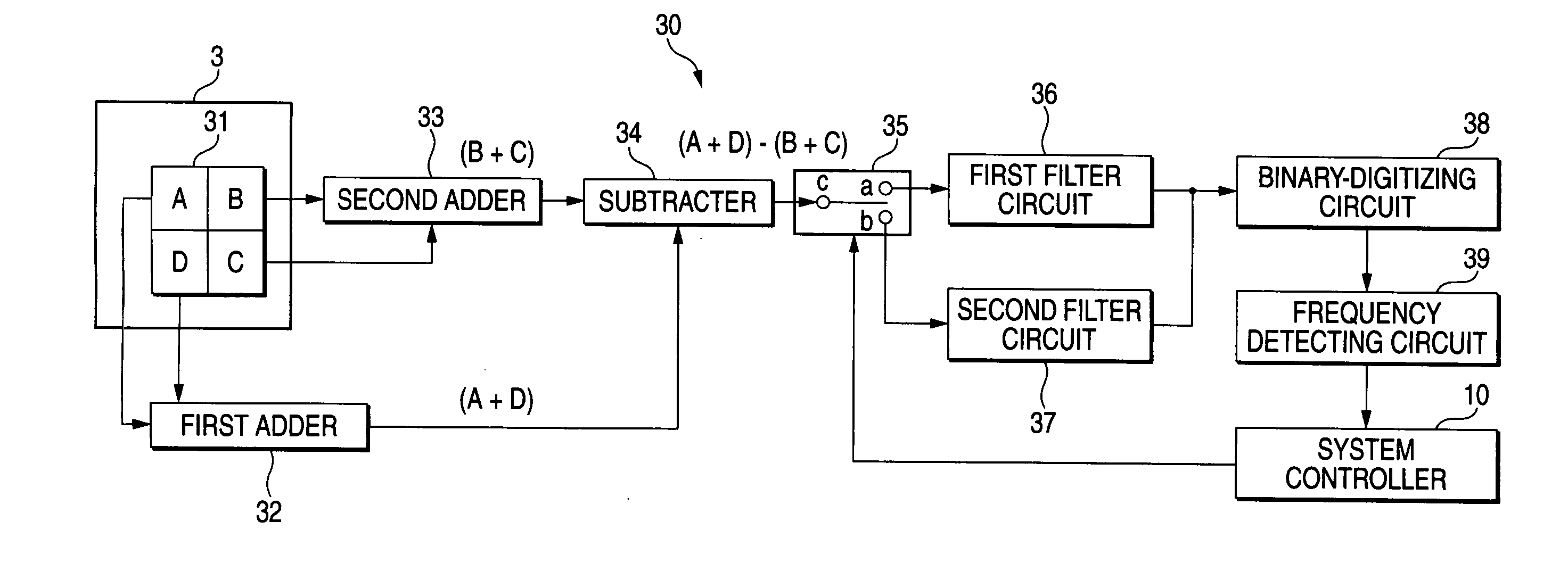
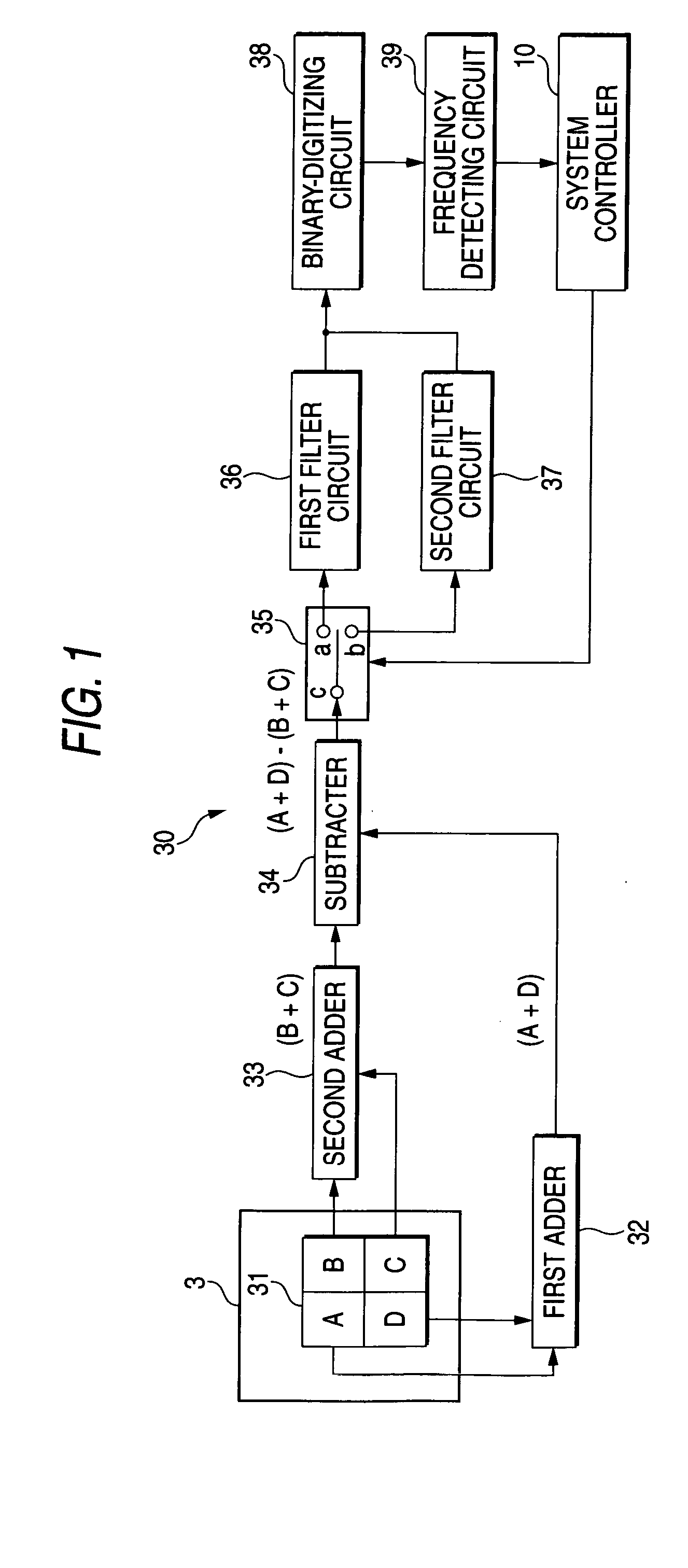
[0048] In the first embodiment, the first filter circuit 36 is constructed of a first band-pass filter 36a, whereas the second filter circuit 37 is constructed of a second band-pass filter 37a.
[0049] In this first embodiment, as shown in FIG. 3B, the first band-pass filter 36a has a bandwidth so that its higher frequency side shoulder (indicated by reference numeral 36a1) is located on the wobble frequency (e.g. 150 kHz). As shown in FIG. 3C, the second band-pass filter 37a has a bandwidth set so that its lower frequency side shoulder (indicated by reference numeral 37a1) is located on the wobble frequency (150 kHz).
[0050] In accordance with the above configuration, with respect to the frequency (150 kHz) of the wobble signal, where the first band-pass filter 36a has the center frequency of 100 kHz and the pass bandwidth of 110 kHz, and the second band-pass filter 37a has the center frequency of 200 kHz and the pass bandwidth of 110 kHz, if the measured signal includes the wobble ...
second embodiment
[0055] In the second embodiment, the first filter circuit 36 is constructed of a band-pass filter 36b, whereas the second filter circuit 37 is constructed of a high-pass filter 37b.
[0056] In this second embodiment, as shown in FIG. 5B, the band-pass filter 36b has a bandwidth set so that its higher frequency side shoulder (indicated by reference numeral 36b1) is located on the wobble frequency (150 kHz). As shown in FIG. 5C, the high-pass filter 37b has a pass band so that its lower frequency side shoulder (indicated by reference numeral 37b1) is located on the wobble frequency (e.g. 150 kHz). In the band-pass filter 36b, the center frequency is set at 100 kHz and the pass bandwidth is set at 110 kHz.
[0057] In accordance with the above configuration, if the measured signal includes the wobble signal S1 as shown in FIG. 5A, through whichever filter of the band-pass filter 36b and high-pass filter 37a, the frequency (frequency of about 150 kHz) in the vicinity of the wobble frequenc...
third embodiment
[0062] In the third embodiment, the first filter circuit 36 is constructed of a low-pass filter 36c, whereas the second filter circuit 37 is constructed of a band-pass filter 37c.
[0063] In this third embodiment, as shown in FIG. 6B, the low-pass filter 36c has a pass band set so that its higher frequency side shoulder (indicated by reference numeral 36c1) is located on the wobble frequency (150 kHz). As shown in FIG. 6C, the band-pass filter 37c has a bandwidth set so that its lower frequency side shoulder (indicated by reference numeral 37c1) is located on the wobble frequency (e.g. 150 kHz). In the band-pass filter 37c, the center frequency is set at 200 kHz and the pass bandwidth is set at 110 kHz.
[0064] In accordance with the above configuration, if the measured signal includes the wobble signal S1 as shown in FIG. 6A, through whichever filter of the low-pass filter 36c and band-pass filter 37c, the frequency (frequency of about 150 kHz) in the vicinity of the wobble frequency...
PUM
 Login to View More
 Abstract
Description
Claims
Application Information
 Login to View More